First Readers Anthology: Cursive Edition is a companion volume to the First Readers Anthology. The contents of the two books are the same except that the regular edition is in Bookman Old Style font, and the new book is in cursive. The Cursive Edition provides students with a uniquely rich opportunity to gain experience reading English sentences, paragraphs, stories, and poems in cursive. Fluency with cursive depends upon providing sufficient experience reading and writing cursive. The First Readers Anthology: Cursive Edition provides ample opportunity to develop high level fluency in reading cursive writing.Parents and teachers concerned about the lack of cursive instruction and students inability to read cursive writing will find First Readers Anthology: Cursive Edition the finest aid available for developing these essential literacy skills.
Blend Phonics Lessons and Stories is a complete phonics reading program. It is unique in that it provides phonics lessons and decodable stories in a single book. Comprehension questions and spelling words are included with every lesson. It is based on the instructional sequence in Hazel Loring's 1980 READING MADE EASY WITH BLEND PHONICS FOR FIRST GRADE.
It is a little known fact that reading was taught by means of spelling for over 200 years. Today the impact of spelling on reading achievement is not as well appreciated as it once was. The late Dr. Ronald P. Carver did extensive research into the causal relationships between spelling instruction and reading ability. Carver concluded, "One very important way to learn how to pronounce more words accurately is sometimes overlooked, that is, learning to spell more words accurately." (Causes of High and Low Reading Achievement, p. 178). He also notes that "spelling was used to teach reading for almost 200 years, but by the beginning of the 20th century, the tide had so turned that learning to spell was largely seen as incidental to learning to read." Quoting C. A. Perfetti, Carver observed, "practice at spelling should help reading more than practice of reading helps spelling." (p. 179.In June of 2004 Miss Geraldine Rodgers sent me her essay, "Why Noah Webster's Way Was the Right Way." She argued from the history of reading and the psychology of reading that Webster's spelling book method of teaching reading and spelling was superior to all other methods. I was surprised to learn that that Webster, in his 1828 American Dictionary of the English Language, defined a Spelling Book as, " A book for teaching children to spell and read." He also wrote under the entry, Spelling, "To tell the name of letters of a word, with a proper division of syllables, for the purpose of learning the pronunciation. In this manner children learn to read by first spelling the words." You can see that Webster was quite clear about the dual purpose of the spelling books in his day. You can imagine my surprise at the improvement I began to get with my tutoring students when they started working through Webster's Spelling Book. I decided to type up my own edition to use in my private tutoring and my tutoring work at the Odessa Christian School in Odessa, TX, where I teach remedial reading and Spanish. In this edition, I have retained everything in the original 1908 (descendant from the 1829 edition). The only differences relate to formatting. I chose to list the words in rows instead of columns. I also allow the words to divide at the ends of lines. I have found that this works fine for all students. We are teaching students to read and spell by syllables and not by word shapes or context. When reading and spelling are taught by the Spelling Book Method, all guessing at words from shape or context is completely eliminated. The student's total focus is on pronouncing the words correctly, high levels of comprehension are a natural result.
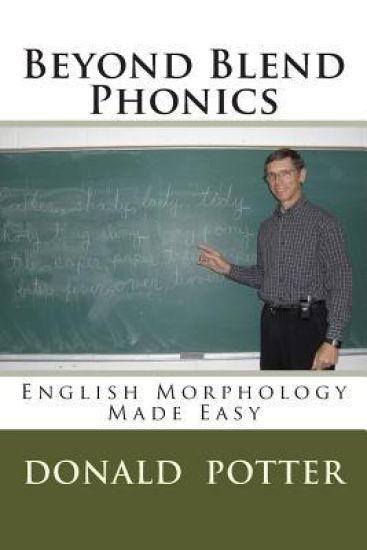
Beyond Blend Phonics is designed as a followup to any good phonics program such as Mr. Potter's Blend Phonics Lessons and Stories. Beyond Blend Phonics teaches the three main Levels of Advanced English Morphology (word prefixes, suffixes, and roots) based on the language of origin. Words of Anglo-Saxon, Latin, French, and Greek origin are taught.Mr. Potter used a unique dual sentence approach to teaching word meanings that he learned from Dr. George Gonzalez, when Mr. Potter was a bilingual teacher, teaching English words to Spanish speaking students. The procedures pairs a new word in one sentence with a simple word the students know in another sentence. The approach is natural and easy. Even younger children can significantly boost their vocabulary and reading levels with this pleasant method of learning.
Blend Phonics Lessons and Stories: Cursive Edition is a very unique book for helping students of all ages to develop high level fluency reading, writing, and spelling cursive. The phonics lessons, stories, and spelling words are written in Traditional American Cursive. Comprehension questions are included for every story. The phonics coverage is very comprehensive and all 220 Dolch List Sight Words are included so there is no need to teach them separately with harmful look-say memory techniques.