Kirjojen hintavertailu. Mukana 11 342 296 kirjaa ja 12 kauppaa.

Kirjahaku

Etsi kirjoja tekijän nimen, kirjan nimen tai ISBN:n perusteella.

6 kirjaa tekijältä Donald S. Frazier

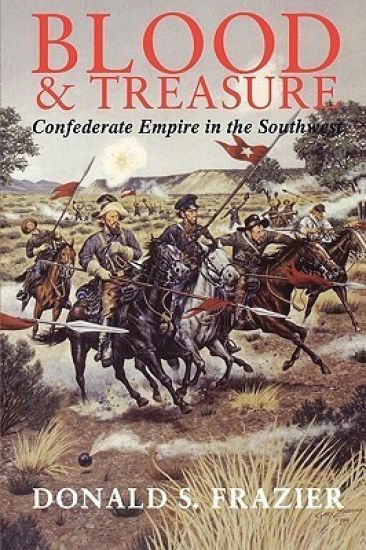
Blood and Treasure

Blood and Treasure

Donald S. Frazier

Texas A M University Press
1997
nidottu
For decades before the Civil War, Southern writers and warriors had been urging the occupation and development of the American Southwest. When the rift between North and South had been finalized in secession, the Confederacy moved to extend their traditions to the west–a long-sought goal that had been frustrated by northern states. It was a common sentiment among Southerners and especially Texans that Mexico must be rescued from indolent inhabitants and granted the benefits of American civilization. Blood and Treasure , written in a readable narrative style that belies the rigorous research behind it, tells the story of the Confederacy's ambitious plan to extend a Confederate empire across the continent. Led by Lieutenant Colonel John R. Baylor, later a governor of Arizona, and General H. H. Sibley, Texan soldiers trekked from San Antonio to Fort Bliss in El Paso, then north along the Rio Grande to Santa Fe. Fighting both Apaches and Federal troops, the half-trained, undisciplined army met success at the Battle of Val Verde and defeat at the Battle of Apache Canyon. Finally, the Texans won the Battle of Glorieta Pass, only to lose their supply train--and eventually the campaign. Pursued and dispirited, the Confederates abandoned their dream of empire and retreated to El Paso and San Antonio. Frazier has made use of previously untapped primary sources, allowing him to present new interpretations of the famous Civil War battles in the Southwest. Using narratives of veterans of the campaign and official Confederate and Union documents, the author explains how this seemingly far-fetched fantasy of building a Confederate empire was an essential part of the Confederate strategy. Military historians will be challenged to modify traditional views of Confederate imperial ambitions. Generalists will be drawn into the fascinating saga of the soldiers' fears, despair, and struggles to survive.
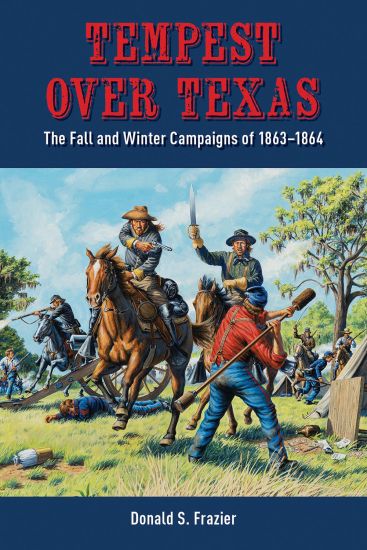
Tempest Over Texas

Tempest Over Texas

Donald S. Frazier

State House Press / McWhiney Foundation Press
2023
pokkari
Tempest Over Texas: The Fall and Winter Campaigns, 1863–1864 is the fourth installment in Dr. Donald S. Frazier’s award-winning Louisiana Quadrille series. Picking up the story of the Civil War in Louisiana and Texas after the fall of Port Hudson and Vicksburg, Tempest Over Texas describes Confederate confusion on how to carry on in the Trans-Mississippi given the new strategic realities. Likewise, Federal forces gathered from Memphis to New Orleans were in search of a new mission. International intrigues and disasters on distant battlefields would all conspire to confuse and perplex war-planners. One thing remained, however. The Stars and Stripes needed to fly once again in Texas, and as soon as possible.
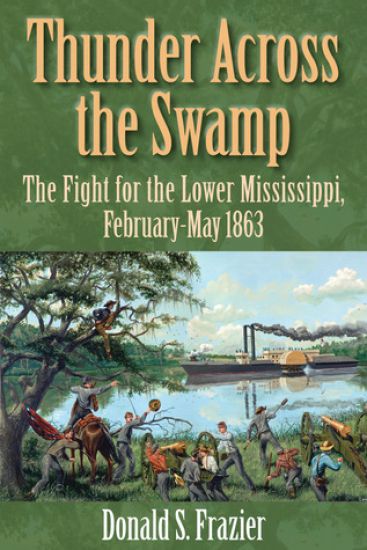
Thunder Across the Swamp

Thunder Across the Swamp

Donald S. Frazier

State House Press
2011
sidottu
Confederate President Jefferson Davis hoped one of his commanders could baffle the enemy in his designs on the Mississippi Valley. Confederate Major General Richard Taylor knew that the only long- term solution to protecting the twin river citadels at Vicksburg and Port Hudson was an active offensive. To that end he had already built a modest but well-supplied army while his powerful Rebel gunboat flotilla grew daily. Taylor just needed time. With the enemy army under General Nathaniel P. Banks fixated east of the Mississippi, Taylor believed he might just see his plans put into action With luck, the Confederate army might regain territory lost in Louisiana and its flag might once against float over New Orleans. The Union army would then have much larger issues to worry about.Taylor had cause to be optimistic. The Federal Army and navy had been trying the direct approach against Vicksburg and Port Hudson with mounting casualties, lost ships, and growing frustration. “There is no use longer deceiving the public, for the Banks expedition is a failure,” wrote a Massachusetts journalist. “Much as I admire Gen. Banks I am forced to admit that he is not the soldier I judged him to be nor the general this department needs.”As Rebel plans matured, time grew short for Union efforts. Banks needed to redeem himself, and his officers suggested an indirect approach west of the Mississippi, working from enclaves captured the previous fall, as the the key to victory. “The Teche county was to the war in Louisiana what the Shenandoah Valley was to the war in Virginia” Captain John William De Forest of the 12th Connecticut Infantry noted. “It was sort of a back alley, parallel to the main street wherein the heavy fighting must go on”. Instead of wasting his army against enemy entrenchments and prepared positions, Banks decided instead to roll up Bayou Teche, destroy Taylor’s small army, and isolate Port Hudson from its groceries. Capturing places like Franklin, New Iberia, Opelousas, and Alexandria, he might even open the possibility of cooperation with the army under General Ulysses S. Grant operating against Vicksburg.Taylor, caught by surprise and beaten to the punch, reacted with typical pugnacity “To retreat without fighting was . . . to abandon Louisiana”, he wrote. Unless his army held its ground, the way across the Pelican State lay open to Union invasion with potentially catastrophic results for the fight for the lower Mississippi River. If Union land and naval forces gained control of the Red River, they would shut off the steady supply of corn, hogs, and beef heading into the forts across the river.In the spring of 1863, the opening act of the final scene of the Mississippi Valley campaign would play out in southwestern Louisiana among the bayous and swamps of the massive Atchafalaya Basin.Donald S. Frazier, author of the award-winning Fire in the Cane Field, expands up his Louisiana Quadrille with the release of book two, Thunder Across the Swamp: The Fight for the Lower Mississippi, February-May 1863. The better known stories of the campaigns for Vicksburg and Port Hudson grow richer and more nuanced by taking a look at the fighting west of the river as part of a larger picture.
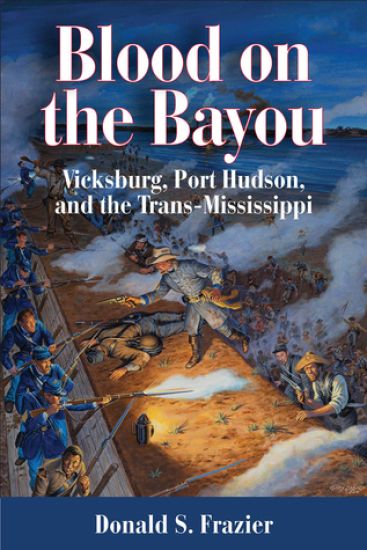
Blood on the Bayou

Blood on the Bayou

Donald S. Frazier

State House Press
2015
sidottu
Blood on the Bayou: Vicksburg, Port Hudson, and the Trans-Mississippi takes a well-known story, the struggle for control of the Mississippi River in the American Civil War, and recasts it as a contest for control of African-American populations. The Emancipation Proclamation may have freed the slaves, but the task of actually moving these liberated people into the Union lines and directing their labor to the benefit of the Union fell to the Federal army and navy. Control of the Mississippi has often been cast in economic terms. This book, by examining the campaigns from west of the river, shows how the campaign to reduce these Rebel forts also involved the creation of a black army of occupation and a remaking of the social and political landscape of Louisiana and the nation.This book is new scholarship and, most importantly, fresh research that challenges many commonly held notions of the Vicksburg and Port Hudson campaigns. In the past, the movement of large armies and the grand assaults garnered the most attention. As Blood on the Bayou reveals, small unit actions and big government policies in the Trans-Mississippi did as much to shape the outcome of the war as did the great armies and famous captains of legend and lore. No student of the Civil War should ignore this book. Scholars of Vicksburg and Port Hudson will find their studies incomplete without a thorough examination of this work.As with the other books in the Louisiana Quadrille series, the military campaigns remain front and center. I trace the movements of obscure regiments and battles fought on unfamiliar trans-Mississippi landscapes in June and July, 1863, and tell a little-known aspect of the sieges of Vicksburg and Port Hudson. I examine the evolution of Federal and Confederate strategy and sketch the leaders tasked with carrying these plans forward. There is enough combat to satisfy even the most ardent student of campaigns and commanders.The sources, however, revealed an almost obsessive concern over slavery by both sides. Actually, these soldiers, civilians, and politicians did not fret over the institution of slavery as much as control over the slaves themselves. Both Federal and Confederate authorities seemed preoccupied with who physically controlled the enslaved population. This led me to review Republican views on this subject, and especially those held by Abraham Lincoln. The tug-of-war over people—whom some considered persons held in bondage and others considered human property—also caused me to reexamine the peculiar institution as a salient feature of Confederate national identity. A greater appreciation for the causes of the war emerged. While states’ rights certainly provided a framework and context for the argument, slavery caused the war, not vice versa.Physical control of the slave population impacted how the Federal Government conducted the war. When war broke out, slaves emerged first as “contraband,” then morphed into “self-emancipated” persons, before becoming the raison d’être of the Mississippi Valley campaigns in 1863. The African-Americans became plunder, if you will. I came to the conclusion that the gathering of these persons drove, in part, Union military strategy in the Mississippi Valley. Lincoln wanted slaves removed from southern owners, concentrated in areas convenient to Union logistics centers, and then redistributed to serve as soldiers or farmers on behalf of the United States. The longer the military campaigns in the Mississippi Valley dragged on, the more Federal officials could feed liberated slaves into the system.This strategy held that, once Union troops had removed slaves from bondage and repurposed them to other tasks, it would be nearly impossible for their former masters to re-enslave them. No matter the outcome of the war, the Federal government set out to break slavery—forever. Fearing a rapid collapse of the Confederacy, abolitionists intended to make sure that readmitted states did not reestablish slavery. Remember, slavery was then a state prerogative. Passage of the Thirteenth Amendment still lay months into the future.Concurrently, Lincoln believed Black troops would help achieve victory and then secure the peace. One the shooting ended these African-American regiments might serve as an army of occupation. The largest concentration of slaves lay in the Mississippi Valley and this population needed to be under Federal control. The Rebel forts at Vicksburg and Port Hudson were impediments. Even so, despite the presence of these Confederate citadels, US troops could remove the African-American population of this region into zones of their choosing with increasing impunity. The fall of these positions facilitated commerce and navigation on the Mississippi. Yet, the great gathering of African-Americans began, and continued, notwithstanding the Rebels in the earthworks.
Fire in the Cane Field

Fire in the Cane Field

Donald S. Frazier

State House Press
2016
nidottu
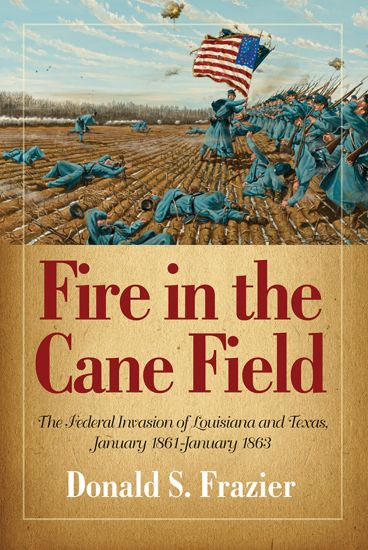
Award-winning author Donald S. Frazier returns to the field of Civil War history with keen turn of phrase and enthralling story-telling with the release of Fire in the Cane Field: The Invasion of Louisiana and Texas, January 1861–January 1863. Beginning with the spasms of secession in the Pelican State, Frazier weaves a stirring tale of bravado, reaction, and war as he describes the consequences of disunion for the hapless citizens of Louisiana. The army and navy campaigns he portrays weave a tale of the Federal Government's determination to suppress the newborn Confederacy - and nearly succeeding - by putting ever-increasing pressure on its adherents from New Orleans to Galveston. The surprising triumph of Texas troops on their home soil in early 1863 proved to be a decisive reverse to Union ambitions and doomed the region to even bloodier destruction to come. This bracing work, ten years in the making, ushered in a chronological string of books on the Civil War in Louisiana and Texas, as Frazier presents fresh sources on new topics in a series of captivating narratives.
Tempest Over Texas

Tempest Over Texas

Donald S. Frazier

State House Press
2020
sidottu
Tempest Over Texas: The Fall and Winter Campaigns, 1863-1864 is the fourth installment in Dr. Donald S. Frazier's award-winning Louisiana Quadrille series. Picking up the story of the Civil War in Louisiana and Texas after the fall of Port Hudson and Vicksburg, Tempest Over Texas describes Confederate confusion on how to carry on in the Trans-Mississippi given the new strategic realities. Likewise, Federal forces gathered from Memphis to New Orleans were in search of a new mission. International intrigues and disasters on distant battlefields would all conspire to confuse and perplex war-planners. One thing remained, however. The Stars and Stripes needed to fly once again in Texas, and as soon as possible.