Kirjojen hintavertailu. Mukana 11 244 527 kirjaa ja 12 kauppaa.

Kirjahaku

Etsi kirjoja tekijän nimen, kirjan nimen tai ISBN:n perusteella.

7 kirjaa tekijältä Dora Musielak

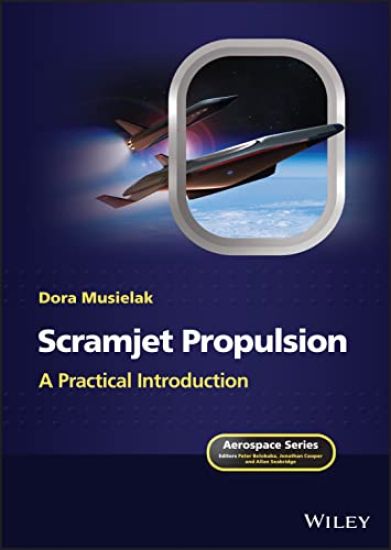
Scramjet Propulsion

Scramjet Propulsion

Dora Musielak

JOHN WILEY SONS INC
2022
sidottu
Scramjet Propulsion Explore the cutting edge of HAP technologies with this comprehensive resource from an international leader in her field Scramjet Propulsion: A Practical Introduction delivers a comprehensive treatment of hypersonic air breathing propulsion and its applications. The book covers the most up-to-date hypersonic technologies, like endothermic fuels, fuel injection and flameholding systems, high temperature materials, and TPS, and offers technological overviews of hypersonic flight platforms like the X-43A, X-51A, and HiFIRE. It is organized around easy-to-understand explanations of technical challenges and provides extensive references for the information contained within. The highly accomplished author provides readers with a fulsome description of the theoretical underpinnings of hypersonic technologies, as well as critical design and technology issues affecting hypersonic air breathing propulsion technologies. The book’s combination of introductory theory and advanced instruction about individual hypersonic engine components is ideal for students and practitioners in fields as diverse as hypersonic vehicle and propulsion development for missile defense technologies, launch aerospaceplanes, and civilian transports. Over 250 illustrations and tables round out the material. Readers will also learn from: A thorough introduction to hypersonic flight, hypersonic vehicle concepts, and a review of fundamental principles in hypersonic air breathing propulsionExplorations of the aerothermodynamics of scramjet engines and the design of scramjet components, as well as hypersonic air breathing propulsion combustors and fuelsAnalyses of dual-mode combustion phenomena, materials structures, and thermal management in hypersonic vehicles, and combined cycle propulsionAn examination of CFD analysis, ground and flight testing, and simulation Perfect for researchers and graduate students in aerospace engineering, Scramjet Propulsion: A Practical Introduction is also an indispensable addition to the libraries of engineers working on hypersonic vehicle development seeking a state-of-the-art resource in one of the most potentially disruptive areas of aerospace research today.

Sophie's Diary

Sophie's Diary

Dora Musielak

AMERICAN MATHEMATICAL SOCIETY
2012
nidottu
Sophie Germain overcame gender stigmas and a lack of formal education to prove that for all prime exponents less than 100 Case I of Fermat's Last Theorem holds. Hidden behind a man's name, her brilliance as mathematician was first discovered by three of the greatest scholars of the eighteenth century, Lagrange, Gauss, and Legendre. In Sophie's Diary, Germain comes to life through a fictionalized journal that intertwines mathematics with historical descriptions of the brutal events that took place in Paris between 1789 and 1793. This format provides a plausible perspective of how a young Sophie could have learned mathematics on her own--both fascinated by numbers and eager to master tough subjects without a teacher's guidance. Her passion for mathematics is integrated into her personal life as an escape from societal outrage. Sophie's Diary is suitable for a variety of readers--both young and old, mathematicians and novices--who will be inspired and enlightened on a field of study made easy, as told through the intellectual and personal struggles of an exceptional young woman.
Sophie Germain

Sophie Germain

Dora Musielak

Springer Nature Switzerland AG
2020
sidottu
This biography of the mathematician, Sophie Germain, paints a rich portrait of a brilliant and complex woman, the mathematics she developed, her associations with Gauss, Legendre, and other leading researchers, and the tumultuous times in which she lived. Sophie Germain stood right between Gauss and Legendre, and both publicly recognized her scientific efforts. Unlike her female predecessors and contemporaries, Sophie Germain was an impressive mathematician and made lasting contributions to both number theory and the theories of plate vibrations and elasticity. She was able to walk with ease across the bridge between the fields of pure mathematics and engineering physics. Though isolated and snubbed by her peers, Sophie Germain was the first woman to win the prize of mathematics from the French Academy of Sciences. She is the only woman who contributed to the proof of Fermat’s Last Theorem. In this unique biography, Dora Musielak has done the impossible-she has chronicled Sophie Germain’s brilliance through her life and work in mathematics, in a way that is simultaneously informative, comprehensive, and accurate.
Sophie Germain

Sophie Germain

Dora Musielak

Springer Nature Switzerland AG
2021
nidottu
This biography of the mathematician, Sophie Germain, paints a rich portrait of a brilliant and complex woman, the mathematics she developed, her associations with Gauss, Legendre, and other leading researchers, and the tumultuous times in which she lived. Sophie Germain stood right between Gauss and Legendre, and both publicly recognized her scientific efforts. Unlike her female predecessors and contemporaries, Sophie Germain was an impressive mathematician and made lasting contributions to both number theory and the theories of plate vibrations and elasticity. She was able to walk with ease across the bridge between the fields of pure mathematics and engineering physics. Though isolated and snubbed by her peers, Sophie Germain was the first woman to win the prize of mathematics from the French Academy of Sciences. She is the only woman who contributed to the proof of Fermat’s Last Theorem. In this unique biography, Dora Musielak has done the impossible-she has chronicled Sophie Germain’s brilliance through her life and work in mathematics, in a way that is simultaneously informative, comprehensive, and accurate.
Leonhard Euler and the Foundations of Celestial Mechanics

Leonhard Euler and the Foundations of Celestial Mechanics

Dora Musielak

Springer International Publishing AG
2022
sidottu
The intention of this book is to shine a bright light on the intellectual context of Euler’s contributions to physics and mathematical astronomy. Leonhard Euler is one of the most important figures in the history of science, a blind genius who introduced mathematical concepts and many analytical tools to help us understand and describe the universe. Euler also made a monumental contribution to astronomy and orbital mechanics, developing what he called astronomia mechanica. Orbital mechanics of artificial satellites and spacecraft is based on Euler’s analysis of astromechanics. However, previous books have often neglected many of his discoveries in this field. For example, orbital mechanics texts refer to the five equilibrium points in the Sun-Earth-Moon system as Lagrange points, failing to credit Euler who first derived the differential equations for the general n-body problem and who discovered the three collinear points in the three-body problem of celestial mechanics. These equilibrium points are essential today in space exploration; the James Webb Space Telescope (successor to the Hubble), for example, now orbits the Sun near L2, one of the collinear points of the Sun-Earth-Moon system, while future missions to study the universe will place observatories in orbit around Sun-Earth and Earth-Moon equilibrium points that should be properly called Euler-Lagrange points. In this book, the author uses Euler’s memoirs, correspondence, and other scholarly sources to explore how he established the mathematical groundwork for the rigorous study of motion in our Solar System. The reader will learn how he studied comets and eclipses, derived planetary orbits, and pioneered the study of planetary perturbations, and how, old and blind, Euler put forward the most advanced lunar theory of his time.
Leonhard Euler and the Foundations of Celestial Mechanics

Leonhard Euler and the Foundations of Celestial Mechanics

Dora Musielak

Springer International Publishing AG
2023
nidottu
The intention of this book is to shine a bright light on the intellectual context of Euler’s contributions to physics and mathematical astronomy. Leonhard Euler is one of the most important figures in the history of science, a blind genius who introduced mathematical concepts and many analytical tools to help us understand and describe the universe. Euler also made a monumental contribution to astronomy and orbital mechanics, developing what he called astronomia mechanica. Orbital mechanics of artificial satellites and spacecraft is based on Euler’s analysis of astromechanics. However, previous books have often neglected many of his discoveries in this field. For example, orbital mechanics texts refer to the five equilibrium points in the Sun-Earth-Moon system as Lagrange points, failing to credit Euler who first derived the differential equations for the general n-body problem and who discovered the three collinear points in the three-body problem of celestial mechanics. These equilibrium points are essential today in space exploration; the James Webb Space Telescope (successor to the Hubble), for example, now orbits the Sun near L2, one of the collinear points of the Sun-Earth-Moon system, while future missions to study the universe will place observatories in orbit around Sun-Earth and Earth-Moon equilibrium points that should be properly called Euler-Lagrange points. In this book, the author uses Euler’s memoirs, correspondence, and other scholarly sources to explore how he established the mathematical groundwork for the rigorous study of motion in our Solar System. The reader will learn how he studied comets and eclipses, derived planetary orbits, and pioneered the study of planetary perturbations, and how, old and blind, Euler put forward the most advanced lunar theory of his time.
Introduction to Rocket Propulsion for Astronautics

Introduction to Rocket Propulsion for Astronautics

Dora Musielak

Springer International Publishing AG
2025
sidottu
This book discusses the basic principles, performance, and technologies unique to the propulsion systems that power space vehicles. It is intended as a stimulating and accessible way in to the subject, aiming for a clear understanding of basic principles, providing a description of propulsion key physical mechanisms, and emphasizing the current state of technologies for the different applications such as launch vehicles, and space probes. The seven chapters comprise the wide scope of space rocket propulsion, filtered to highlight the main ideas without sacrificing the most important results.