Kirjojen hintavertailu. Mukana 11 342 296 kirjaa ja 12 kauppaa.

Kirjahaku

Etsi kirjoja tekijän nimen, kirjan nimen tai ISBN:n perusteella.

5 kirjaa tekijältä Doris Sommer

Foundational Fictions

Foundational Fictions

Doris Sommer

University of California Press
1993
pokkari
National consolidation and romantic novels go hand in hand in Latin America. "Foundational Fictions" shows how 19th century patriotism and heterosexual passion historically depend on one another to engender productive citizens.
Bilingual Aesthetics

Bilingual Aesthetics

Doris Sommer

Duke University Press
2004
sidottu
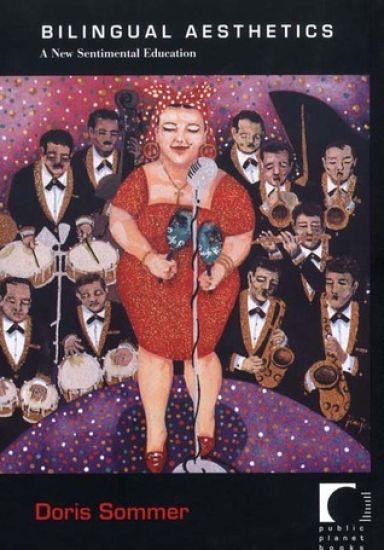
Knowing a second language entails some unease; it requires a willingness to make mistakes and work through misunderstandings. The renowned literary scholar Doris Sommer argues that feeling funny is good for you, and for society. In Bilingual Aesthetics Sommer invites readers to make mischief with meaning, to play games with language, and to allow errors to stimulate new ways of thinking. Today’s global world has outgrown any one-to-one correlation between a people and a language; liberal democracies can either encourage difference or stifle it through exclusionary policies. Bilingual Aesthetics is Sommer’s passionate call for citizens and officials to cultivate difference and to realize that the precarious points of contact resulting from mismatches between languages, codes, and cultures are the lifeblood of democracy, as well as the stimulus for aesthetics and philosophy.Sommer encourages readers to entertain the creative possibilities inherent in multilingualism. With her characteristic wit and love of language, she focuses on humor-particularly bilingual jokes-as the place where tensions between and within cultures are played out. She draws on thinking about humor and language by a range of philosophers and others, including Sigmund Freud, Immanuel Kant, Ludwig Wittgenstein, Hannah Arendt, and Mikhail Bakhtin. In declaring the merits of allowing for crossed signals, Sommer sends a clear message: Making room for more than one language is about value added, not about remediation. It is an expression of love for a contingent and changing world.
Bilingual Aesthetics

Bilingual Aesthetics

Doris Sommer

Duke University Press
2004
pokkari
Knowing a second language entails some unease; it requires a willingness to make mistakes and work through misunderstandings. The renowned literary scholar Doris Sommer argues that feeling funny is good for you, and for society. In Bilingual Aesthetics Sommer invites readers to make mischief with meaning, to play games with language, and to allow errors to stimulate new ways of thinking. Today’s global world has outgrown any one-to-one correlation between a people and a language; liberal democracies can either encourage difference or stifle it through exclusionary policies. Bilingual Aesthetics is Sommer’s passionate call for citizens and officials to cultivate difference and to realize that the precarious points of contact resulting from mismatches between languages, codes, and cultures are the lifeblood of democracy, as well as the stimulus for aesthetics and philosophy.Sommer encourages readers to entertain the creative possibilities inherent in multilingualism. With her characteristic wit and love of language, she focuses on humor-particularly bilingual jokes-as the place where tensions between and within cultures are played out. She draws on thinking about humor and language by a range of philosophers and others, including Sigmund Freud, Immanuel Kant, Ludwig Wittgenstein, Hannah Arendt, and Mikhail Bakhtin. In declaring the merits of allowing for crossed signals, Sommer sends a clear message: Making room for more than one language is about value added, not about remediation. It is an expression of love for a contingent and changing world.

The Work of Art in the World

The Work of Art in the World

Doris Sommer

Duke University Press
2014
sidottu
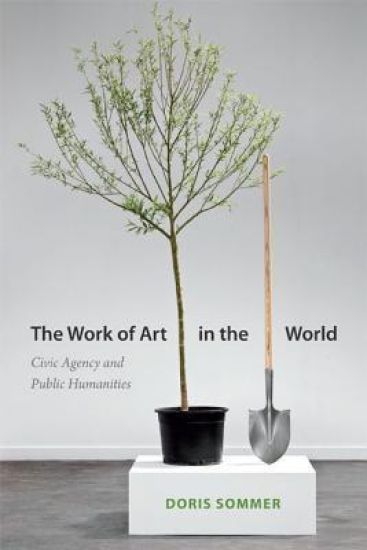
Celebrating art and interpretation that take on social challenges, Doris Sommer steers the humanities back to engagement with the world. The reformist projects that focus her attention develop momentum and meaning as they circulate through society to inspire faith in the possible. Among the cases that she covers are top-down initiatives of political leaders, such as those launched by Antanas Mockus, former mayor of Bogotá, Colombia, and also bottom-up movements like the Theatre of the Oppressed created by the Brazilian director, writer, and educator Augusto Boal. Alleging that we are all cultural agents, Sommer also takes herself to task and creates Pre-Texts, an international arts-literacy project that translates high literary theory through popular creative practices. The Work of Art in the World is informed by many writers and theorists. Foremost among them is the eighteenth-century German poet and philosopher Friedrich Schiller, who remains an eloquent defender of art-making and humanistic interpretation in the construction of political freedom. Schiller's thinking runs throughout Sommer's modern-day call for citizens to collaborate in the endless co-creation of a more just and more beautiful world.
The Work of Art in the World

The Work of Art in the World

Doris Sommer

Duke University Press
2014
pokkari
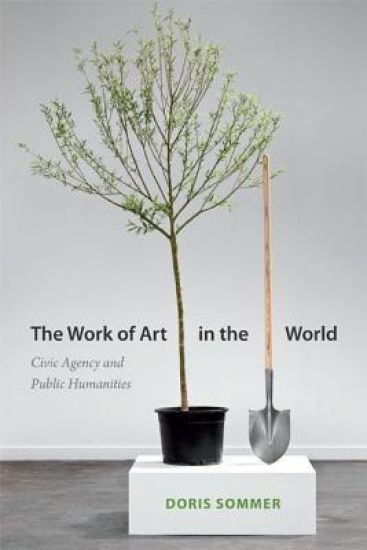
Celebrating art and interpretation that take on social challenges, Doris Sommer steers the humanities back to engagement with the world. The reformist projects that focus her attention develop momentum and meaning as they circulate through society to inspire faith in the possible. Among the cases that she covers are top-down initiatives of political leaders, such as those launched by Antanas Mockus, former mayor of Bogotá, Colombia, and also bottom-up movements like the Theatre of the Oppressed created by the Brazilian director, writer, and educator Augusto Boal. Alleging that we are all cultural agents, Sommer also takes herself to task and creates Pre-Texts, an international arts-literacy project that translates high literary theory through popular creative practices. The Work of Art in the World is informed by many writers and theorists. Foremost among them is the eighteenth-century German poet and philosopher Friedrich Schiller, who remains an eloquent defender of art-making and humanistic interpretation in the construction of political freedom. Schiller's thinking runs throughout Sommer's modern-day call for citizens to collaborate in the endless co-creation of a more just and more beautiful world.