Kirjojen hintavertailu. Mukana 12 595 353 kirjaa ja 12 kauppaa.

Kirjahaku

Etsi kirjoja tekijän nimen, kirjan nimen tai ISBN:n perusteella.

2 kirjaa tekijältä Doris T. Myers

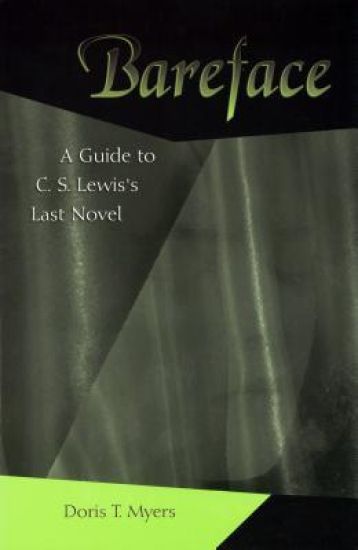
Bareface

Bareface

Doris T. Myers

University of Missouri Press
2018
nidottu
C. S. Lewis wanted to name his last novel “Bareface.” Now Doris T. Myers’s Bareface provides a welcome study of Lewis’s last, most profound, and most skillfully written novel, Till We Have Faces. Although many claim it is his best novel, Till We Have Faces is a radical departure from the fantasy genre of Lewis’s Chronicles of Narnia and The Screwtape Letters and has been less popular than Lewis’s earlier works. In Bareface, Myers supplies background information on this difficult work and suggests reading techniques designed to make it more accessible to general readers. She also presents a fresh approach to Lewis criticism for the enjoyment of specialists. Previous studies have often treated the novel as mere myth, ignoring Lewis’s effort to present the story of Cupid and Psyche as something that could have happened. Myers emphasizes the historical background, the grounding of the characterizations in modern psychology, and the thoroughly realistic narrative presentation. She identifies key books in ancient and medieval literature, history, and philosophy that influenced Lewis’s thinking as well as pointing out a previously unnoticed affinity with William James. From this context, a clearer understanding of Till We Have Faces can emerge. Approached in this way, the work can be seen as a realistic twentieth-century novel using modernist techniques such as the unreliable narrator and the manipulation of time. The major characters fit neatly into William James’s typology of religious experience, and Orual, the narrator-heroine, also develops the kind of personal maturity described by Carl Jung. At the same time, both setting and plot provide insights into the ancient world and pre-Christian modes of thought. Organized to facilitate browsing according to the reader’s personal interests and needs, this study helps readers explore this complex and subtle novel in their own way. Containing fresh insights that even the most experienced Lewis scholar will appreciate, Bareface is an accomplishment worthy of Lewis’s lifelong contemplation.
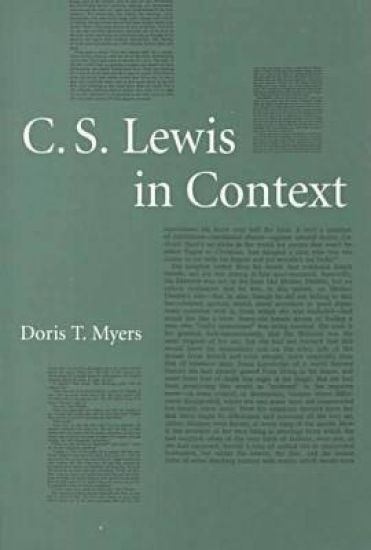
C.S.Lewis in Context

C.S.Lewis in Context

Doris T. Myers

Kent State University Press
1998
nidottu
Although C. S. Lewis (1898-1963) achieved a level of popularity as a fiction writer, literary scholars have tended to view him as a minor figure working in an insignificant genre-science fiction-or have pigeonholed him as a Christian apologist and moralist. In C. S. Lewis in Context, Doris T. Myers places his work in the literary milieu of his times and the public context of language rather than in the private realm of personal habits or relationships. A central debate early in the 20th century concerned the nature of language: was it primarily objective and empirical, as Charles K. Ogden and Ivor A. Richards argued in The Meaning of Meaning, or essentially metaphorical and impressionistic, the approach of Owen Garfield in Poetic Diction? Lewis espoused the latter theory and integrated it into the purpose and style of his fiction. Myers therefore argues that he was not “out of touch with his time" as some critics claim, but a 20th-century literary figure engaged in the issues of his day. New readings of many of Lewis’s best known works reflect this linguistic approach. For example, Myers analyzes The Pilgrim’s Regress (1933) in terms of a distinction between archetypal and individual metaphor to highlight the work’s strengths and weaknesses. Instead of interpreting That Hideous Strength (1945) conventionally as a defense of Christianity, she reformulates the debate as that of language the facilitator of rule versus language the instrument of tyranny. She also draws a new parallel between the Chronicles of Narnia and Spenser’s Faerie Queen, showing that they are modeled on similar heroic ideals and narrative technique. Out of the Silent Planet (1938), Perelandra (1943), and Till We Have Faces (1956) are discussed in a new light as well. By approaching Lewis’s fiction through the linguistic controversies of his day, Myers not only develops a new framework within which to evaluate his works, but also clarifies his literary contributions. This valuable study will appeal to literary and linguistic scholars as well as to general enthusiasts of Lewis’s fiction.