Kirjojen hintavertailu. Mukana 11 342 296 kirjaa ja 12 kauppaa.

Kirjahaku

Etsi kirjoja tekijän nimen, kirjan nimen tai ISBN:n perusteella.

4 kirjaa tekijältä Dorothea Olkowski

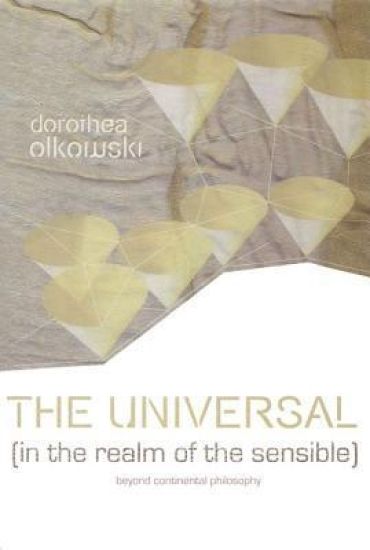
The Universal (In the Realm of the Sensible)

The Universal (In the Realm of the Sensible)

Dorothea Olkowski

Columbia University Press
2007
sidottu
The Universal proposes a radically new philosophical system that moves from ontology to ethics. Drawing on the work of De Beauvoir, Sartre, and Le Doeuff, among others, and addressing a range of topics from the Asian sex trade to late capitalism, quantum gravity, and Merleau-Ponty's views on cinema, Dorothea Olkowski stretches the mathematical, political, epistemological, and aesthetic limits of continental philosophy and introduces a new perspective on political structures. Straddling a course between formalism and conventionalism, Olkowski develops the concept of an ontological unconscious that arises from our "sensible" relation to the world-the information we absorb and emit that affects our encounters with the environment and others. In this "realm of the senses," or the field of vulnerability defined by our experience with pleasure and pain, Olkowski is able to rethink the space-time relations put forth by Irigaray's notion of the "interval," Bergson's "recollection," Merleau-Ponty's idea of the "flesh," and Deleuze's "plane of immanence." This aesthetic sense is shared by all humankind and nonhuman entities in the organic and inorganic world. The sensible universal can be applied to categories of pure and practical reason; experiential binaries of male-female and subject-object; and issues of autonomy, moral laws, and the regulation of perception.
The Universal (In the Realm of the Sensible)

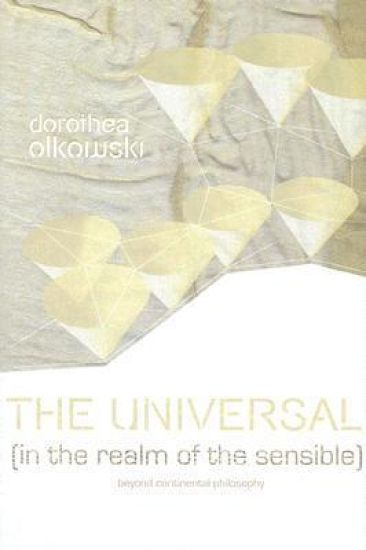
The Universal (In the Realm of the Sensible)

Dorothea Olkowski

Edinburgh University Press
2007
sidottu
The Universal (In the realm of the sensible): Beyond Continental Philosophy proposes a radical, new philosophical system that moves from ontology to ethics. Dorothea Olkowski develops the concept of an ontological unconscious, a connection arising from our sensible relation to the world that conditions encounters with the environment and with others. This fundamental ontology rethinks the space-time relations opened by Irigaray's notion of the 'interval,' Bergson's 'recollection,' Merleau-Ponty's idea of the 'flesh' and Deleuze's 'plane of immanence'. Writing in an original style, inspired by literature and the arts, Olkowski locates a 'realm of the senses', a field of vulnerability, felt as pleasures and pains. This presents an aesthetic sense of something universal to all human kind, as well as to the organic and inorganic world. In addition to this proposal for a wider ontology, the relation between traditional ontologies and politics is examined as a means of opening politics beyond a no exit or limit cycle. Instead a multiplicity of self-organized, emergent perspectives emerges, eliminating the need for the connections, conjunctions, and disjunctions of the Kantian paradigm at work in contemporary continental philosophy. This is a timely, controversial and important book that will contribute enormously to the study of Deleuze and Continental Philosophy.
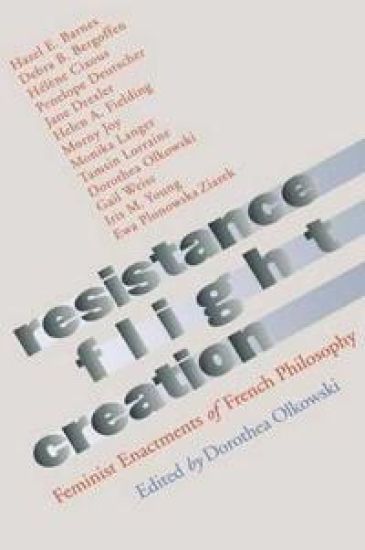
Resistance, Flight, Creation

Resistance, Flight, Creation

Dorothea Olkowski

Cornell University Press
2000
pokkari
Thirteen women at the forefront of philosophy locate new feminist points of view within the discipline by rigorously engaging works of contemporary French philosophy. In so doing, they both transform the standard practices of the field and carve out new territory. These writers amplify the work of feminist philosophers such as Simone de Beauvoir, Luce Irigaray, and Sarah Kofman in ways that are both stylistically and substantively creative. They also appropriate for radical feminist use the works of male philosophers such as Michel Foucault, Gilles Deleuze, Maurice Merleau-Ponty, and Jean-Paul Sartre.The essays illustrate the manner in which feminist philosophers bypass traditional methodology in favor of a disciplinary freedom characterized by fluid methodologies—best exemplified in Beauvoir's work—and by the employment of imaginative forms, including the autobiographical and the poetic. The modes of inquiry used here range variously from psychoanalysis and existentialism to deconstruction, post-structuralism, and newly resurgent phenomenology. This volume also contains a comprehensive bibliography of feminist thinkers who are enacting French philosophy in English, German, and French.