Kirjojen hintavertailu. Mukana 11 717 486 kirjaa ja 12 kauppaa.

Kirjahaku

Etsi kirjoja tekijän nimen, kirjan nimen tai ISBN:n perusteella.

5 kirjaa tekijältä Duane Armitage

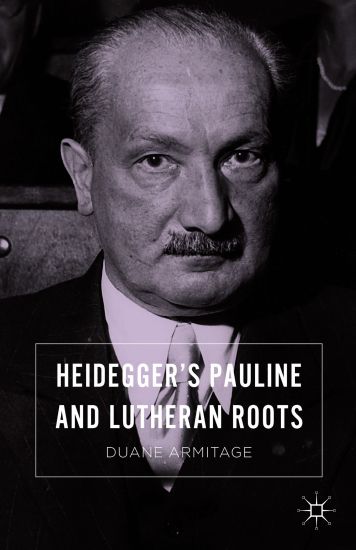
Heidegger’s Pauline and Lutheran Roots

Heidegger’s Pauline and Lutheran Roots

Duane Armitage

Palgrave Macmillan
2016
sidottu
In this work of philosophy, theology, and intellectual history, Duane Armitage offers a clear interpretation of Heidegger's enigmatic theology as uniquely Pauline and Lutheran. He argues that the real impetus, aim, and structure of Heidegger's philosophy of religion as well as his philosophy as a whole, are rooted in Pauline (and Lutheran) ontology. He thus demonstrates that continental philosophy of religion, and, to an extent, Continental Philosophy as a whole, is indebted to St. Paul and Martin Luther. This examination also shows how much of continental thinking itself is traceable to Heidegger's onto-theological critique and hence to Luther and St. Paul. Armitage argues that St. Paul and Luther, or at least Luther's specific reading of St. Paul, remain the un-thought origins of postmodern thinking on religion, and perhaps postmodern thinking in general.

Heidegger’s Pauline and Lutheran Roots

Heidegger’s Pauline and Lutheran Roots

Duane Armitage

Palgrave Macmillan
2018
nidottu
In this work of philosophy, theology, and intellectual history, Duane Armitage offers a clear interpretation of Heidegger's enigmatic theology as uniquely Pauline and Lutheran. He argues that the real impetus, aim, and structure of Heidegger's philosophy of religion as well as his philosophy as a whole, are rooted in Pauline (and Lutheran) ontology. He thus demonstrates that continental philosophy of religion, and, to an extent, Continental Philosophy as a whole, is indebted to St. Paul and Martin Luther. This examination also shows how much of continental thinking itself is traceable to Heidegger's onto-theological critique and hence to Luther and St. Paul. Armitage argues that St. Paul and Luther, or at least Luther's specific reading of St. Paul, remain the un-thought origins of postmodern thinking on religion, and perhaps postmodern thinking in general.

Philosophy's Violent Sacred

Philosophy's Violent Sacred

Duane Armitage

Michigan State University Press
2021
nidottu
Continental and postmodern thinking has misidentified the source of violence as originating from Western metaphysics. It has further failed to acknowledge the Judeo- Christian source of its ethic—the ethic of concern for victims. In this volume Duane Armitage attempts a critique of continental philosophy and postmodernism through the lens of René Girard’s mimetic theory. This critique is directed primarily at the philosophies of Nietzsche and Heidegger, both among the foremost representatives of continental and postmodern thought. Armitage argues that Girard’s engagement with Heidegger and Nietzsche radically alters many of the axioms of current postmodern continental philosophy, in particular the overcoming of metaphysics on the theoretical level and continental philosophy’s tacit commitments to (neo-)Marxism on the practical level. Detailed attention to the implications of Girard’s philosophical thought results in a paradigm shift that deals perhaps a deadly blow to continental and postmodern thinking. Armitage further argues that Girard’s thinking solves the very problems that continental and postmodern thinking sought (but failed) to solve, namely the problems of violence and victimization, particularly within the context of the aftermath of the Second World War. Ultimately, this volume shows that at the heart of postmodern thinking lies an entanglement with the violent sacred.
Heidegger and the Death of God

Heidegger and the Death of God

Duane Armitage

Springer International Publishing AG
2017
sidottu
This book presents a reading of Martin Heidegger’s philosophy as an effort to strike a middle position between the philosophies of Plato and Friedrich Nietzsche. Duane Armitage interprets the history of Western philosophy as comprising a struggle over the meaning of “being,” and argues that this struggle is ultimately between materialism and idealism, and, in the end, between atheism and theism. This work therefore concerns the question of the meaning of the so called “death of God” in the context of contemporary Continental Philosophy.
Heidegger and the Death of God

Heidegger and the Death of God

Duane Armitage

Springer International Publishing AG
2018
nidottu
This book presents a reading of Martin Heidegger’s philosophy as an effort to strike a middle position between the philosophies of Plato and Friedrich Nietzsche. Duane Armitage interprets the history of Western philosophy as comprising a struggle over the meaning of “being,” and argues that this struggle is ultimately between materialism and idealism, and, in the end, between atheism and theism. This work therefore concerns the question of the meaning of the so called “death of God” in the context of contemporary Continental Philosophy.