Kirjojen hintavertailu. Mukana 12 016 292 kirjaa ja 12 kauppaa.

Kirjahaku

Etsi kirjoja tekijän nimen, kirjan nimen tai ISBN:n perusteella.

4 kirjaa tekijältä Duncan J. Watts

Everything Is Obvious: How Common Sense Fails Us
By understanding how and when common sense fails, we can improve our understanding of the present and better plan for the future. Drawing on the latest scientific research, along with a wealth of historical and contemporary examples, Watts shows how common sense reasoning and history conspire to mislead us into believing that we understand more about the world of human behavior than we do; and in turn, why attempts to predict, manage, or manipulate social and economic systems so often go awry. It seems obvious, for example, that people respond to incentives; yet policy makers and managers alike frequently fail to anticipate how people will respond to the incentives they create. Social trends often seem to be driven by certain influential people; yet marketers have been unable to identify these "influencers" in advance. And although successful products or companies always seem in retrospect to have succeeded because of their unique qualities, predicting the qualities of the next hit product or hot company is notoriously difficult even for experienced professionals. Watts' argument has important implications in politics, business, and marketing, as well as in science and everyday life.
Six Degrees

Six Degrees

Duncan J. Watts

WW Norton Co
2004
pokkari
Combining a historical survey of the field with real-world examples, this book sets out to explain the research being done to create a blueprint of our connected planet, and shows how a multidiciplinary science of networks has come into being.
Small Worlds

Small Worlds

Duncan J. Watts

Princeton University Press
2003
pokkari
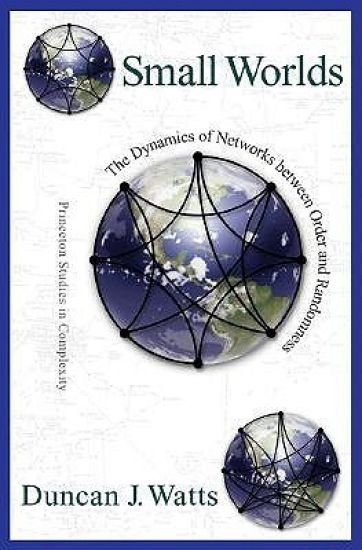
Everyone knows the small-world phenomenon: soon after meeting a stranger, we are surprised to discover that we have a mutual friend, or we are connected through a short chain of acquaintances. In his book, Duncan Watts uses this intriguing phenomenon--colloquially called "six degrees of separation"--as a prelude to a more general exploration: under what conditions can a small world arise in any kind of network? The networks of this story are everywhere: the brain is a network of neurons; organisations are people networks; the global economy is a network of national economies, which are networks of markets, which are in turn networks of interacting producers and consumers. Food webs, ecosystems, and the Internet can all be represented as networks, as can strategies for solving a problem, topics in a conversation, and even words in a language. Many of these networks, the author claims, will turn out to be small worlds. How do such networks matter? Simply put, local actions can have global consequences, and the relationship between local and global dynamics depends critically on the network's structure. Watts illustrates the subtleties of this relationship using a variety of simple models---the spread of infectious disease through a structured population; the evolution of cooperation in game theory; the computational capacity of cellular automata; and the sychronisation of coupled phase-oscillators. Watts's novel approach is relevant to many problems that deal with network connectivity and complex systems' behaviour in general: How do diseases (or rumours) spread through social networks? How does cooperation evolve in large groups? How do cascading failures propagate through large power grids, or financial systems? What is the most efficient architecture for an organisation, or for a communications network? This fascinating exploration will be fruitful in a remarkable variety of fields, including physics and mathematics, as well as sociology, economics, and biology.
Everything is Obvious

Everything is Obvious

Duncan J. Watts

Atlantic Books
2012
nidottu
Sociologist Duncan Watts explains in this provocative book that the explanations that we give for the outcomes that we observe in life - explanations that seem obvious once we know the answer - are less useful than they seem. Watts shows how commonsense reasoning and history conspire to mislead us into thinking that we understand more about the world of human behavior than we do; and in turn, why attempts to predict, manage, or manipulate social and economic systems so often go awry.Only by understanding how and when common sense fails can we improve how we plan for the future, as well as understand the present-an argument that has important implications in politics, business, marketing, and even everyday life.