Kirjojen hintavertailu. Mukana 12 357 868 kirjaa ja 12 kauppaa.

Kirjahaku

Etsi kirjoja tekijän nimen, kirjan nimen tai ISBN:n perusteella.

5 kirjaa tekijältä E. Bruce Geelhoed

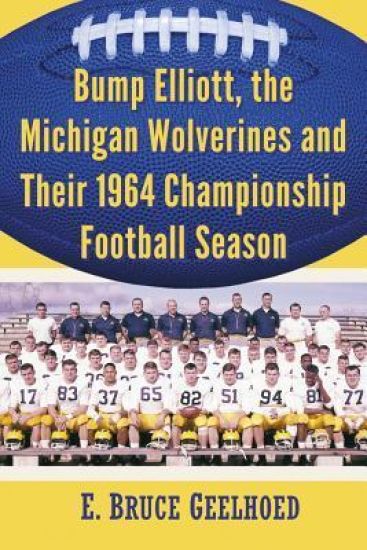
Bump Elliott, the Michigan Wolverines and Their 1964 Championship Football Season
Under the leadership of head coach Bump Elliott, the 1964 Wolverines won Michigan's first Big Ten championship since 1950 and their first Rose Bowl since 1951, and finished fourth in the national college football polls. They defeated four top-ten ranked teams: Navy, Michigan State, Ohio State, and Oregon State, their Rose Bowl opponent. The Wolverines also defeated Minnesota for the first time since 1960, and reclaimed the prized Little Brown Jug. Despite its impressive record, the 1964 team failed to attract the national attention it deserved. At the beginning of the season, few football observers expected Michigan to contend for the Big Ten championship. But by the end of the season it was clear that the Wolverines were one of America's elite teams--perhaps the best in the country. This book chronicles for the first time the exploits of Michigan's 1964 team and gives them long-overdue recognition.
Diplomacy Shot Down

Diplomacy Shot Down

E. Bruce Geelhoed

University of Oklahoma Press
2020
sidottu
The history of the Cold War is littered with what-ifs, and in Diplomacy Shot Down, E. Bruce Geelhoed explores one of the most intriguing: What if the Soviets had not shot down the American U-2 spy plane and President Dwight D. Eisenhower had visited the Soviet Union in 1960 as planned? In August 1959, with his second term nearing its end, Eisenhower made the surprise announcement that he and Soviet premier Nikita S. Khrushchev would visit each other's countries as a means of ""thawing some of the ice"" of the Cold War. Khrushchev's trip to the United States in September 1959 resulted in plans for a four-power summit involving Great Britain and France, and for Eisenhower's visit to Russia in early summer 1960. Then, in May 1960, the Soviet Union shot down an American U-2 surveillance plane piloted by Francis Gary Powers. The downing of Powers's plane was, in Geelhoed's recounting of this episode in Cold War history, not just a diplomatic crisis. The ensuing collapse of the summit and the subsequent cancelation of Eisenhower's trip to the Soviet Union amounted to a critical missed opportunity for improved US-Soviet relations at a crucial juncture in the Cold War. In a blow-by-blow description of the diplomatic overtures, the U-2 incident, and the aftermath, Diplomacy Shot Down draws upon Eisenhower's projected itinerary and unmade speeches and statements, as well as the American and international press corps' preparations for covering the aborted visit, to give readers a sense of what might have been. Eisenhower's prestige within the Soviet Union was so great, Geelhoed observes, that the trip, if it had happened, could well have led to a détente in the increasingly dangerous US-Soviet relationship. Instead, the cancelation of Ike's visit led to an escalation in hostilities that played out around the globe and nearly guaranteed that the ""missile gap"" would reemerge as an issue in the 1960 presidential campaign. A detailed account of an episode that defined the Cold War for a generation, Diplomacy Shot Down is, in its insights and revelations, something rarer still - a behind-the-scenes look at history in the unmaking.
Diplomacy Shot Down

Diplomacy Shot Down

E. Bruce Geelhoed

UNIVERSITY OF OKLAHOMA PRESS
2022
nidottu
The history of the Cold War is littered with what-ifs, and in Diplomacy Shot Down, E. Bruce Geelhoed explores one of the most intriguing: What if the Soviets had not shot down the American U-2 spy plane and President Dwight D. Eisenhower had visited the Soviet Union in 1960 as planned? In August 1959, with his second term nearing its end, Eisenhower made the surprise announcement that he and Soviet premier Nikita S. Khrushchev would visit each other’s countries as a means of “thawing some of the ice” of the Cold War. Khrushchev’s trip to the United States in September 1959 resulted in plans for a four-power summit involving Great Britain and France, and for Eisenhower’s visit to Russia in early summer 1960. Then, in May 1960, the Soviet Union shot down an American U-2 surveillance plane piloted by Francis Gary Powers. The downing of Powers’s plane was, in Geelhoed’s recounting of this episode in Cold War history, not just a diplomatic crisis. The ensuing collapse of the summit and the subsequent cancelation of Eisenhower’s trip to the Soviet Union amounted to a critical missed opportunity for improved US-Soviet relations at a crucial juncture in the Cold War. In a blow-by-blow description of the diplomatic overtures, the U-2 incident, and the aftermath, Diplomacy Shot Down draws upon Eisenhower’s projected itinerary and unmade speeches and statements, as well as the American and international press corps’ preparations for covering the aborted visit, to give readers a sense of what might have been. Eisenhower’s prestige within the Soviet Union was so great, Geelhoed observes, that the trip, if it had happened, could well have led to a dÉtente in the increasingly dangerous US-Soviet relationship. Instead, the cancelation of Ike’s visit led to an escalation in hostilities that played out around the globe and nearly guaranteed that the “missile gap” would reemerge as an issue in the 1960 presidential campaign. A detailed account of an episode that defined the Cold War for a generation, Diplomacy Shot Down is, in its insights and revelations, something rarer still—a behind-the-scenes look at history in the unmaking.
Ball State University

Ball State University

E. Bruce Geelhoed; Michael G. Szajewski; Brandon T. Pieczko

Arcadia Publishing Library Editions
2018
sidottu
Ball State University in Muncie, Indiana, celebrates its centennial anniversary in 2018. Begun in 1918 as the Eastern Division of the Indiana State Normal School, Ball State remained a branch campus of Indiana State until 1929 when it became Ball State Teachers College, Indianaa (TM)s fourth public institution of higher education. In 1965, the teachers college became Ball State University. Throughout its history, Ball Statea (TM)s distinguishing characteristic has been the positive interactions between students, faculty, and members of the community. This book will show how these interactions have worked out at Ball State: in the classroom; on the athletic field; in social organizations, such as student government; fraternities, sororities, and clubs; and throughout the region. The book will also show how the members of the Ball family have played a major role in the growth and development of the university.
The Dragon and the Snake

The Dragon and the Snake

Millicent Anne Gates; E. Bruce Geelhoed

University of Pennsylvania Press
1986
sidottu
The United States Liaison Office (USLO) served as the diplomatic contact for Sino-American relations between the time of the Nixon-Kissinger opening of China in 1971-1972 and the achievement of full normalization in 1979. This book presents the importance of the USLO to American foreign policy in the 1970s.