
Kirjahaku
Etsi kirjoja tekijän nimen, kirjan nimen tai ISBN:n perusteella.
5 kirjaa tekijältä Earle H. Waugh

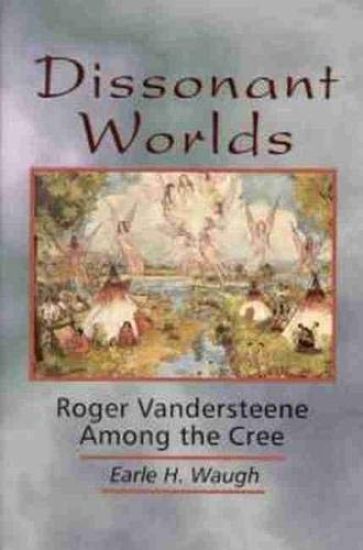
How did a Belgian Oblate missionary who came to Canada to convert the aboriginals come to be buried as a Cree chief? In Dissonant Worlds Earle Waugh traces the remarkable career of Roger Vandersteene: his life as an Oblate missionary among the Cree, his intensive study of the Cree language and folkways, his status as a Cree medicine man, and the evolution of his views on the relationship between aboriginal traditions and the Roman Catholicism of the missionaries who worked among them. Above all, Dissonant Worlds traces Vandersteene's quest to build a new religious reality: a strong, spiritually powerful Cree church, a magnificent Cree formulation of Christian life. In the wilderness of northern Canada Vandersteene found an aboriginal spirituality that inspired his own poetic and artistic nature and encouraged him to pursue a religious vision that united Cree tradition and Catholicism, one that constituted a dramatic revision of contemporary Catholic ritual. Through his paintings, poetry and liturgical modifications, Vandersteene attempted to recreate Cree reality and provide images grounded in Cree spirituality. Dissonant Worlds, in telling the story of Vandersteene's struggle to integrate European Catholicism and aboriginal spirituality, raises the larger issue: Is there a place for missionary work in the modern church? It will be of interest to students of Native studies, the religious history of the Oblates, Canadian studies and Catholicism in the mid-twentieth century.
Forty years ago, as a young scholar in Islamic Studies at the University of Alberta, Al Rashid's Muslims welcomed my queries, tolerated my ignorance, and joyfully opened their homes and their hearts. Edmonton's Al Rashid Mosque has played a key role in Islam's Canadian development. Founded by Muslims from Lebanon, it has grown into a vibrant community fully integrated into Canada's cultural mosaic. The mosque continues to be a concrete expression of social good, a symbol of a proud Muslim-Canadian identity. Al Rashid Mosque provides a welcome introduction to the ethics and values of homegrown Muslims. The book traces the mosque's role in education and community leadership, and celebrates the numerous contributions of Muslim Canadians in Edmonton and across Canada. Written to mark the 75th anniversary of the mosque's opening in 1938, Al Rashid Mosque is a timely and important volume of Islamic and Canadian history.
Al Rashid Mosque, Canada’s first and one of the earliest in North America, was erected in Edmonton in the depth of the Depression of the 1930s. Over time, the story of this first mosque, which served as a magnet for more Lebanese Muslim immigrants to Edmonton, was woven into the folklore of the local community. —Baha Abu-Laban, Foreword Edmonton’s Al Rashid Mosque has played a key role in Islam’s Canadian development. Founded by Muslims from Lebanon, it has grown into a vibrant community fully integrated into Canada’s cultural mosaic. The mosque continues to be a concrete expression of social good, a symbol of a proud Muslim Canadian identity. Al Rashid Mosque provides a welcome introduction to the ethics and values of homegrown Muslims. The book traces the mosque’s role in education and community leadership and celebrates the numerous contributions of Muslim Canadians in Edmonton and across Canada. Al Rashid Mosque is a timely and important volume of Islamic and Canadian history. "Forty years ago, as a young scholar in Islamic Studies at the University of Alberta, Al Rashid’s Muslims welcomed my queries, tolerated my ignorance, and joyfully opened their homes and their hearts." —Earle H. Waugh Earle H. Waugh has studied Islam in Canada and the Middle East for most of his adult life. He is Professor Emeritus at the University of Alberta and a senior scholar in the areas of religious studies, health and culture, and Indigenous language maintenance.
Memory, Music, and Religion
Earle H. Waugh; Frederick M. Denny
University of South Carolina Press
2005
sidottu
Why do religious communities remember some events and not others? Why do some kinds of music find a continuing place in worship while others seem to lose their appeal? Why is it that the Islamic tradition is understood so narrowly, even by some Muslims, when in fact it has a broadly textured history of belief and practice? In Memory, Music, and Religion, Earle H. Waugh addresses such probing questions while exploring a rich vein of Islam in Morocco - the mystical chanters. In this book, a detailed study of the interplay between memory, music, and religion, Waugh opens new areas of thought, particularly regarding a theme that cuts across religious traditions: the role of memory in religious formation. Since the glorious days of Andalusia, Muslim poetic and musical traditions have found a vibrant home among Moroccan Sufis. Through rituals of dhikr, or remembrance, the old forms of music and word blend into a new form of worship for today. In this study, Waugh probes the depths of religious memory within Islam and notes the singular importance of memory in comprehending the meaning and styles of music. Showing how the powerful tradition of music nurtures the Muslim soul, Waugh brings new insights to the study of the religious function of memory.