Kirjojen hintavertailu. Mukana 11 244 527 kirjaa ja 12 kauppaa.

Kirjahaku

Etsi kirjoja tekijän nimen, kirjan nimen tai ISBN:n perusteella.

7 kirjaa tekijältä Edgar Morin

The Cinema, or The Imaginary Man

The Cinema, or The Imaginary Man

Edgar Morin

University of Minnesota Press
2005
nidottu
When The Cinema, or The Imaginary Man first appeared in 1956, the movies and the moviegoing experience were generally not regarded as worthy of serious scholarly consideration. Yet, French critic and social theorist Edgar Morin perceived in the cinema a complex phenomenon capable of illuminating fundamental truths about thought, imagination, and human nature - which allowed him to connect the mythic universe of gods and spirits present within the most primitive societies to the hyperreality emanating from the images projected on the screen. Now making its English-language debut, this audacious, provocative work draws on insights from poets, filmmakers, anthropologists, and philosophers to restore to the cinema the sense of magic first enjoyed at the dawn of the medium. Morin's inquiry follows two veins of investigation. The first focuses on the cinematic image as the nexus between the real and the imaginary; the second examines the cinema's re-creation of the archaic universe of doubles and ghosts and its power to possess, to bewitch, to nourish dreams, desires, and aspirations. "We experience the cinema in a state of double consciousness," Morin writes, "an astonishing phenomenon where the illusion of reality is inseparable from the awareness that it is really an illusion."
Vidal and His Family

Vidal and His Family

Edgar Morin

Sussex Academic Press
2009
nidottu
Edgar Morin, one of France's greatest living intellectuals, tells the story of his father, Vidal Nahoum, but also the story of Sephardic Jews, and of Europe. In this 'holographic history' Vidal's story, and that of his family, carries within it the flowering, decline, and death of Jewish culture in Spain, the passage from Empires to Nation States, the complex relations between Jews and Gentiles, between East and West, and, ultimately, the history of the twentieth century itself. Morin's work ranges from the great sweep of global historical events to the everyday details of individual lives, letters, feelings, reflections, and experiences. Vidal was born in 1894 in the Ottoman Empire's great Macedonian port. His great-grandfather came from Tuscany and spoke Italian. His mother tongue was fifteenth-century Spanish. He learned French and German as a child. When he was an adolescent, he dreamed of living in France; he was deported there as a prisoner, and then liberated by the French Prime Minister. He lived through the Balkan wars, the collapse of the Ottoman Empire, and two World Wars. Vidal cannot be isolated from his family. And as Edgar Morin explains, "this book also tells the stories of the men and women in his immediate family When, as his son, I inevitably come into his story... I describe him as objectively as possible. The reverence that inspired me did not call for a work of edification; it implied that I should attempt to write a truthful book. For this reason, the book is not in the least respectful, or at least not in the usual sense of the word. Vidal felt that loving someone meant being able to tease him. The author of these lines, who has inherited something of this trait, does not think it disrespectful to tease or make fun of the people he loves."
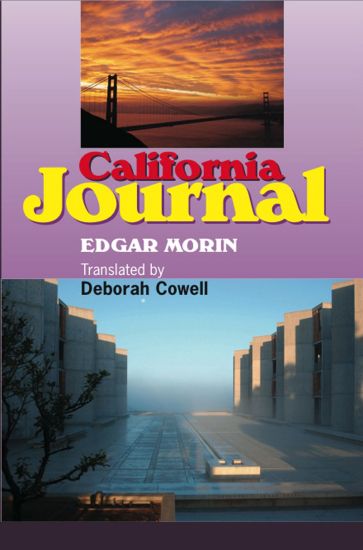
California Journal

California Journal

Edgar Morin

Sussex Academic Press
2008
nidottu
In 1969, California is not just the new Eldorado: it is the crucible where civilisation is accelerating, self-destructs, and is reborn. It's the probe of Spaceship Earth. The hippy phenomenon, communes, the ecological movement, great collective ceremonies like park-ins and rock concerts, the flourishing of sects ranging from mystics to Marxists, the experience of 'weed' and 'acid', are temporary images and elements of a search for a new truth, a new religion, a new society. Long before it became fashionable for European intellectuals to write about their voyages to the United States, Edgar Morin, one of France's leading intellectual figures and at that time known as a path-breaking and innovative sociologist and researcher of popular culture, recounts the story of his experiences in the cauldron of change that was California, including his encounters with some of the leading minds of that time. The book combines Morin's accounts of his experiences with his own search for answers to fundamental questions about the human condition. For a few months, the author had a profound feeling of being drawn into the heart of the 'great questions', played out personally and societally. The result is an engaging and prophetic work that has as much if not more to offer today than it did when it was first published in French.