Kirjojen hintavertailu. Mukana 11 342 296 kirjaa ja 12 kauppaa.

Kirjahaku

Etsi kirjoja tekijän nimen, kirjan nimen tai ISBN:n perusteella.

8 kirjaa tekijältä Edith Wyschogrod

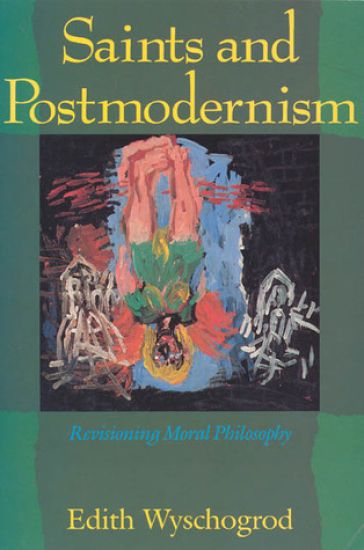
Saints and Postmodernism

Saints and Postmodernism

Edith Wyschogrod

University of Chicago Press
1990
nidottu
"In this exciting and important work, Wyschogrod attempts to read contemporary ethical theory against the vast unwieldy tapestry that is postmodernism. . . . [A] provocative and timely study."—Michael Gareffa, Theological Studies"A 'must' for readers interested in the borderlands between philosophy, hagiography, and ethics."—Mark I. Wallace, Religious Studies Review
An Ethics of Remembering

An Ethics of Remembering

Edith Wyschogrod

University of Chicago Press
1998
sidottu
What are the ethical responsibilities of the historian in an age of mass murder and hyper-reality? Can one be postmodern and still write history? For whom should history be written? The author explores these questions through the figure of the "heterological historian". Realizing the philosophical impossibilities of ever recovering "what really happened", this historian nevertheless acknowledges a moral imperative to speak for those who have been rendered voiceless. The book also weighs the impact of modern archival methods, such as photographs, film and the Internet, which bring with them new constraints on the writing of history and which mandate a different vision of community. Drawing on the works of continental philosophers, historiographers, cognitive scientists and filmmakers, the book creates a framework for the understanding of history and the ethical duties of the historian.
An Ethics of Remembering

An Ethics of Remembering

Edith Wyschogrod

University of Chicago Press
1998
nidottu
What are the ethical responsibilities of the historian in an age of mass murder and hyper-reality? Can one be postmodern and still write history? For whom should history be written? The author explores these questions through the figure of the "heterological historian". Realizing the philosophical impossibilities of ever recovering "what really happened", this historian nevertheless acknowledges a moral imperative to speak for those who have been rendered voiceless. The book also weighs the impact of modern archival methods, such as photographs, film and the Internet, which bring with them new constraints on the writing of history and which mandate a different vision of community. Drawing on the works of continental philosophers, historiographers, cognitive scientists and filmmakers, the book creates a framework for the understanding of history and the ethical duties of the historian.
Spirit in Ashes

Spirit in Ashes

Edith Wyschogrod

Yale University Press
1990
pokkari
Contemporary phenomena of mass death—such as Hiroshima and Auschwitz—have brought with them the threat of annihilation of human life. In this provocative and disturbing book, Edith Wyschogrod shows that the various manifestations of man-made mass death form a single structure, a “death-event,” which radically alters our understanding of language, time, and self. She contends that the death event has its own logic and driving force that she traces to pre-Socratic philosophy and to certain mythological motifs that recur in Western thought.“Spirit in Ashes is one book in contemporary philosophy that should be read aloud and taken to heart by any professional or intellectual who purports to have a conscience.”—Carl Rasche, Journal of the American Academy of Religion“A masterful blend of scholarship, originality, and serious passion.”—Robert C. Neville, Commonweal“An original, insightful, and challenging work.”—Robert Burch, Canadian Philosophical Reviews
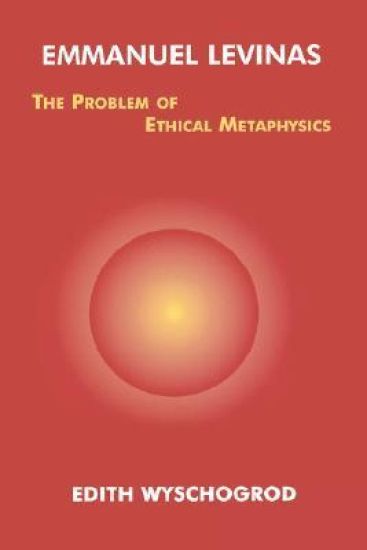
Emmanuel Levinas

Emmanuel Levinas

Edith Wyschogrod

Fordham University Press
2000
sidottu
Edith Wyschogrod presents the first full-length study in English of the important contemporary French philosopher Emmanuel Levinas. It is a revision of the author's earlier study and includes discussions of his recent writings as well as current scholarship. Dr. Wyschogrod's extensive discussion of Levinas's relation to Judaism, especially his use of literature from the Torah and other religious writings, will be of interest to religious scholars. The author compares Levinas's thought with that of his contemporaries, most notably Jacques Derrida and Husserl.
Emmanuel Levinas

Emmanuel Levinas

Edith Wyschogrod

Fordham University Press
2000
pokkari
Edith Wyschogrod presents the first full-length study in English of the important contemporary French philosopher Emmanuel Levinas. It is a revision of the author's earlier study and includes discussions of his recent writings as well as current scholarship. Dr. Wyschogrod's extensive discussion of Levinas's relation to Judaism, especially his use of literature from the Torah and other religious writings, will be of interest to religious scholars. The author compares Levinas's thought with that of his contemporaries, most notably Jacques Derrida and Husserl.
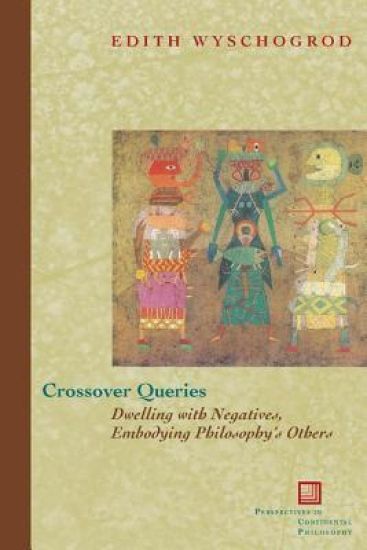
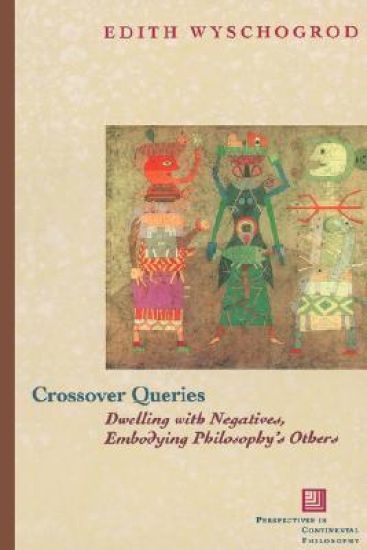
Crossover Queries

Crossover Queries

Edith Wyschogrod

Fordham University Press
2006
sidottu
Exploring the risks, ambiguities, and unstable conceptual worlds of contemporary thought, Crossover Queries brings together the wide-ranging writings, across twenty years, of one of our most important philosophers. Ranging from twentieth-century European philosophy—the thought of Heidegger, Foucault, Derrida, Levinas, Janicaud, and others—to novels and artworks, music and dance, from traditional Jewish thought to Jain and Buddhist metaphysics, Wyschogrod's work opens radically new vistas while remaining mindful that the philosopher stands within and is responsible to a philosophical legacy conditioned by the negative. Rather than point to a Hegelian dialectic of overcoming negation or to a postmetaphysical exhaustion, Wyschogrod treats negative moments as opening novel spaces for thought. She probes both the desire for God and an ethics grounded in the interests of the other person, seeing these as moments both of crossing over and of negation. Alert to the catastrophes that have marked our times, she exposes the underlying logical structures of nihilatory forces that have been exerted to exterminate whole peoples. Analyzing the negations of biological research and cultural images of mechanized and robotic bodies, she shows how they contest the body as lived in ordinary experience. "Crossover Queries brings together important essays on a remarkable range of topics by one of our most insightful cultural critics. Commenting on philosophical and theological issues that have shaped the recent past as well as scientific and technological questions that will preoccupy us in the near future, Wyschogrod consistently alerts us to the urgency of problems whose importance few recognize. To avoid the challenge these essays pose is to avoid responsibility for a future that appears to be increasingly fragile."—Mark C. Taylor, Columbia University
Crossover Queries

Crossover Queries

Edith Wyschogrod

Fordham University Press
2006
pokkari
Exploring the risks, ambiguities, and unstable conceptual worlds of contemporary thought, Crossover Queries brings together the wide-ranging writings, across twenty years, of one of our most important philosophers. Ranging from twentieth-century European philosophy—the thought of Heidegger, Foucault, Derrida, Levinas, Janicaud, and others—to novels and artworks, music and dance, from traditional Jewish thought to Jain and Buddhist metaphysics, Wyschogrod's work opens radically new vistas while remaining mindful that the philosopher stands within and is responsible to a philosophical legacy conditioned by the negative. Rather than point to a Hegelian dialectic of overcoming negation or to a postmetaphysical exhaustion, Wyschogrod treats negative moments as opening novel spaces for thought. She probes both the desire for God and an ethics grounded in the interests of the other person, seeing these as moments both of crossing over and of negation. Alert to the catastrophes that have marked our times, she exposes the underlying logical structures of nihilatory forces that have been exerted to exterminate whole peoples. Analyzing the negations of biological research and cultural images of mechanized and robotic bodies, she shows how they contest the body as lived in ordinary experience. "Crossover Queries brings together important essays on a remarkable range of topics by one of our most insightful cultural critics. Commenting on philosophical and theological issues that have shaped the recent past as well as scientific and technological questions that will preoccupy us in the near future, Wyschogrod consistently alerts us to the urgency of problems whose importance few recognize. To avoid the challenge these essays pose is to avoid responsibility for a future that appears to be increasingly fragile."—Mark C. Taylor, Columbia University