Kirjojen hintavertailu. Mukana 11 342 296 kirjaa ja 12 kauppaa.

Kirjahaku

Etsi kirjoja tekijän nimen, kirjan nimen tai ISBN:n perusteella.

9 kirjaa tekijältä Edward B. Barbier

A Global Green New Deal

A Global Green New Deal

Edward B. Barbier

Cambridge University Press
2010
pokkari
Meeting the short run challenges of reviving the worldwide economy need not mean sacrificing long run economic and environmental sustainability. A Global Green New Deal (GGND) is an economic policy strategy for ensuring a more economically and environmentally sustainable world economic recovery. Reviving growth and creating jobs should be essential objectives. But policies should also aim to reduce carbon dependency, protect ecosystems and water resources, and alleviate poverty. Otherwise, economic recovery today will do little to avoid future economic and environmental crises. Part One argues why a GGND strategy is essential to the sustainability of the global economy. Part Two provides an overview of the key national policies whilst Part Three focuses on the global actions necessary to allow national policies to work. Part Four summarizes the main recommendations for national and international action, and discusses the wider implications for restructuring the world economy towards 'greener' development.
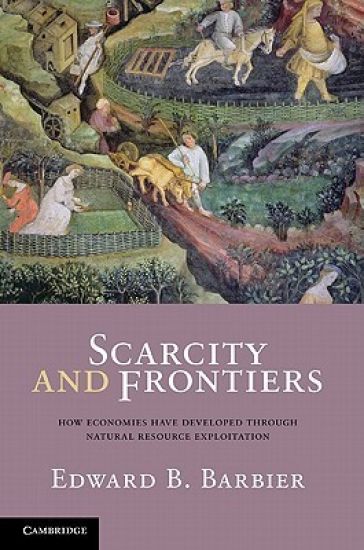
Scarcity and Frontiers

Scarcity and Frontiers

Edward B. Barbier

Cambridge University Press
2010
pokkari
Throughout much of history, a critical driving force behind global economic development has been the response of society to the scarcity of key natural resources. Increasing scarcity raises the cost of exploiting existing natural resources and creates incentives in all economies to innovate and conserve more of these resources. However, economies have also responded to increasing scarcity by obtaining and developing more of these resources. Since the agricultural transition over 12,000 years ago, this exploitation of new 'frontiers' has often proved to be a pivotal human response to natural resource scarcity. This book provides a fascinating account of the contribution that natural resource exploitation has made to economic development in key eras of world history. This not only fills an important gap in the literature on economic history but also shows how we can draw lessons from these past epochs for attaining sustainable economic development in the world today.
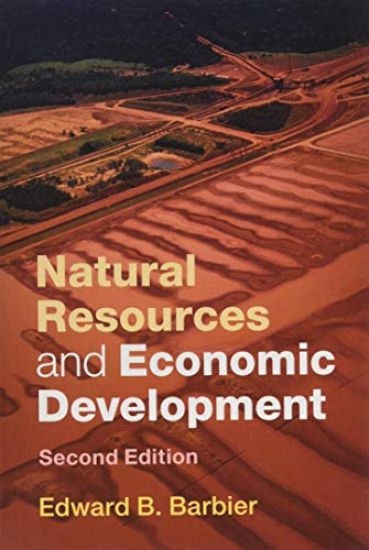
Natural Resources and Economic Development

Natural Resources and Economic Development

Edward B. Barbier

Cambridge University Press
2007
pokkari
Natural Resources and Economic Development, first published in 2005, explores a key paradox: why is natural resource exploitation not yielding greater benefits to the poor economies of Africa, Asia and Latin America? Part I examines this paradox both through a historical review of resource use and development and through examining current theories which explain the under-performance of today's resource-abundant economies, and proposes a frontier expansion hypothesis as an alternative explanation. Part II develops models to analyse the key economic factors underlying land expansion and water use in developing countries. Part III explores further the 'dualism within dualism' structure of resource dependency, rural poverty and resource degradation within developing countries, and through illustrative country case-studies, proposes policy and institutional reforms necessary for successful resource-based development.
A Global Green New Deal

A Global Green New Deal

Edward B. Barbier

Cambridge University Press
2010
sidottu
Meeting the short run challenges of reviving the worldwide economy need not mean sacrificing long run economic and environmental sustainability. A Global Green New Deal (GGND) is an economic policy strategy for ensuring a more economically and environmentally sustainable world economic recovery. Reviving growth and creating jobs should be essential objectives. But policies should also aim to reduce carbon dependency, protect ecosystems and water resources, and alleviate poverty. Otherwise, economic recovery today will do little to avoid future economic and environmental crises. Part One argues why a GGND strategy is essential to the sustainability of the global economy. Part Two provides an overview of the key national policies whilst Part Three focuses on the global actions necessary to allow national policies to work. Part Four summarizes the main recommendations for national and international action, and discusses the wider implications for restructuring the world economy towards 'greener' development.
Scarcity and Frontiers

Scarcity and Frontiers

Edward B. Barbier

Cambridge University Press
2010
sidottu
Throughout much of history, a critical driving force behind global economic development has been the response of society to the scarcity of key natural resources. Increasing scarcity raises the cost of exploiting existing natural resources and creates incentives in all economies to innovate and conserve more of these resources. However, economies have also responded to increasing scarcity by obtaining and developing more of these resources. Since the agricultural transition over 12,000 years ago, this exploitation of new 'frontiers' has often proved to be a pivotal human response to natural resource scarcity. This book provides a fascinating account of the contribution that natural resource exploitation has made to economic development in key eras of world history. This not only fills an important gap in the literature on economic history but also shows how we can draw lessons from these past epochs for attaining sustainable economic development in the world today.
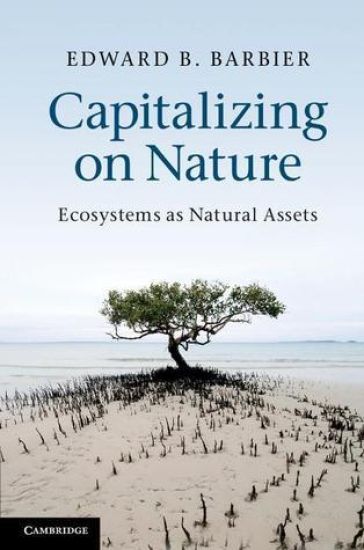
Capitalizing on Nature

Capitalizing on Nature

Edward B. Barbier

Cambridge University Press
2011
sidottu
The basic unit of nature – the ecosystem – is a special form of wealth, which we can think of as a stock of natural capital. However, perhaps because this capital is free, we have tended to view it as limitless, abundant and always available for our use, exploitation and conversion. Capitalizing on Nature shows how modeling ecosystems as natural capital can help us to analyze the economic behavior that has led to the overuse of so much ecological wealth. It explains how this concept of ecosystem as natural capital sheds light on a number of important issues, including landscape conversion, ecological restoration, ecosystem resilience and collapse, spatial benefits and payments for ecosystem services. The book concludes by focusing on major policy challenges that need to be overcome in order to avert the worsening problem of ecological scarcity and how we can fund novel financing mechanisms for global conservation.
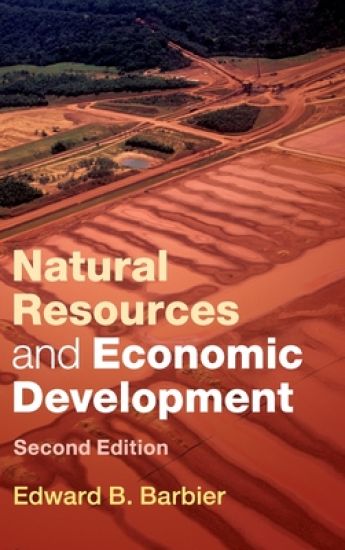
Natural Resources and Economic Development

Natural Resources and Economic Development

Edward B. Barbier

Cambridge University Press
2019
sidottu
Why is natural resource exploitation not yielding greater benefits for the poor economies? In this second edition of his landmark book, Barbier explores this paradox in three parts. Part I gives a historical review of resource use and development, examining current theories that explain the under-performance of today's resource-abundant economies, and proposing a hypothesis of frontier expansion as an alternative explanation. Part II develops models to analyse the key economic factors underlying land expansion and water use in developing countries. Part III explores further the structural pattern of resource dependency, rural poverty and resource degradation within developing countries, and through illustrative country case studies, proposes policy and institutional reforms necessary for successful resource-based development. First published in 2005, each chapter in this new edition has been thoroughly revised and updated, with new material, tables, figures and supporting empirical evidence. It will appeal to graduate students and scholars researching environmental and developmental economics.
Natural Resources and Economic Development

Natural Resources and Economic Development

Edward B. Barbier

Cambridge University Press
2019
pokkari
Why is natural resource exploitation not yielding greater benefits for the poor economies? In this second edition of his landmark book, Barbier explores this paradox in three parts. Part I gives a historical review of resource use and development, examining current theories that explain the under-performance of today's resource-abundant economies, and proposing a hypothesis of frontier expansion as an alternative explanation. Part II develops models to analyse the key economic factors underlying land expansion and water use in developing countries. Part III explores further the structural pattern of resource dependency, rural poverty and resource degradation within developing countries, and through illustrative country case studies, proposes policy and institutional reforms necessary for successful resource-based development. First published in 2005, each chapter in this new edition has been thoroughly revised and updated, with new material, tables, figures and supporting empirical evidence. It will appeal to graduate students and scholars researching environmental and developmental economics.
The Economics of Environment and Development

The Economics of Environment and Development

Edward B. Barbier

Edward Elgar Publishing Ltd
1998
sidottu
The Economics of Environment and Development is a carefully edited selection of Edward Barbier's most influential papers on the role of environmental economics in economic development.This book begins with a brief overview and summary of the papers, placing each in its original context and in relation to the development of Barbier's ideas. The first section deals with the concept of sustainable development, in particular its practical implications for economic policy in developing countries, as well as the long run conditions under which an economy might trade-off environment and growth to achieve its development aims. The second section is concerned mainly with land degradation and tropical deforestation. Using case studies from Africa, Central America and Southeast Asia, the underlying causes of these problems are examined and innovative policies are prescribed to reverse environmental degradation in these areas. The third part of the book is dedicated to the economics of wetlands, wildlands and biodiversity conservation, and discusses the optimal use and management of a region's remaining wild or natural habitat areas. The final section of the book deals with trade and the environment and focuses on the linkages between sustainable resource management and the trade in ivory, timber and forest products, and the role of trade interventions as a means of encouraging a developing country to conserve more of a biological resource.This authoritative volume will be of great interest to academics, policymakers and students of environmental, ecological and development economics.