Kirjojen hintavertailu. Mukana 12 016 292 kirjaa ja 12 kauppaa.

Kirjahaku

Etsi kirjoja tekijän nimen, kirjan nimen tai ISBN:n perusteella.

5 kirjaa tekijältä Edward Baron Turk

Hollywood Diva

Hollywood Diva

Edward Baron Turk

University of California Press
2000
pokkari
Jeanette MacDonald, the movie musical's first superstar, was an American original whose onscreen radiance mirrored a beguiling real-life personality. Based in large part on the author's exclusive access to MacDonald's private papers, including her unpublished memoir, this vivid, often touching biography transports us to a time when lavish musical films were major cultural events and a worldwide public eagerly awaited each new chance to fall under the singer's spell. Edward Baron Turk shows how MacDonald brilliantly earned her Hollywood nickname of 'Iron Butterfly', and why she deserves a privileged position in the history of music and motion pictures. What made MacDonald a woman for our times, readers will discover, was her uncommon courage: onscreen, the actress portrayed strong characters in pursuit of deep emotional fulfillment, often in defiance of social orthodoxy, while offscreen she personified energy, discipline, and practical intellect. Drawing on interviews with individuals who knew her and on MacDonald's own words, Turk brings to life the intricate relations between the star and her legendary costars Maurice Chevalier, Clark Gable, and, above all, baritone Nelson Eddy. He reveals the deep crushes she inspired in movie giants Ernst Lubitsch and Louis B. Mayer and the extraordinary love story she shared with her husband of twenty-seven years, actor Gene Raymond. More than simply another star biography, however, this is a chronicle of American music from 1920s Broadway to 1960s television, in which Turk details MacDonald's fearless efforts to break down distinctions between High Art and mass-consumed entertainment. "Hollywood Diva" will attract fans of opera and concert music as much as enthusiasts of the great Hollywood musicals. It is first-rate cultural and film history.
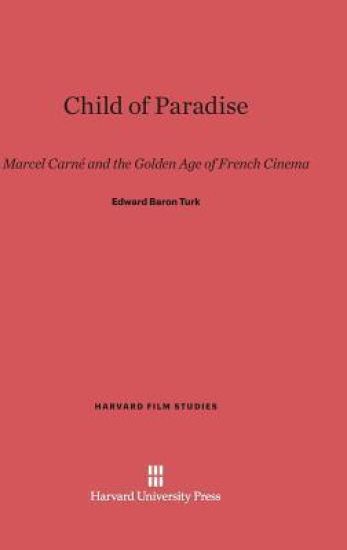
Child of Paradise

Child of Paradise

Edward Baron Turk

Harvard University Press
1989
sidottu
Marcel Carne symbolizes the period, approximately 1930-1945, when French cinema recaptured the creative vitality and prestige it had relinquished almost completely to the American film industry. The first critical biography of this director of classic films, including the epic historical romance "Les Enfants du paradis" (Children of Paradise), relates the saga of Carne s meteoric rise in the 1930s and his decline from critical grace after the war. Between 1937 and 1945 Carne directed a number of works that are now part of France s cultural patrimony, most notably "Le Quai des Brumes" (1938), "LeJour se leve" (1939), "Les Visiteurs du soir" (1942), and the best known, "Les Enfants du paradis" (1945). The artistic merit of these films is widely acknowledged; their significance, however, is not solely aesthetic. To know Carne and his films is to know how cinematic art responded to social and political events to the period of French history that witnessed the Popular Front, the Front s demise, the fall of France, and the Occupation. Edward Baron Turk discloses the incongruities between the director s aesthetic of poetic realism and his professed leftist sympathies; he situates Carne s questionable stance and activities during the Occupation within the broader context of an artist s ethical responsibilities in times of war; and he examines the ramifications of Carne s censure during the postwar purges for the director s subsequent fortunes. Turk s use of the psychoanalytic concepts of androgyny, masochism, fetishism, and primal scene allows us to understand more clearly how Carne thought and worked. Turk also addresses the representations and maskings of homosexuality in Carne s films and the extent to which they have colored film history s often ambivalent assessments of the director. The centerpiece of the book is an extended analysis of what is arguably the most famous and beloved of all French films, "Les Enfants du paradis," scripted by the poet-screenwriter Jacques Prevert. The book draws on unpublished correspondence from, among others, Jean Cocteau, Francois Truffaut, and Simone Signoret, and on interviews by the author with Arletty, Jean-Louis Barrault, Mme. Jacques Prevert, Pierre Prevert, Claude Renoir, Alexander Trauner, Truffaut, and Carne himself. This portrait of Carne thus becomes the portrait of an age, a great age in the history of French cinema, albeit a tragic age in the history of France.
French Theatre Today

French Theatre Today

Edward Baron Turk

University of Iowa Press
2011
nidottu
Provides a seamless mix of critical analysis with lively description, theoretical considerations with reflexive remarks by the theatremakers, and matters of current French and American cultural politics.