
Kirjahaku
Etsi kirjoja tekijän nimen, kirjan nimen tai ISBN:n perusteella.
5 kirjaa tekijältä Edward Craig
Seeking to rediscover the connection between philosophy as studied in universities and those general views of man and reality which are 'philosophy' to the educated layman, Edward Craig here offers a view of philosophy and its history since the early seventeenth century. He presents this period as concerned primarily with just two visions of the essential nature of man. One portrays human beings as made in the image of God, required to resemble him as far as lies in our power; the other sees us as autonomous creators of our own environment and values. The author writes with a broad sweep not encouraged by recent fashion, yet shows (with particular reference to Hume and Hegel) how textual detail which previous commentators have found opaque becomes transparent when viewed against such a background. In the final chapter he treats passages from recent work in the same way. The general conceptions which philosophical thought embodies can equally well be embodied in other media, especially literary. The author illustrates this point with German and English examples and thereby draws together disciplines often felt to be far apart. He also reveals striking similarities between Anglo-American and certain twentieth-century continental European lines of thought.
The standard philosophical project of analysing the concept of knowledge has radical defects in its arbitrary restriction of the subject matter, and its risky theoretical presuppositions. Edward Craig suggests a more illuminating approach, akin to the `state of nature' method found in political theory, which builds up the concept from a hypothesis about the social function of knowledge and the needs it fulfils. Light is thrown on much that philosophers have written about knowledge, about its analysis and the obstacles to its analysis (such as the counter-examples of Edmund Gettier), and on the debate over scepticism. It becomes apparent why many languages not only have such constructions as `knows whether' and `knows that', but also have equivalents of `knows how to' and `know' followed by a direct object. Thus the inquiry is both broadened in scope and made theoretically less fragile.
The standard philosophical project of analysing the concept of knowledge has radical defects in its arbitrary restriction of the subject matter, and its risky theoretical presuppositions. Edward Craig suggests a more illuminating approach, akin to the `state of nature' method found in political theory, which builds up the concept from a hypothesis about the social function of knowledge and the needs it fulfils. Light is thrown on much that philosophers have written about knowledge, about its analysis and the obstacles to its analysis (such as the counter-examples of Edmund Gettier), and on the debate over scepticism. It becomes apparent why many languages not only have such constructions as `knows whether' and `knows that', but also have equivalents of `knows how to' and `know' followed by a direct object. Thus the inquiry is both broadened in scope and made theoretically less fragile.
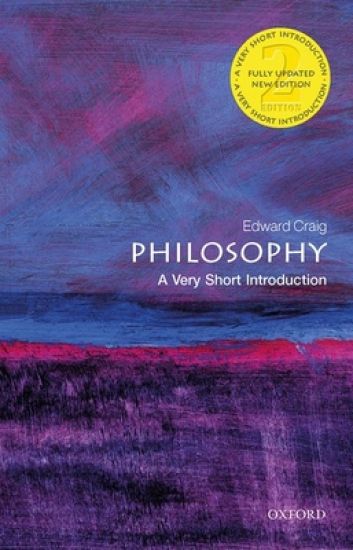
How ought we to live? What really exists? How do we know? This Very Short Introduction discusses some of the key questions philosophy engages with. Edward Craig explores important themes in ethics, and the nature of knowledge and the self, through readings from Plato, Hume, Descartes, Hegel, Darwin, and Buddhist writers. Throughout, he emphasizes why we do phiilosophy, explains how different areas of philosophy are related, and explores the contexts in which philosophy was and is done. This new edition includes a new chapter on free will, discussing determinism and indeterminism in the context of Descartes and Hegel's work. Craig also covers the Problem of Evil, and Kant's argument on the source of moral obligation. ABOUT THE SERIES: The Very Short Introductions series from Oxford University Press contains hundreds of titles in almost every subject area. These pocket-sized books are the perfect way to get ahead in a new subject quickly. Our expert authors combine facts, analysis, perspective, new ideas, and enthusiasm to make interesting and challenging topics highly readable.