Kirjojen hintavertailu. Mukana 12 016 292 kirjaa ja 12 kauppaa.

Kirjahaku

Etsi kirjoja tekijän nimen, kirjan nimen tai ISBN:n perusteella.

15 kirjaa tekijältä Edward Dutton

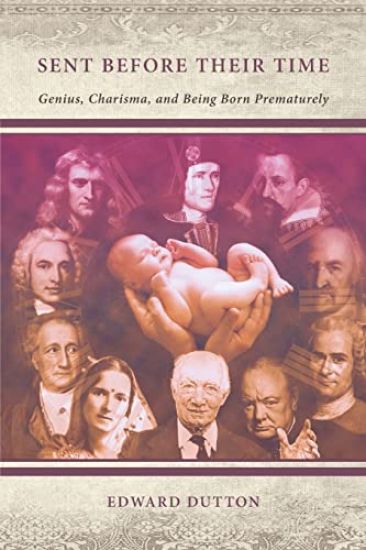
Sent Before Their Time

Sent Before Their Time

Edward Dutton

Manticore Press
2022
pokkari
What do Sir Isaac Newton, Johannes Kepler, and Buddha have in common? They were all born prematurely. Tiny, weak, and brain-damaged, they very nearly didn't survive. But, just about pulling-through, they went on to change the world. And so did Rousseau, Goethe, and Moses, despite being born tiny and many months early. In Sent Before Their Time, Edward Dutton, who was born 3 months early himself, explores the massive and disproportionately high impact that people born prematurely or with low birth weight have had on world history. He shows that the mental characteristics caused by being born prematurely - being a 'preemie' - are precisely those that have always been associated with the heights of genius and of spell-binding charisma. And Dutton, whose analysis includes an eye-opening account of his own preemie childhood, presents an evolutionary theory for preterm birth, arguing that under the harsh Darwinian conditions that existed before the Industrial Revolution, the group with the optimum number of surviving preterm children - and, therefore, geniuses and inspiring people - would have been better able to win wars against other groups and, thus, triumph in the battle of Darwinian selection.

Churchill's Headmaster

Churchill's Headmaster

Edward Dutton

Manticore Press
2019
pokkari
Winston Churchill is Britain's national hero. His prep school headmaster was a sadist who almost ruined Churchill's life. This first ever biography of Churchill's headmaster pulls these myths apart. Churchill emerges as an intelligent and inspiring Narcissist who took Britain into a needless war, bankrupted it, lost its Empire and set off a process culminating in traditional British freedoms being lost and the country being Balkanized.Churchill's headmaster fought for the traditional Britain which Churchill's war was central to destroying. And as this book painstakingly documents, almost everything we think we know about Churchill's prep school headmaster is wrong. Herbert Sneyd-Kynnersley was less sadistic and severe than many headmasters. His arrested development made him no different from a large minority of such men. His beatings did not exceed anything at Eton or at reform schools. Churchill was not taken out of his school because of these beatings. The sources providing the worst accounts of the headmaster are the least reliable. The collapse of the school was not due to rumours of Sneyd-Kynnersley's brutality. Sneyd-Kynnersley was highly educated, contagiously enthusiastic, and intent on preserving a traditionalist Britain and making Churchill into a responsible leader of the Empire built on these traditions. If Churchill hadn't been withdrawn from his school, then Britain would never have gone to war, may never have lost the Empire, and may never have descended into the nihilism and Balkanization we see today. This 'sadistic' headmaster came very close to saving the British Empire and Britain itself.
Meeting Jesus at University

Meeting Jesus at University

Edward Dutton

Ashgate Publishing Limited
2008
sidottu
How does university turn students into who they become? Why are student evangelicals such a significant and controversial force at so many universities? In many countries, university has become the main Rite of Passage between the child and adult worlds. University can be enjoyable and fascinating but also life-changing and traumatic. And at the exact time when a student's identity is the most challenged and uncertain, student evangelical groups are highly organised on many university campuses to offer students a powerful identity so that the world makes sense once again. For some, these groups will protect them from the university's assault on their faith. For others, they will challenge and even change who they are. Meeting Jesus at University explores universities in six countries. Drawing upon detailed fieldwork, it examines the largest student evangelical group at each university in order to understand in depth the relationship between the student evangelical group and the university which it aims to convert. Meeting Jesus at University offers an original contribution to the discussion of Rites of Passage, examining what is experienced at university and how university breaks down and remoulds young people. It explores why student evangelicals are so active, particularly at Britain and America's most prestigious and identity-challenging institutions meaning that students at these places are the most likely to find themselves meeting Jesus at university.
Meeting Jesus at University

Meeting Jesus at University

Edward Dutton

Taylor Francis Ltd
2021
nidottu
How does university turn students into who they become? Why are student evangelicals such a significant and controversial force at so many universities? In many countries, university has become the main Rite of Passage between the child and adult worlds. University can be enjoyable and fascinating but also life-changing and traumatic. And at the exact time when a student's identity is the most challenged and uncertain, student evangelical groups are highly organised on many university campuses to offer students a powerful identity so that the world makes sense once again. For some, these groups will protect them from the university's assault on their faith. For others, they will challenge and even change who they are. Meeting Jesus at University explores universities in six countries. Drawing upon detailed fieldwork, it examines the largest student evangelical group at each university in order to understand in depth the relationship between the student evangelical group and the university which it aims to convert. Meeting Jesus at University offers an original contribution to the discussion of Rites of Passage, examining what is experienced at university and how university breaks down and remoulds young people. It explores why student evangelicals are so active, particularly at Britain and America's most prestigious and identity-challenging institutions meaning that students at these places are the most likely to find themselves meeting Jesus at university.
Islam

Islam

Edward Dutton

Washington Summit Publishers
2021
pokkari
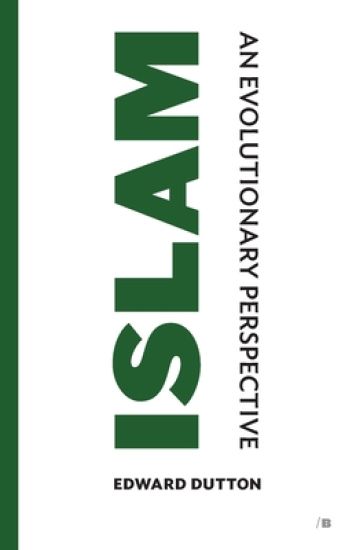
An intellectual gap separates the Islamic world and the West. Muslim children underperform on most all educational measures, and the societies as a whole produce fewer books, scientific advances, and cultural achievements. Evolutionary psychologist Edward Dutton demonstrates that this is not just a matter of genetics, war, or politics. It comes from Islam itself. Holding to Islamic belief forces people to avoid analytical and creative ways of thinking. Veiling, female circumcision, the Ramadan fast, polygamy, and even praying regularly does the same, leading to worse education systems, increased poverty, and less intellectual development.That said, Islam has clear advantages. The Muslim practices that reduce cognitive ability also elevate ethnocentrism-in-group co-operation. And it is the more ethnocentric groups that win in the intense struggle of Darwinian selection. Thus, Dutton predicts that Islam will come to triumph over the West precisely because it reduces intelligence. This raises disturbing questions. Are there terminal disadvantages to developing cultures of high intelligence and individualism? Might the West need t0 adopt something akin to Islam, and become rather less thoughtful, in order to survive? ---Edward Dutton is Professor of Evolutionary Psychology at Asbiro University in L dź, Poland, and is a prolific researcher and commentator. He is the author of Religion and Intelligence (2014), Making Sense of Race (2020), among many other books.---"Edward Dutton is one of the liveliest and most engaging of this new generation of academic dissidents."-John Derbyshire
Witches, Feminism, and the Fall of the West
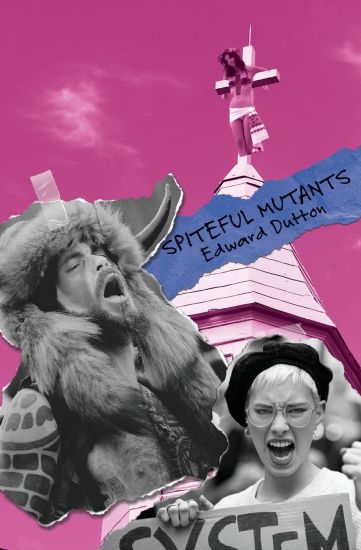
The archetype of the "witch" is burnt deep into the European psyche, recurring again and again in folklore and fairytales. But is she merely the stuff of fantasy? Roald Dahl warned that witches don't always don black hats and ride on broom sticks. They "dress in ordinary clothes, and look very much like ordinary women. . . . That is why they are so hard to catch." In Witches, Feminism and the Fall of the West, Edward Dutton examines the history of witches and witch-hunting in light of evolutionary psychology. Throughout the centuries, witches were ostracized across Europe and often condemned and executed for sorcery and harming children. They generally adhered to a type: witches were low-status, anti-social, and childless, and their very presence was viewed as poisonous to the community. Dutton demonstrates that witches did, in their way, represent a maladaptive mentality and behavior, which undermined Europe's patriarchal system. When times got tough-that is, when Europe got poorer or colder-the witches were persecuted with a vengeance. Today, the evolutionary situation has been turned on its head. The intense selection pressures of the past have been overcome by the Industrial Revolution and its technological marvels. Modern witches survive and thrive in the postmodern West, still possessed by the motivations and dispositions of their sisters of yore. "Sorcery" (nihilism and self-hatred) is no longer taboo but has become a high-status ideology. Roald Dahl was all-too correct. Witches do exist, and they mean to do us harm.
Witches, Feminism, and the Fall of the West
The archetype of the "witch" is burnt deep into the European psyche, recurring again and again in folklore and fairytales. But is she merely the stuff of fantasy? Roald Dahl warned that witches don't always don black hats and ride on broom sticks. They "dress in ordinary clothes, and look very much like ordinary women. . . . That is why they are so hard to catch." In Witches, Feminism and the Fall of the West, Edward Dutton examines the history of witches and witch-hunting in light of evolutionary psychology. Throughout the centuries, witches were ostracized across Europe and often condemned and executed for sorcery and harming children. They generally adhered to a type: witches were low-status, anti-social, and childless, and their very presence was viewed as poisonous to the community. Dutton demonstrates that witches did, in their way, represent a maladaptive mentality and behavior, which undermined Europe's patriarchal system. When times got tough-that is, when Europe got poorer or colder-the witches were persecuted with a vengeance. Today, the evolutionary situation has been turned on its head. The intense selection pressures of the past have been overcome by the Industrial Revolution and its technological marvels. Modern witches survive and thrive in the postmodern West, still possessed by the motivations and dispositions of their sisters of yore. "Sorcery" (nihilism and self-hatred) is no longer taboo but has become a high-status ideology. Roald Dahl was all-too correct. Witches do exist, and they mean to do us harm.
Genius Under House Arrest

Genius Under House Arrest

Edward Dutton

ACADEMICA PRESS
2025
sidottu
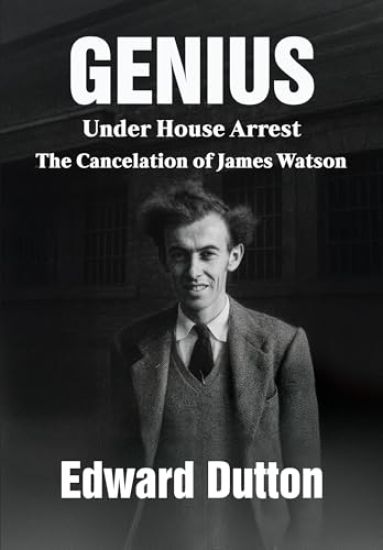
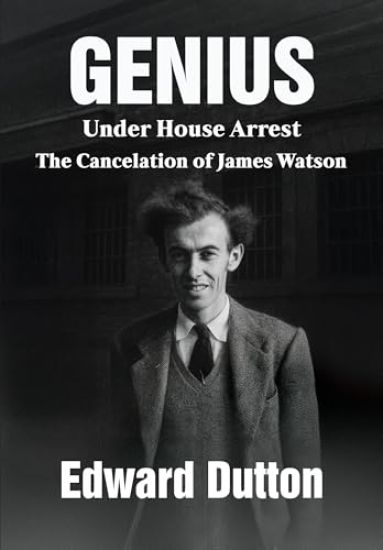
In 2007, the Watson Affair – the worldwide character assassination and exclusion from public life of Dr. James Watson, the brilliant, Nobel Prize-winning scientist co-credited with the discovery of DNA – shocked the global public in an early episode of what would come to be called "cancel culture." Watson was as an early and very public victim of incipient wokeism: a warning to others who might be tempted to dissent from favored ideologies of expression and behavior. With the Watson Affair, Western society had changed to the point of inversion; from being broadly supportive of genius, and providing protected niches for those of great accomplishment, to exactly the opposite – a censorious surveillance culture where even minor missteps could result in personal and professional ruin. Genius Under House Arrest explores how this dramatic shift occurred and argues that not only was every "controversial" remark of Watson's empirically accurate, but that geniuses – with Watson as the example – are a package deal: extreme creative ability as a consequence of sometimes difficult personalities, with effects ranging across social, ideological, and professional life. As society has begun to realize, nothing less than the West's culture of merit and achievement is at stake.
The Genius Famine

The Genius Famine

Edward Dutton

The University of Buckingham Press
2016
nidottu
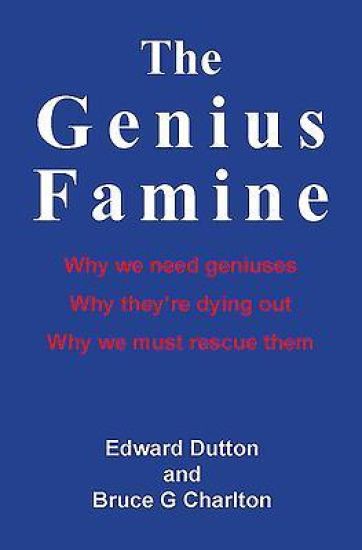
Geniuses are rare and exceptional people. The majority of the great ideas, discoveries and inventions of human history, which have allowed the development of civilization itself, were the products of geniuses.A genius combines extremely high intelligence with a unworldly, intuitive personality. Geniuses will seldom fit-into normal society, they will seldom want to. And we shouldn't want them to, because it is their unusual and socially-difficult nature which drives geniuses to come up with original ideas, and solutions to otherwise unsolvable problems. But modern society has been hit by a genius famine. There are ever-fewer geniuses and, to make matters worse, modern society has become actively hostile to those few geniuses we still have.The Genius Famine explores the nature of genius, why the genius famine has happened, how the famine will lead to the decline of civilization, and what we can and should do to overcome it.
Genius Under House Arrest

Genius Under House Arrest

Edward Dutton

ACADEMICA PRESS
2025
nidottu
In 2007, the Watson Affair – the worldwide character assassination and exclusion from public life of Dr. James Watson, the brilliant, Nobel Prize-winning scientist co-credited with the discovery of DNA – shocked the global public in an early episode of what would come to be called “cancel culture.” Watson was as an early and very public victim of incipient wokeism: a warning to others who might be tempted to dissent from favored ideologies of expression and behavior. With the Watson Affair, Western society had changed to the point of inversion; from being broadly supportive of genius, and providing protected niches for those of great accomplishment, to exactly the opposite – a censorious surveillance culture where even minor missteps could result in personal and professional ruin. Genius Under House Arrest explores how this dramatic shift occurred and argues that not only was every “controversial” remark of Watson’s empirically accurate, but that geniuses – with Watson as the example – are a package deal: extreme creative ability as a consequence of sometimes difficult personalities, with effects ranging across social, ideological, and professional life. As society has begun to realize, nothing less than the West’s culture of merit and achievement is at stake.