Kirjojen hintavertailu. Mukana 11 342 296 kirjaa ja 12 kauppaa.

Kirjahaku

Etsi kirjoja tekijän nimen, kirjan nimen tai ISBN:n perusteella.

8 kirjaa tekijältä Edward G. Gray

Colonial America

Colonial America

Edward G. Gray

Oxford University Press Inc
2013
nidottu
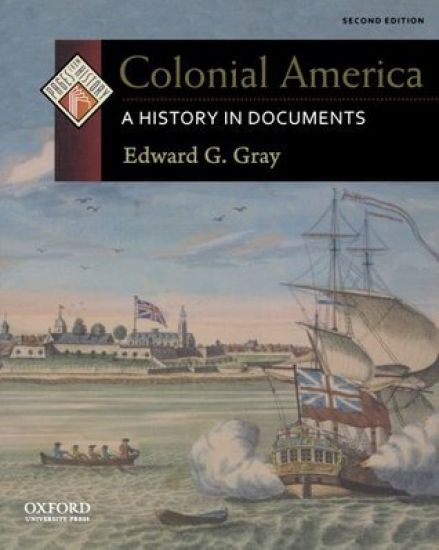
By examining the lives of the colonists through their own words--in diaries, letters, sermons, newspaper columns, and poems--Colonial America: A History in Documents, Second Edition, reveals how immigrants, despite their vast differences, laid the foundations for a new nation: the United States. One of the earliest documents is Sir Walter Raleigh's account of the failed colony at Roanoke, the first British settlement. The harrowing experiences of the first colonists are recorded in Captain John Smith's tale of an Indian attack. A Catawba Indian's letter to the governor of South Carolina describing a devastating smallpox epidemic is evidence of the even greater toll that war and illness had on the Native Americans. An exchange of letters between friends about choosing a husband provides insight into colonial family life. The title page of a book about evil spirits and a Mohawk Indian's telling of the creation myth demonstrate the diversity of colonial religious beliefs. A picture essay about the material world gathers objects ranging from military artifacts to fine furnishings to reveal how the colonies evolved from rough outposts to nearly independent states. Using such historical evidence, Colonial America provides a captivating look at the textured lives of the people who founded the United States. The second edition includes a new chapter, "The Tumult of Empire," on the imperial tensions that erupted during this period and the internal strife within the colonies, as demonstrated in the violence by Bacon's Rebellion, Governor Andros's harsh rule over the Dominion of New England, and the overturning of provincial regimes in response to William and Mary's Glorious Revolution. Twenty-eight new visual documents enrich this edition, including a map of Native American villages, a proclamation on the destruction of forests, and hippopotamus hide whips used on slaves. Additional updates include ten new sidebars, a new note on sources and interpretation, and revised further reading and website recommendations.
The  Making of John Ledyard

The Making of John Ledyard

Edward G. Gray

Yale University Press
2007
sidottu
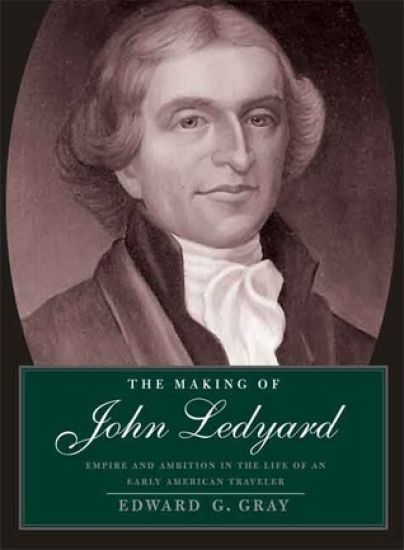
During the course of his short but extraordinary life, John Ledyard (1751–1789) came in contact with some of the most remarkable figures of his era: the British explorer Captain James Cook, American financier Robert Morris, Revolutionary naval commander John Paul Jones, Benjamin Franklin, Thomas Jefferson, and others. Ledyard lived and traveled in remarkable places as well, journeying from the New England backcountry to Tahiti, Hawaii, the American Northwest coast, Alaska, and the Russian Far East. In this engaging biography, the historian Edward Gray offers not only a full account of Ledyard’s eventful life but also an illuminating view of the late eighteenth-century world in which he lived.Ledyard was both a product of empire and an agent in its creation, Gray shows, and through this adventurer’s life it is possible to discern the many ways empire shaped the lives of nations, peoples, and individuals in the era of the American Revolution, the world’s first modern revolt against empire.
Tom Paine's Iron Bridge

Tom Paine's Iron Bridge

Edward G. Gray

WW Norton Co
2016
sidottu
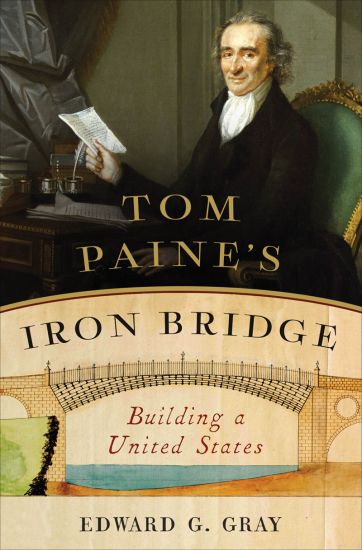
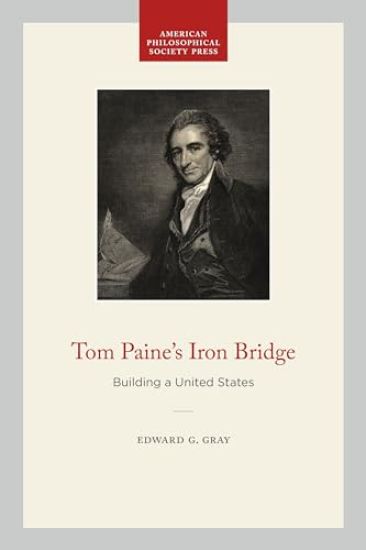
In a letter to his wife Abigail, John Adams judged the author of Common Sense as having “a better hand at pulling down than building.” Adams’s dismissive remark has helped shape the prevailing view of Tom Paine ever since. But, as Edward G. Gray shows in this fresh, illuminating work, Paine was a builder. He had a clear vision of success for his adopted country. It was embodied in an architectural project that he spent a decade planning: an iron bridge to span the Schuylkill River at Philadelphia. When Paine arrived in Philadelphia from England in 1774, the city was thriving as America’s largest port. But the seasonal dangers of the rivers dividing the region were becoming an obstacle to the city’s continued growth. Philadelphia needed a practical connection between the rich grain of Pennsylvania’s backcountry farms and its port on the Delaware. The iron bridge was Paine’s solution. The bridge was part of Paine’s answer to the central political challenge of the new nation: how to sustain a republic as large and as geographically fragmented as the United States. The iron construction was Paine’s brilliant response to the age-old challenge of bridge technology: how to build a structure strong enough to withstand the constant battering of water, ice, and wind. The convergence of political and technological design in Paine’s plan was Enlightenment genius. And Paine drew other giants of the period as patrons: Benjamin Franklin, George Washington, Thomas Jefferson, and for a time his great ideological opponent, Edmund Burke. Paine’s dream ultimately was a casualty of the vicious political crosscurrents of revolution and the American penchant for bridges of cheap, plentiful wood. But his innovative iron design became the model for bridge construction in Britain as it led the world into the industrial revolution.
Mason-Dixon

Mason-Dixon

Edward G. Gray

HARVARD UNIVERSITY PRESS
2025
nidottu
“Deeply researched and highly readable.” —Eric Foner, Times Literary Supplement“A rich history of regional distinctions, especially as they shaped the antebellum Republic.” —Kirkus Reviews“A fitting testament to a career marked by boundary-crossing curiosity and stalwart service to the historical profession…[a] splendid new history.” —Richard Bell, Register of the Kentucky Historical Society“Fascinating…does justice to the full sweep and complexity of American history by expertly tracing a century of change across one especially revealing patch of ground.” —James H. Read, American Political Thought“Erudite, gripping, and highly significant. Gray puts his talents as a historian of the American Revolution and the early republic to excellent use, persuasively arguing that the Mason-Dixon Line is worth seeing as a geopolitical border.” —Kathleen DuVal, author of Independence LostAcclaimed scholar Edward Gray offers the first comprehensive history of the Mason-Dixon Line, a border at the center of early American political contestation. Formalized in 1767 to fully and finally demarcate Pennsylvania, Maryland, and Delaware, the Line resolved a longstanding jurisdictional conflict that had provoked bloodshed among colonists and ensnared Lenape and Susquehannock populations. In 1780, Pennsylvania’s Act for the Gradual Abolition of Slavery inaugurated a new phase, as the Line became a boundary between free and slave states and their distinct legal regimes. Then, with the passage of the Fugitive Slave Act in 1850, the Line became a federal instrument to arrest freedom-seeking Blacks. Only with the end of the Civil War did the Line’s significance fade, though it haunted the geography of Jim Crow.Mason-Dixon tells the gripping story of colonial grandees, Native American diplomats, Quaker abolitionists, fugitives from slavery, capitalist railroad and canal builders, US presidents, Supreme Court justices, and Underground Railroad conductors—all contending with the relentless violence and political discord of a borderland that transformed American history.
Mason-Dixon

Mason-Dixon

Edward G. Gray

HARVARD UNIVERSITY PRESS
2023
sidottu
“A magisterial yet highly nuanced account that ventures back and forth across Mason and Dixon’s fabled demarcation line as audaciously as 18th-century raiding parties once did.”—Harold Holzer, Wall Street JournalThe first comprehensive history of the Mason-Dixon Line—a dramatic story of imperial rivalry and settler-colonial violence, the bonds of slavery and the fight for freedom.The United States is the product of border dynamics—not just at international frontiers but at the boundary that runs through its first heartland. The story of the Mason-Dixon Line is the story of America’s colonial beginnings, nation building, and conflict over slavery.Acclaimed historian Edward Gray offers the first comprehensive narrative of the America’s defining border. Formalized in 1767, the Mason-Dixon Line resolved a generations-old dispute that began with the establishment of Pennsylvania in 1681. Rivalry with the Calverts of Maryland—complicated by struggles with Dutch settlers in Delaware, breakneck agricultural development, and the resistance of Lenape and Susquehannock natives—had led to contentious jurisdictional ambiguity, full-scale battles among the colonists, and ethnic slaughter. In 1780, Pennsylvania’s Act for the Gradual Abolition of Slavery inaugurated the next phase in the Line’s history. Proslavery and antislavery sentiments had long coexisted in the Maryland–Pennsylvania borderlands, but now African Americans—enslaved and free—faced a boundary between distinct legal regimes. With the passage of the Fugitive Slave Act in 1850, the Mason-Dixon Line became a federal instrument to arrest the northward flow of freedom-seeking Blacks. Only with the end of the Civil War did the Line’s significance fade, though it continued to haunt African Americans as Jim Crow took hold.Mason-Dixon tells the gripping story of colonial grandees, Native American diplomats, Quaker abolitionists, fugitives from slavery, capitalist railroad and canal builders, US presidents, Supreme Court justices, and Underground Railroad conductors—all contending with the relentless violence and political discord of a borderland that was a transformative force in American history.
New World Babel

New World Babel

Edward G. Gray

Princeton University Press
2014
pokkari
New World Babel is an innovative cultural and intellectual history of the languages spoken by the native peoples of North America from the earliest era of European conquest through the beginning of the nineteenth century. By focusing on different aspects of the Euro-American response to indigenous speech, Edward Gray illuminates the ways in which Europeans' changing understanding of "language" shaped their relations with Native Americans. The work also brings to light something no other historian has treated in any sustained fashion: early America was a place of enormous linguistic diversity, with acute social and cultural problems associated with multilingualism. Beginning with the sixteenth and seventeenth centuries, and using rarely seen first-hand accounts of colonial missionaries and administrators, the author shows that European explorers and colonists generally regarded American-Indian languages, like all languages, as a divine endowment that bore only a superficial relationship to the distinct cultures of speakers. By relating these accounts to thinkers like Locke, Adam Smith, Jefferson, and others who sought to incorporate their findings into a broader picture of human development, he demonstrates how, during the eighteenth century, this perception gave way to the notion that language was a human innovation, and, as such, reflected the apparent social and intellectual differences of the world's peoples. The book is divided into six chronological chapters, each focusing on different aspects of the Euro-American response to indigenous languages. New World Babel will fascinate historians, anthropologists, and linguists--anyone interested in the history of literacy, print culture, and early ethnological thought. Originally published in 1999. The Princeton Legacy Library uses the latest print-on-demand technology to again make available previously out-of-print books from the distinguished backlist of Princeton University Press. These editions preserve the original texts of these important books while presenting them in durable paperback and hardcover editions. The goal of the Princeton Legacy Library is to vastly increase access to the rich scholarly heritage found in the thousands of books published by Princeton University Press since its founding in 1905.
New World Babel

New World Babel

Edward G. Gray

Princeton University Press
2016
sidottu
New World Babel is an innovative cultural and intellectual history of the languages spoken by the native peoples of North America from the earliest era of European conquest through the beginning of the nineteenth century. By focusing on different aspects of the Euro-American response to indigenous speech, Edward Gray illuminates the ways in which Europeans' changing understanding of "language" shaped their relations with Native Americans. The work also brings to light something no other historian has treated in any sustained fashion: early America was a place of enormous linguistic diversity, with acute social and cultural problems associated with multilingualism. Beginning with the sixteenth and seventeenth centuries, and using rarely seen first-hand accounts of colonial missionaries and administrators, the author shows that European explorers and colonists generally regarded American-Indian languages, like all languages, as a divine endowment that bore only a superficial relationship to the distinct cultures of speakers. By relating these accounts to thinkers like Locke, Adam Smith, Jefferson, and others who sought to incorporate their findings into a broader picture of human development, he demonstrates how, during the eighteenth century, this perception gave way to the notion that language was a human innovation, and, as such, reflected the apparent social and intellectual differences of the world's peoples. The book is divided into six chronological chapters, each focusing on different aspects of the Euro-American response to indigenous languages. New World Babel will fascinate historians, anthropologists, and linguists--anyone interested in the history of literacy, print culture, and early ethnological thought. Originally published in 1999. The Princeton Legacy Library uses the latest print-on-demand technology to again make available previously out-of-print books from the distinguished backlist of Princeton University Press. These editions preserve the original texts of these important books while presenting them in durable paperback and hardcover editions. The goal of the Princeton Legacy Library is to vastly increase access to the rich scholarly heritage found in the thousands of books published by Princeton University Press since its founding in 1905.