

Kirjahaku
Etsi kirjoja tekijän nimen, kirjan nimen tai ISBN:n perusteella.
42 kirjaa tekijältä Edward King

Remarks Concerning Stones Said to Have Fallen from the Clouds, Both in These Days, and in Antient Times. by Edward King, ...
Edward King
Gale Ecco, Print Editions
2010
pokkari
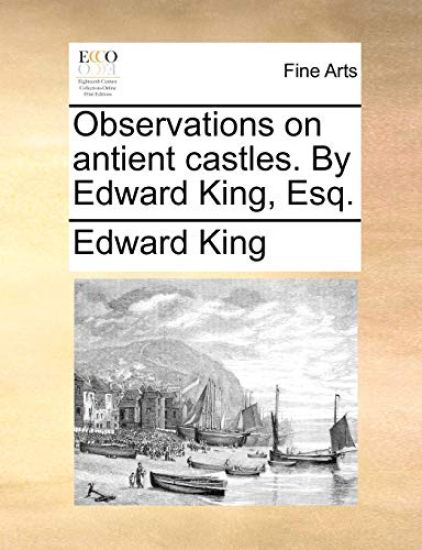
Observations on Antient Castles. by Edward King, Esq.
Edward King
Gale Ecco, Print Editions
2010
pokkari

Vestiges of Oxford Castle. Or a Small Fragment of a Work, Intended to be Published Speedily; on the History of Antient Castles; and on the Progress of Architecture. By Edward King,
Edward King
Gale Ecco, Print Editions
2018
sidottu
The 18th century was a wealth of knowledge, exploration and rapidly growing technology and expanding record-keeping made possible by advances in the printing press. In its determination to preserve the century of revolution, Gale initiated a revolution of its own: digitization of epic proportions to preserve these invaluable works in the largest archive of its kind. Now for the first time these high-quality digital copies of original 18th century manuscripts are available in print, making them highly accessible to libraries, undergraduate students, and independent scholars.Rich in titles on English life and social history, this collection spans the world as it was known to eighteenth-century historians and explorers. Titles include a wealth of travel accounts and diaries, histories of nations from throughout the world, and maps and charts of a world that was still being discovered. Students of the War of American Independence will find fascinating accounts from the British side of conflict. ++++The below data was compiled from various identification fields in the bibliographic record of this title. This data is provided as an additional tool in helping to insure edition identification: ++++British LibraryT135688With a half-title and final leaf directions to the binder. Published as part of 'Munimenta antiqua'; the plates are numbered CXXVI-CXXX.London: printed by W. Bulmer and Co. for George Nicol, 1796. 4], iv,30, 2]p., plates; 2
Remarks Concerning Stones Said to Have Fallen From the Clouds, Both in These Days, and in Antient Times. By Edward King,
Edward King
Gale Ecco, Print Editions
2018
sidottu
The 18th century was a wealth of knowledge, exploration and rapidly growing technology and expanding record-keeping made possible by advances in the printing press. In its determination to preserve the century of revolution, Gale initiated a revolution of its own: digitization of epic proportions to preserve these invaluable works in the largest archive of its kind. Now for the first time these high-quality digital copies of original 18th century manuscripts are available in print, making them highly accessible to libraries, undergraduate students, and independent scholars.Medical theory and practice of the 1700s developed rapidly, as is evidenced by the extensive collection, which includes descriptions of diseases, their conditions, and treatments. Books on science and technology, agriculture, military technology, natural philosophy, even cookbooks, are all contained here.++++The below data was compiled from various identification fields in the bibliographic record of this title. This data is provided as an additional tool in helping to insure edition identification: ++++British LibraryT054313With a final advertisement leaf.London: printed for G. Nicol, 1796. 34, 2]p., plate; 4
Observations on Antient Castles. By Edward King, Esq
Edward King
Gale Ecco, Print Editions
2018
sidottu
The 18th century was a wealth of knowledge, exploration and rapidly growing technology and expanding record-keeping made possible by advances in the printing press. In its determination to preserve the century of revolution, Gale initiated a revolution of its own: digitization of epic proportions to preserve these invaluable works in the largest archive of its kind. Now for the first time these high-quality digital copies of original 18th century manuscripts are available in print, making them highly accessible to libraries, undergraduate students, and independent scholars.The eighteenth-century fascination with Greek and Roman antiquity followed the systematic excavation of the ruins at Pompeii and Herculaneum in southern Italy; and after 1750 a neoclassical style dominated all artistic fields. The titles here trace developments in mostly English-language works on painting, sculpture, architecture, music, theater, and other disciplines. Instructional works on musical instruments, catalogs of art objects, comic operas, and more are also included. ++++The below data was compiled from various identification fields in the bibliographic record of this title. This data is provided as an additional tool in helping to insure edition identification: ++++Huntington LibraryN041594London: printed by W. Bowyer and J. Nichols, 1777. 53, 1]p., plates; 4

Remarks Concerning Stones Said to Have Fallen From the Clouds, Both in These Days, and in Antient Times
Edward King
Anson Street Press
2025
pokkari


Old Times Revisited In The Borough And Parish Of Lymington, Hants (1879)
Edward King
KESSINGER PUBLISHING, LLC
2009
pokkari

Munimenta Antiqua; Or, Observations on Antient Castles. Including Remarks on the Whole Progress of Architecture, Ecclesiastical, as Well as Military, in Great Britain
Edward King
Gale Ecco, Print Editions
2010
pokkari

Remarks Concerning Stones Said To Have Fallen From The Clouds, Both In These Days And In Antient Times
Edward King
KESSINGER PUBLISHING, LLC
2010
sidottu
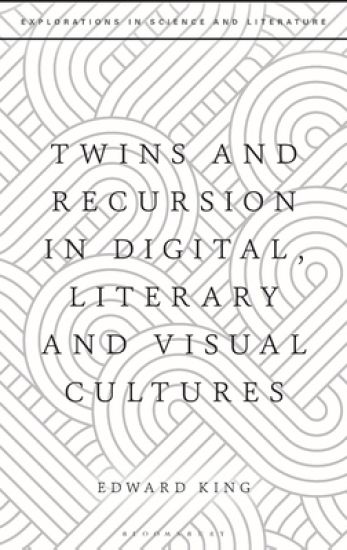
Twins and Recursion in Digital, Literary and Visual Cultures
Edward King
BLOOMSBURY PUBLISHING PLC
2022
sidottu
The tale of twins being reunited after a long separation is a trope that has been endlessly repeated and reworked across different cultures and throughout history, with each moment adapting the twin plot to address its current cultural tensions. In this study, Edward King demonstrates how twins are a means of exploring the social implications of hyper-connectivity and the compromising relationship between humans and digital information, their environment and their genetics. As King demonstrates, twins tell us about the changing forms of connectivity and power in contemporary culture and what new conceptions of the human they present us with. Taking account of a broad range of literary, cultural and scientific practices, Entwined Being probes discussions surrounding twins such as: - The way in which they appear in behavioral genetics as a way of identifying inherited predispositions to social media- How their faces interrupt biometric interfaces such as facial recognition software and undermine advances in neo-liberal surveillance systems- How they represent the uncanny and the weird in the horror genre and how this questions ideologies of communications media and the connectivity it enables- Their association with telepathy and cybernetics in science fiction- Their construction as models for entangled being in ecological thoughtDrawing upon the literary and filmic works of Ken Follet, Edgar Allan Poe, H. P. Lovecraft, Bruce Chatwin, Shelley Jackson, Brian de Palma, Peter Greenway and David Cronenberg, as well as science fiction literature and the television series Orphan Black, King illuminates how twins are employed across a range of disciplines to envision a critical re-conception of the human in times of digital integration and ecological crisis.
Twins and Recursion in Digital, Literary and Visual Cultures
Edward King
BLOOMSBURY PUBLISHING PLC
2023
nidottu
The tale of twins being reunited after a long separation is a trope that has been endlessly repeated and reworked across different cultures and throughout history, with each moment adapting the twin plot to address its current cultural tensions. In this study, Edward King demonstrates how twins are a means of exploring the social implications of hyper-connectivity and the compromising relationship between humans and digital information, their environment and their genetics. As King demonstrates, twins tell us about the changing forms of connectivity and power in contemporary culture and what new conceptions of the human they present us with. Taking account of a broad range of literary, cultural and scientific practices, Entwined Being probes discussions surrounding twins such as: - The way in which they appear in behavioral genetics as a way of identifying inherited predispositions to social media- How their faces interrupt biometric interfaces such as facial recognition software and undermine advances in neo-liberal surveillance systems- How they represent the uncanny and the weird in the horror genre and how this questions ideologies of communications media and the connectivity it enables- Their association with telepathy and cybernetics in science fiction- Their construction as models for entangled being in ecological thoughtDrawing upon the literary and filmic works of Ken Follet, Edgar Allan Poe, H. P. Lovecraft, Bruce Chatwin, Shelley Jackson, Brian de Palma, Peter Greenway and David Cronenberg, as well as science fiction literature and the television series Orphan Black, King illuminates how twins are employed across a range of disciplines to envision a critical re-conception of the human in times of digital integration and ecological crisis.