Kirjojen hintavertailu. Mukana 12 363 183 kirjaa ja 12 kauppaa.

Kirjahaku

Etsi kirjoja tekijän nimen, kirjan nimen tai ISBN:n perusteella.

6 kirjaa tekijältä Edward L. Glaeser

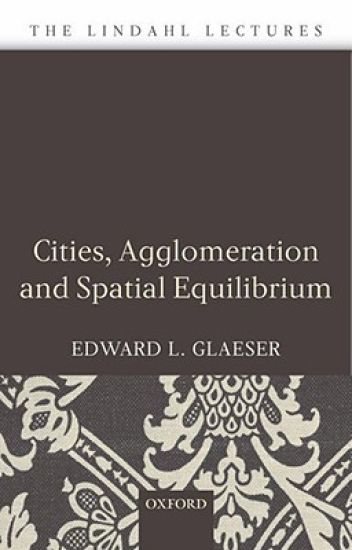
Cities, Agglomeration, and Spatial Equilibrium

Cities, Agglomeration, and Spatial Equilibrium

Edward L. Glaeser

Oxford University Press
2008
sidottu
220 million Americans crowd together in the 3% of the country that is urban. 35 million people live in the vast metropolis of Tokyo, the most productive urban area in the world. The central city of Mumbai alone has 12 million people, and Shanghai almost as many. We choose to live cheek by jowl, in a planet with vast amounts of space. Yet despite all of the land available to us, we choose to live in proximity to cities. Using economics to understand this phenomenon, the urban economist uses the tools of economic theory and empirical data to explain why cities exist and to analyze urban issues such as housing, education, crime, poverty and social interaction. Drawing on the success of his Lindahl lectures, Edward Glaeser provides a rigorous account of his research and unique thinking on cities. Using a series of simple models and economic theory, Glaeser illustrates the primary features of urban economics including the concepts of spatial equilibrium and agglomeration economies. Written for a mathematically inclined audience with an interest in urban economics and cities, the book is written to be accessible to theorists and non-theorists alike and should provide a basis for further empirical work.
Agglomeration Economics

Agglomeration Economics

Edward L. Glaeser

University of Chicago Press
2010
sidottu
When firms and people are located near each other in cities and in industrial clusters, they benefit in various ways, including by reducing the costs of exchanging goods and ideas. One might assume that these benefits would become less important as transportation and communication costs fall. Paradoxically, however, cities have become increasingly important and even within cities, industrial clusters remain vital. "Agglomeration Economics" brings together a group of essays that examine the reasons why economic activity continues to cluster together despite the falling costs of moving goods and transmitting information. The studies cover a wide range of topics and approach the economics of agglomeration from different angles. Together they advance our understanding of agglomeration and its implications for a globalized world.
Housing Markets and the Economy – Risk, Regulation, and Policy

Housing Markets and the Economy – Risk, Regulation, and Policy

Edward L. Glaeser; John M. Quigley

Lincoln Institute of Land Policy
2009
nidottu
The timing of this volume could not be more opportune. Based on the work of Karl "Chip" Case, who is renowned for his scientific contributions to the economics of housing and public policy, chapters analyze risk in the housing market, the regulation of housing markets by government, and other issues in U.S. housing policy. The book investigates derivative markets; the role that home equity insurance can play in reducing risk; the role that the regulation of government-sponsored enterprises has played in extending credit to home purchasers in low-income neighborhoods; and the growth in the market for subprime mortgages. The impact of local zoning regulations on housing prices and new construction is also considered. This is a must read during a time of restructuring our nation's system of housing finance.
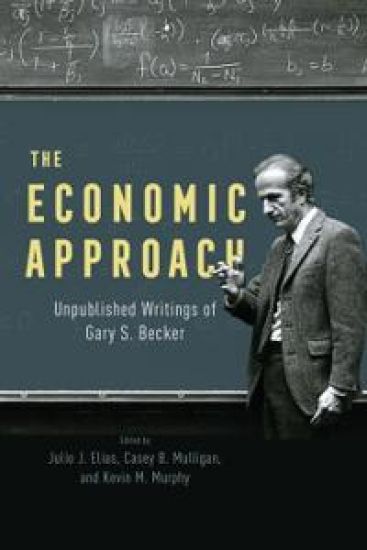
The Economic Approach

The Economic Approach

Gary S. Becker; Edward L. Glaeser

THE UNIVERSITY OF CHICAGO PRESS
2023
sidottu
A revealing collection from the intellectual titan whose work shaped the modern world. As an economist and public intellectual, Gary S. Becker was a giant. The recipient of a Nobel Prize, a John Bates Clark Medal, and a Presidential Medal of Freedom, Becker is widely regarded as the greatest microeconomist in history. After forty years at the University of Chicago, Becker left a slew of unpublished writings that used an economic approach to human behavior, analyzing such topics as preference formation, rational indoctrination, income inequality, drugs and addiction, and the economics of family. These papers unveil the process and personality—direct, critical, curious—that made him a beloved figure in his field and beyond. The Economic Approach examines these extant works as a capstone to the Becker oeuvre—not because the works are perfect, but because they offer an illuminating, instructive glimpse into the machinations of an economist who wasn’t motivated by publications. Here, and throughout his works, an inquisitive spirit remains remarkable and forever resonant.
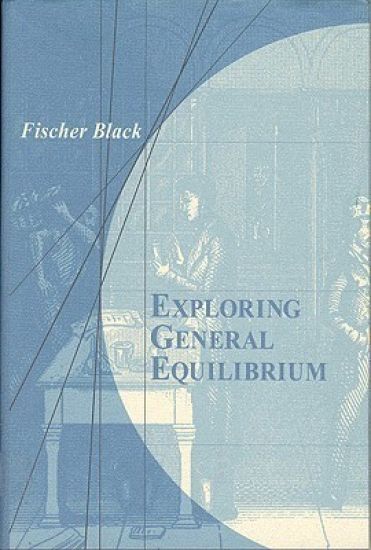
Exploring General Equilibrium

Exploring General Equilibrium

Fischer S. Black; Edward L. Glaeser

MIT Press
2010
pokkari
An incisive, unconventional assessment of general equilibrium theory; with a previously unpublished paper.Fischer Black is known for his brilliance as well as his sometimes controversial opinions. Highly respected for his scholarly writings in finance, he now moves into different territory with this incisive, unconventional assessment of general equilibrium theory and what that theory reveals about business cycles, growth, and labor economics. The general equilibrium approach, Black asserts, can be used to explain most of the economy's behavior. It can explain business cycles and growth without using sticky prices, irrationality, economies of scale, or imperfect competition. It can explain the volatility of consumption, output, sales, investment, and inventories with axiomatic utility and constant-returns-to-scale production. It can explain temporary layoffs, job changes with and without intervening unemployment, and the behavior of vacancies. It can explain lower wages in part-time jobs, wages that increase rapidly with time on the job, and the forces that cause migration from poor to rich countries. Although the general equilibrium approach can't be tested in conventional ways, it can be used to generate examples that explain stylized facts-generalized observations from the real world-that have preoccupied macroeconomists for the last decade. Black contrasts his interpretation of these facts with conventional interpretations. Finally, he reviews a substantial body of literature on these topics.
Strategic Analytics: The Insights You Need from Harvard Business Review

Strategic Analytics: The Insights You Need from Harvard Business Review

Harvard Business Review; Eric Siegel; Edward L. Glaeser; Cassie Kozyrkov; Thomas H. Davenport

Harvard Business Review Press
2020
pokkari
Is your company ready for the next wave of analytics?Data analytics offer the opportunity to predict the future, use advanced technologies, and gain valuable insights about your business. But unless you're staying on top of the latest developments, your company is wasting that potential--and your competitors will be gaining speed while you fall behind.Strategic Analytics: The Insights You Need from Harvard Business Review will provide you with today's essential thinking about what data analytics are capable of, what critical talents your company needs to reap their benefits, and how to adopt analytics throughout your organization--before it's too late.Business is changing. Will you adapt or be left behind?Get up to speed and deepen your understanding of the topics that are shaping your company's future with the Insights You Need from Harvard Business Review series. Featuring HBR's smartest thinking on fast-moving issues--blockchain, cybersecurity, AI, and more--each book provides the foundational introduction and practical case studies your organization needs to compete today and collects the best research, interviews, and analysis to get it ready for tomorrow. You can't afford to ignore how these issues will transform the landscape of business and society. The Insights You Need series will help you grasp these critical ideas--and prepare you and your company for the future.