Kirjojen hintavertailu. Mukana 11 699 587 kirjaa ja 12 kauppaa.

Kirjahaku

Etsi kirjoja tekijän nimen, kirjan nimen tai ISBN:n perusteella.

2 kirjaa tekijältä Edward M. Hundert

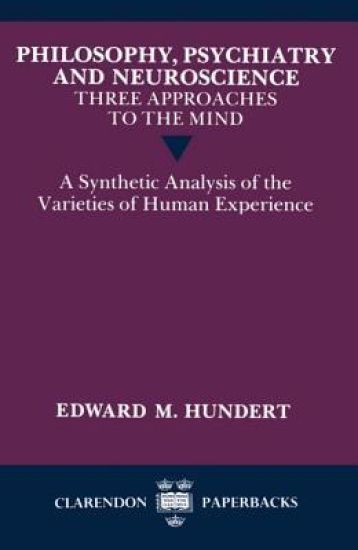
Philosophy, Psychiatry and Neuroscience - Three Approaches to the Mind
This book proposes a new, unified view of the mind which integrates the insights of philosophers, psychologists, and neuroscientists. Through a detailed discussion of major theories from all these, and related disciplines, the author gradually reveals fundamental links between these previously unconnected approaches to human thought and experience. The author has studied medicine, philosophy, mathematics and history, and is currently a practising psychiatrist and a teacher at the Harvard Medical School. He discusses diverse fields of thought with depth and clarity, and his unique perspective should stimulate a re-evaluation of our traditional approaches to the mind.
Lessons from an Optical Illusion

Lessons from an Optical Illusion

Edward M. Hundert

Harvard University Press
1997
nidottu
Facts are facts, we often say with certainty; but values--well, they're relative. But every day we are confronted with situations where these simple distinctions begin to blur--whether our concerns are the roots of crime and violence, the measure of intelligence, the causes of disease, the threat and promise of genetic engineering. Where do our "facts" end and our "values" begin?Recent developments in neuroscience have begun to shed light on this confusion, by radically revising our notions of where human nature ends and human nurture begins. As Edward Hundert--a philosopher, psychiatrist, and award-winning educator--makes clear in this eloquent interdisciplinary work, the newly emerging model for the interactions of brain and environment has enormous implications for our understanding of who we are, how we know, and what we value.Lessons from an Optical Illusion is a bold modern recasting of the age-old nature-nurture debate, informed by revolutionary insights from brain science, artificial intelligence, psychiatry, linguistics, evolutionary biology, child development, ethics, and even cosmology. As this radical new synthesis unfolds, we are introduced to characters ranging from Immanuel Kant to Gerald Edelman, from Charles Darwin to Sigmund Freud, from Jean Piaget to Stephen Hawking, from Socrates to Jonas Salk. Traversing the nature-nurture terrain, we encounter simulated robots, optical illusions, game theory, the anthropic principle, the prisoner's dilemma, and the language instinct. In the course of Hundert's wide-ranging exploration, the comfortable dichotomies that once made sense (objectivity-subjectivity, heredity-environment, fact-value) break down under sharp analysis, as he reveals the startling degree to which facts are our creations and values are woven into the fabric of the world. Armed with an updated understanding of how we became who we are and how we know what we know, readers are challenged to confront anew the eternal question of what it means to live a moral life.