Kirjojen hintavertailu. Mukana 11 499 064 kirjaa ja 12 kauppaa.

Kirjahaku

Etsi kirjoja tekijän nimen, kirjan nimen tai ISBN:n perusteella.

4 kirjaa tekijältä Edward Mack

Acquired Alterity

Acquired Alterity

Edward Mack

University of California Press
2022
pokkari
A free open access ebook is available upon publication. Learn more at www.luminosoa.org. This is the first book-length study in English of the Japanese-language literary activities of early Japanese migrants to Brazil. It provides a detailed history of Japanese-language bookstores, serialized newspaper fiction, original creative works, and critical apparatuses that existed in Brazil prior to World War II. This case study of the reading and writing of one diasporic population challenges the dominant mode of literary study, in which texts are often explicitly or implicitly understood through a framework of ethno-nationalism. Self-representations by writers in the diaspora reveal flaws in this prevailing framework through what Edward Mack calls “acquired alterity,” in which expectations about the stability of ethnic identity are subverted in surprising ways. Acquired Alterity encourages a reconsideration of the ramifications (and motivations) of cultural analyses of texts and the constructions of peoplehood that are often the true objects of literary knowledge production.
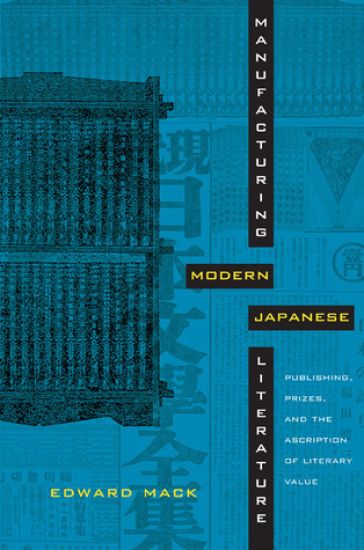
Manufacturing Modern Japanese Literature

Manufacturing Modern Japanese Literature

Edward Mack

Duke University Press
2010
sidottu
Emphasizing how modes of book production, promotion, and consumption shape ideas of literary value, Edward Mack examines the role of Japan’s publishing industry in defining modern Japanese literature. In the late nineteenth century and early twentieth, as cultural and economic power consolidated in Tokyo, the city’s literary and publishing elites came to dominate the dissemination and preservation of Japanese literature. As Mack explains, they conferred cultural value on particular works by creating prizes and multivolume anthologies that signaled literary merit. One such anthology, the Complete Works of Contemporary Japanese Literature (published between 1926 and 1931), provided many readers with their first experience of selected texts designated as modern Japanese literature. The low price of one yen per volume allowed the series to reach hundreds of thousands of readers. An early prize for modern Japanese literature, the annual Akutagawa Prize, first awarded in 1935, became the country’s highest-profile literary award. Mack chronicles the history of book production and consumption in Japan, showing how advances in technology, the expansion of a market for literary commodities, and the development of an extensive reading community enabled phenomena such as the Complete Works of Contemporary Japanese Literature and the Akutagawa Prize to manufacture the very concept of modern Japanese literature.
Manufacturing Modern Japanese Literature

Manufacturing Modern Japanese Literature

Edward Mack

Duke University Press
2010
pokkari
Emphasizing how modes of book production, promotion, and consumption shape ideas of literary value, Edward Mack examines the role of Japan’s publishing industry in defining modern Japanese literature. In the late nineteenth century and early twentieth, as cultural and economic power consolidated in Tokyo, the city’s literary and publishing elites came to dominate the dissemination and preservation of Japanese literature. As Mack explains, they conferred cultural value on particular works by creating prizes and multivolume anthologies that signaled literary merit. One such anthology, the Complete Works of Contemporary Japanese Literature (published between 1926 and 1931), provided many readers with their first experience of selected texts designated as modern Japanese literature. The low price of one yen per volume allowed the series to reach hundreds of thousands of readers. An early prize for modern Japanese literature, the annual Akutagawa Prize, first awarded in 1935, became the country’s highest-profile literary award. Mack chronicles the history of book production and consumption in Japan, showing how advances in technology, the expansion of a market for literary commodities, and the development of an extensive reading community enabled phenomena such as the Complete Works of Contemporary Japanese Literature and the Akutagawa Prize to manufacture the very concept of modern Japanese literature.