Kirjojen hintavertailu. Mukana 11 342 296 kirjaa ja 12 kauppaa.

Kirjahaku

Etsi kirjoja tekijän nimen, kirjan nimen tai ISBN:n perusteella.

6 kirjaa tekijältä Edward Timms

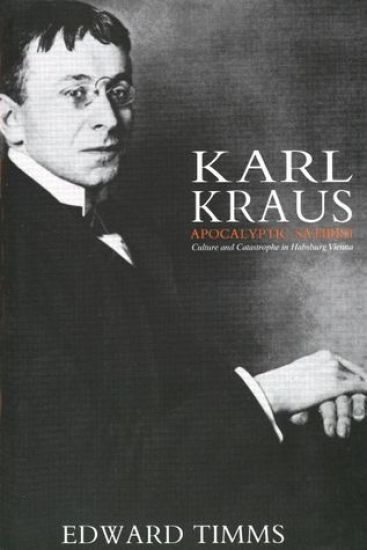
Karl Kraus

Karl Kraus

Edward Timms

Yale University Press
1989
pokkari
A fascinating study of the life and work of Karl Kraus, the Austrian satirist whose critiques of the mass media, the military-industrial complex, and technology running out of control have earned him a following fifty years after his death. Drawing on unfamiliar sources, Edward Timms analyzes Kraus's involvement in fundamental ideological issues of his time, such as psychoanalysis, social morality, design and architecture, the role of the artist, Zionism, anti-semitism, and war, and shows that Kraus' political position—caught between traditional Habsburg loyalties and new democratic commitments—was far more complex than has previously been suspected. "Dr. Timms' book is a major landmark in Kraus' studies, and an important contribution to our understanding of the culture of the early 20th century. It abounds in discoveries and insights."—W.E. Yeats, Times Literary Supplement "Timm's lucid prose, his masterly organization of the voluminous material he treats, his excellent translations of the documents he cites and his broad, readable portrayal of Viennese fin-de-siecle culture make this study accessible to the average reader and a pleasure for the literary professional. . . . An example of German studies at its best."—James Knowlton, European Studies Journal "Timms successfully weaves a colorful, and thoroughly researched and documented, account of essential cultural currents in Habsburg Vienna around his central figure. Copious illustrations and photographs enhance a most enjoyable text, making this an ideal introduction to Kraus and his work."—Choice
Karl Kraus: Apocalyptic Satirist, Volume 2

Karl Kraus: Apocalyptic Satirist, Volume 2

Edward Timms

Yale University Press
2013
pokkari
In this second volume of Karl Kraus: Apocalyptic Satirist, Edward Timms takes up Kraus’s story in November 1918, when the satirist responded to the creation of the new republics with a defiant hope, invoking international law against the dual threat of reactionary politics and irresponsible media. While contemporaries like Walter Benjamin regarded Kraus as heroically isolated, this book places him within a dynamic field of cultural production. Timms highlights the court cases Kraus pursued with his lawyer Oskar Samek and the theatrical projects that earned him Brecht’s friendship.In the final section of the book, the author refutes the legend that Kraus responded with stunned silence to Hitler’s seizure of power. His career culminated in Third Walpurgis Night, an analysis of Nazi ideology that has proved enduringly influential. Timms concludes that Kraus’s lifelong critique of the media, combining Orwell’s political radicalism with Joyce’s linguistic playfulness, incisively anticipates the propaganda techniques of our own age.
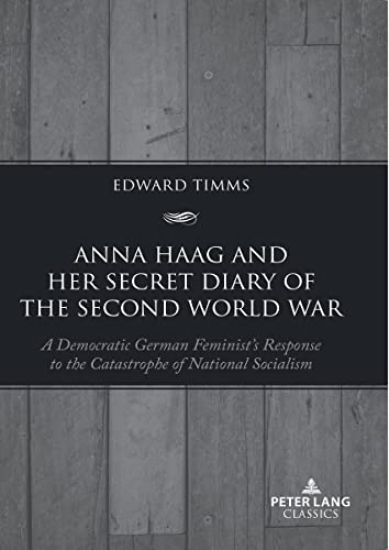
Anna Haag and her Secret Diary of the Second World War

Anna Haag and her Secret Diary of the Second World War

Edward Timms

Peter Lang International Academic Publishers
2023
nidottu
How was it possible for a well-educated nation to support a regime that made it a crime to think for yourself? This was the key question for the Stuttgart-based author Anna Haag (1888–1982), the democratic feminist whose anti-Nazi diaries are analysed in this book. Like Victor Klemperer, she deconstructed German political propaganda day by day, giving her critique a gendered focus by challenging the ethos of masculinity that sustained the Nazi regime. This pioneering study interprets her diaries, secretly written in twenty notebooks now preserved at the Stuttgart City Archive, as a fascinating source for the study of everyday life in the Third Reich. The opening sections sketch the paradigms that shaped Haag’s creativity, analysing the impact of the First World War and the feminist and pacifist commitments that influenced her literary and journalistic writings. Extensive quotations from the diaries are provided, with English translations, to illustrate her responses to the cataclysms that followed the rise of Hitler, from the military conquests and Jewish deportations to the devastation of strategic bombing. The book concludes with a chapter that traces the links between Haag’s critique of military tyranny and her contribution to post-war reconstruction.
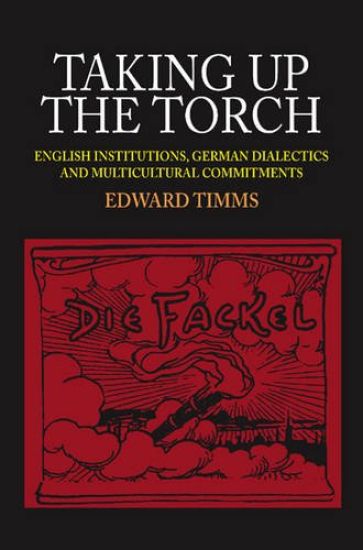
Taking Up the Torch

Taking Up the Torch

Edward Timms

Sussex Academic Press
2011
sidottu
This is an unusual narrative in that it successfully combines subjectivity -- how an English person was led by a sequence of educational developments, personal encounters and historical constraints to become the founder of the German-Jewish Centre at the University of Sussex; and objectivity -- a book that introduces English and American readers to an important and evolving field of historical and cultural studies through intellectual autobiography. It documents the formative experiences of a scholar who was to become a pioneering teacher and researcher in the field of German culture and politics. The aim is to relate the shaping of self to the drift of history in a period of radical social change, extending from the refugee crisis caused by Hitler's seizure of power through the ordeals of the Second World War to post-war reconstruction, and the transformation of Britain into a modern multicultural society. The focus is on the formative role of institutions: vicarage childhood, Anglican schooling, Cambridge and other university environments -- especially the new map of learning at Sussex University in the 1960s. The 'Torch' in the title alludes to the transmission of a radical intellectual tradition and to a specific commitment to the study of Die Fackel, the satirical journal edited by Karl Kraus in Vienna from 1899 to 1936. From this emerged the innovative agenda developed by the Centre for German-Jewish Studies.
Taking Up The Torch

Taking Up The Torch

Edward Timms

Sussex Academic Press
2012
nidottu
This is an unusual narrative in that it successfully combines subjectivity -- how an English person was led by a sequence of educational developments, personal encounters and historical constraints to become the founder of the German-Jewish Centre at the University of Sussex; and objectivity -- a book that introduces English and American readers to an important and evolving field of historical and cultural studies through intellectual autobiography. It documents the formative experiences of a scholar who was to become a pioneering teacher and researcher in the field of German culture and politics. The aim is to relate the shaping of self to the drift of history in a period of radical social change, extending from the refugee crisis caused by Hitler's seizure of power through the ordeals of the Second World War to post-war reconstruction, and the transformation of Britain into a modern multicultural society. The focus is on the formative role of institutions: vicarage childhood, Anglican schooling, Cambridge and other university environments -- especially the new map of learning at Sussex University in the 1960s.The 'Torch' in the title alludes to the transmission of a radical intellectual tradition and to a specific commitment to the study of Die Fackel, the satirical journal edited by Karl Kraus in Vienna from 1899 to 1936. From this emerged the innovative agenda developed by the Centre for German-Jewish Studies.
Anna Haag and her Secret Diary of the Second World War

Anna Haag and her Secret Diary of the Second World War

Edward Timms

Peter Lang AG, Internationaler Verlag der Wissenschaften
2016
nidottu
How was it possible for a well-educated nation to support a regime that made it a crime to think for yourself? This was the key question for the Stuttgart-based author Anna Haag (1888–1982), the democratic feminist whose anti-Nazi diaries are analysed in this book. Like Victor Klemperer, she deconstructed German political propaganda day by day, giving her critique a gendered focus by challenging the ethos of masculinity that sustained the Nazi regime. This pioneering study interprets her diaries, secretly written in twenty notebooks now preserved at the Stuttgart City Archive, as a fascinating source for the study of everyday life in the Third Reich. The opening sections sketch the paradigms that shaped Haag’s creativity, analysing the impact of the First World War and the feminist and pacifist commitments that influenced her literary and journalistic writings. Extensive quotations from the diaries are provided, with English translations, to illustrate her responses to the cataclysms that followed the rise of Hitler, from the military conquests and Jewish deportations to the devastation of strategic bombing. The book concludes with a chapter that traces the links between Haag’s critique of military tyranny and her contribution to post-war reconstruction.