
Kirjahaku
Etsi kirjoja tekijän nimen, kirjan nimen tai ISBN:n perusteella.
33 kirjaa tekijältä Edward de Bono
Traditional thinking habits of businesses need to be greatly improved. Analysis and judgement are no longer enough to make important corporate decisions; you can analyse the past but you have to design the future. Corporate decisions depend on values. Disputes and conflicts often arise because of a clash of those values; each party in the dispute wants to pursue its own values, often at the expense of the other party. It is therefore essential that companies, managers and employees have a full understanding of the values of everyone involved to design a way forward that benefits all parties. From the bestselling author of How to Have a Beautiful Mind and Six Thinking Hats, this groundbreaking business book provides a basis for value assessment, an essential tool in decision-making for 21st century corporations. De Bono demonstrates that values come into all areas of thinking, behaviour and decision-making and outlines a framework to focus employees' attention on a variety of values including human values, organisational values, cultural values and perceptual values. By introducing a scoring system to rate different values as strong, sound, weak or remote de Bono helps readers to prioritise and make executive decisions that count.

People spend a fortune on their bodies, their faces, their hair, their clothes. Cosmetics, plastic surgery, diets, gym membership - everyone's trying to be more attractive. But there's an easier way to become a beautiful person. It doesn't have to be physical. No matter how you look, if you have a mind that's fascinating, creative, exciting - if you're a good thinker - you can be beautiful.And being attractive doesn't necessarily come from being intelligent or highly-educated. It isn't about having a great personality. It's about using your imagination and expanding your creativity. And it's when talking with people that we make the greatest impact. A person may be physically beautiful, but when speaking to others a dull or ugly or uncreative mind will definitely turn them off.In clear, practical language, de Bono shows how by applying lateral and parallel thinking skills to your conversation you can improve your mind. By learning how to listen, make a point, and manoeuvre a discussion, you can become creative and more appealing - more beautiful.
The world is full of problems and conflicts. So why can we not solve them? According to Edward de Bono, world thinking cannot solve world problems because world thinking is itself the problem. And this is getting worse: we are so accustomed to readily available information online that we search immediately for the answers rather than thinking about them. Our minds function like trying to drive a car using only one wheel. There's nothing wrong with that one wheel - conventional thinking - but we could all get a lot further if we used all four... De Bono examines why we think the way we do from a historical perspective and uses some of his famous thinking techniques, such as lateral thinking, combined with new ideas to show us how to change the way we think. If we strengthen our ability and raise our thinking level, other areas of our life - both personal and business success - will improve.De Bono is the master of the original big 'concept' book and his enticement to us to use our minds as constructively as possible should appeal to a whole new generation of fans.
If you want to be the best, focus on your most valuable asset: the power of your creative mindAs competition and the pace of change intensify, companies and individuals need to harness their creativity to stay ahead of the field. Under pressure, people often think they can't be creative; many more are convinced they are not creative at all because they have never been 'arty'. Creative genius Edward de Bono debunks these common notions in this remarkable book. He shows how creativity is a learnable skill - one that everyone can use to improve their performance. He then explains how you can unlock your own creativity to reap the personal and professional rewards it will bring. Learn how to:be creative on demand with de Bono's step-by-step approach add value to ideas and turn them into financial assets boost creativity with the power of lateral thinking break free from old ways of thinking with creative challenging
Why do some people always seem to have new ideas while others of equal intelligence never do? This book offers the portrayal of what lateral thinking is, how it works and how to use it to develop your own potential for thinking and problem solving.
The last millennium has not been a great success. We have advanced in science and technology, but not much in human behaviour. Is it possible that this has been due to poor thinking? Edward de Bono maintains that the thinking of the last millennium has been concerned with what is. This is the thinking of analysis, criticism and argument. What we have not sufficiently developed is the thinking concerned with what can be. This is thinking that is creative and constructive, and which seeks to solve conflicts and problems by designing a way forward. The emphasis of his proposed new thinking is on design and not judgement.
THE classic work about making the complicated simple from the world-renowned writer and philosopher Edward de Bono From confusing manuals to uninterpretable jargon and bureaucratic red-tape, modern life can be highly complicated and frustrating. For many of us it is almost impossible to make sense of. In Simplicity, lateral-thinking guru Edward de Bono shows us how to bring clarity into our increasingly complicated lives. Through his ten rules of simplicity, he encourages us to be creative and break down the complex into manageable and recognisable parts. By making the complicated simple, you will free up time, reduce stress and make better decisions.
How do you raise children to think creatively for themselves and thrive?Edward de Bono, one of the world leading authorities on creative thinking, shows how parents can raise happy, confident and self-assured children through his simple tips, tricks and exercises that you can do with your child. This book will help your child: - Use positive reinforcement effectively - Unleash their creativity - Make the best life choices - Plan well for the future Confidence is one of the greatest gifts a parent can give their child and through this book you will learn how to give them the best start in life.2020 marked the 50th anniversary of Lateral Thinking (1970) and the 35th anniversary of Six Thinking Hats (1985).
THE classic work of intelligent self-empowerment from the world-renowned writer and philosopher Edward de BonoOur happiness and success depend on clear thinking. But too many of us are compromised by confusion, trying to do too much at once, and not knowing what to do next.In Teach Yourself to Think, Edward de Bono shows that good thinking depends on a simple five-stage process that anyone can learn. It will enable you to assess your goals, sort available information, identify the available choices, make a decision and, finally, turn thought into action.This book offers brilliant advice for anyone who needs to be able to respond to and deal with a vast range of situations at work and in life quickly, efficiently and intelligently.

Most of our everyday decision-making tends to be confrontational. Whether in large meetings, one-to-one or even in our own heads, opposite view points are pitted against each other. This book reveals how we can all be winners. It helps you to become a better thinker and decision maker.
People spend vast amounts of money, time and energy to achieve and maintain beauty, and yet despite its undisputed importance few of us devote similar efforts to be interesting. In this book, the author reveals how playing with ideas, making connections, speculating and using the imagination are at the heart of being an interesting person.
THE MULTI-MILLION COPY BESTSELLING PHENOMENON Do you regularly find yourself in long, unstructured meetings which end without a decision? Are you a team leader looking for tips on increasing productivity? Or are you looking for ways to enhance collaboration?Six Thinking Hats, Edward de Bono's classic book on meetings, remains as relevant as ever. Used to huge success by big companies and organisations such as IBM, Siemens and NASA, the Six-Hats method is a proven way to:- Reduce meeting lengths to one quarter of what they were previously- Make decisions in just 15 minutes, rather than 3 hours- Increase productivity by nearly 500%This extremely simple tool not only increases efficiency in discussions and decision-making, but also encourages openness and trust among colleagues, resulting in happier team, a rise in productivity, and decisions which almost make themselves.'An inspiring man with brilliant ideas. De Bono never ceases to amaze' Sir Richard Branson
Shows how to stimulate the mind in new and exciting ways. This is about freeing up your imagination.
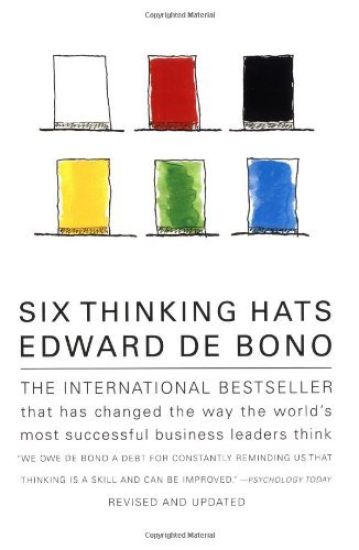
Six Thinking Hats: An Essential Approach to Business Management
Edward de Bono
Back Bay Books
1999
nidottu
A leading authority on lateral thinking streamlines the decision-making process by identifying the central aspects of problem-solving and, by using real-life scenarios, describes how to focus thinking on each aspect individually, then link them into a productive progression. Reprint. 25,000 first printing.
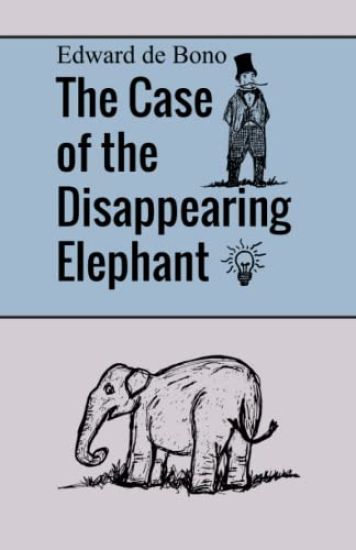
A thought provoking mystery unravels as an Elephant suddenly disappears from the middle of a circus parade. It's up to the novice detective team; the "3Gs" to solve the case of the disappearing elephant. Logical thinking George, the more lateral thinking Gina and the lie-detecting dog G.B. The young detectives must use their imagination and sharp perceptive skills to solve the case. It isn't all easy sailing, as at first no one appears to have a motive to steal an elephant. Then, it suddenly seems that everyone has a motive. The elephant makes matters very complicated by reappearing and then disappearing once again. The young detectives must constantly adjust and restructure their thinking techniques if they are to catch the elephant thieves A story for both young and old about the power of good thinking and creative collaboration to solve problems.
'NO is the basic tool of the logic system. YES is the basic tool of the belief system. PO is the basic tool of the creative system. In the past, ideas have always lived longer than people. Once they were established, ideas would be changed only slowly and over several generations. But today technology and science have so speeded up the rate of change in the world that for the first time ever people actually live longer than ideas. This means that for the first time people need to change their ideas within their lifetime in order to keep up with the world.'
'Many people believe that if you are intelligent you will automatically be a good thinker. However many intelligent people are poor thinkers because they fall into the 'intelligence trap'. On the other hand many people who do not have the highest IQs can become skilled thinkers. The main difficulty with thinking is confusion. We try to do too much in our minds at once. In this book I put forward a framework which allows a thinker to direct his or her attention to one aspect of a matter at a time. My purpose is to provide something that is very simple, very easy to remember, and very easy to use. Simple frameworks used effectively can be very powerful.
A summary by Dr. de Bono of his ideas on thinking as they have been presented in his first books. The titles are, The Five Day Course in Thinking, The Use of Lateral Thinking, The Mechanism of Mind, Lateral Thinking: A Textbook of Creativity, Lateral Thinking for Management, The Dog Exercising Machine, Children Solve Problems, Practical Thinking, Technology Today, PO - Beyond Yes and No.
A book of seven lessons on how to think, not what to think. This Teacher's guide includes student work cards that are also available separately. These Thinking Lessons are the first volume in a series drawn from the work of Dr. Edward de Bono. They are designed to be used for home schooling or in a classroom setting with children aged 8 upwards. The purpose of the lessons is to develop thinking as a skill that can be applied to any situation.