Kirjojen hintavertailu. Mukana 11 590 110 kirjaa ja 12 kauppaa.

Kirjahaku

Etsi kirjoja tekijän nimen, kirjan nimen tai ISBN:n perusteella.

3 kirjaa tekijältä Edwin Budding; Osman Demircan

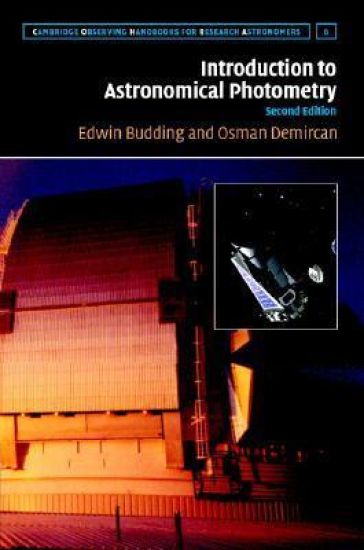
Introduction to Astronomical Photometry

Introduction to Astronomical Photometry

Edwin Budding; Osman Demircan

Cambridge University Press
2007
sidottu
Completely updated, this second edition gives a broad review of astronomical photometry to provide an understanding of astrophysics from a data-based perspective. It explains the underlying principles of the instruments used, and the applications and inferences derived from measurements. Each chapter has been fully revised to account for the latest developments, including the use of CCDs. Highly illustrated, this book provides an overview and historical background of the subject before reviewing the main themes within astronomical photometry. The central chapters focus on the practical design of the instruments and methodology used. The book concludes by discussing specialised topics in stellar astronomy, concentrating on the information derived from the analysis of the light curves of variable stars and close binary systems. It includes numerous bibliographic notes and a glossary of terms. It is ideal for graduate students, academic researchers and advanced amateurs interested in practical and observational astronomy.

A Guide to Close Binary Systems

A Guide to Close Binary Systems

Edwin Budding; Osman Demircan

TAYLOR FRANCIS LTD
2024
nidottu
Introduction to Close Binary Systems provides a comprehensive survey and guide to the fast-moving field of multiple, specifically binary, stars, with an up to date account of research around 'close', i.e. interacting pairs. Such interactions allow direct quantification of stellar properties, opening up factual insights into basic building blocks of the Universe.The book provides a much needed update for the seminal Close Binary Systems of Zdenek Kopal. Following a comparable plan, it presents relevant subject matter with an emphasis on building a framework of understanding to serve as a supporting resource for students and researchers. The text starts from a general historical background and progresses into the main theoretical ideas supporting our prima facie interpretation of observations. The central chapters explore further into these observational methods, arranged according to the classic subdivisions of astrometry, spectroscopy and photometry. Optimal inversion of observational data into model parametrization is a theme through these chapters. Significant here is the problem of how non-uniqueness in modelling affects interpretation. The underlying issues of stellar evolution bearing on observational evidence become paramount in the last four chapters. The book proceeds step-by-step from directly understandable examples of unevolved pairs to the challenging cases where stars are found in more and more extreme conditions, leading up to the mergers of massive black hole pairs seen in the new field of gravitational wave astronomy. This is a valuable reference for postgraduate and advanced undergraduate students working in mainstream areas of stellar astrophysics, with applications also to exoplanet research which shares some methodological features. Course designers for stellar astrophysics will find a useful selection of topics within this book.Key features:• Provides a well-explained and backgrounded, up-to-date account of close binary systems, in a fast-moving field of research that is growing in scientific importance• Surveys a wide range of case-studies within the context of binary and multiple star systems• Fills an acknowledged gap in current literatureCover Image: A public memorial to Zdenek Kopal in his home town (birthplace) of Litomysl in Czechia.
A Guide to Close Binary Systems

A Guide to Close Binary Systems

Edwin Budding; Osman Demircan

TAYLOR FRANCIS LTD
2022
sidottu
Introduction to Close Binary Systems provides a comprehensive survey and guide to the fast-moving field of multiple, specifically binary, stars, with an up to date account of research around 'close', i.e. interacting pairs. Such interactions allow direct quantification of stellar properties, opening up factual insights into basic building blocks of the Universe.The book provides a much needed update for the seminal Close Binary Systems of Zdenek Kopal. Following a comparable plan, it presents relevant subject matter with an emphasis on building a framework of understanding to serve as a supporting resource for students and researchers. The text starts from a general historical background and progresses into the main theoretical ideas supporting our prima facie interpretation of observations. The central chapters explore further into these observational methods, arranged according to the classic subdivisions of astrometry, spectroscopy and photometry. Optimal inversion of observational data into model parametrization is a theme through these chapters. Significant here is the problem of how non-uniqueness in modelling affects interpretation. The underlying issues of stellar evolution bearing on observational evidence become paramount in the last four chapters. The book proceeds step-by-step from directly understandable examples of unevolved pairs to the challenging cases where stars are found in more and more extreme conditions, leading up to the mergers of massive black hole pairs seen in the new field of gravitational wave astronomy. This is a valuable reference for postgraduate and advanced undergraduate students working in mainstream areas of stellar astrophysics, with applications also to exoplanet research which shares some methodological features. Course designers for stellar astrophysics will find a useful selection of topics within this book.Key features:• Provides a well-explained and backgrounded, up-to-date account of close binary systems, in a fast-moving field of research that is growing in scientific importance• Surveys a wide range of case-studies within the context of binary and multiple star systems• Fills an acknowledged gap in current literatureCover Image: A public memorial to Zdenek Kopal in his home town (birthplace) of Litomysl in Czechia.