Kirjojen hintavertailu. Mukana 11 627 220 kirjaa ja 12 kauppaa.

Kirjahaku

Etsi kirjoja tekijän nimen, kirjan nimen tai ISBN:n perusteella.

6 kirjaa tekijältä Eli Friedlander

Walter Benjamin

Walter Benjamin

Eli Friedlander

Harvard University Press
2012
sidottu
Walter Benjamin is often viewed as a cultural critic who produced a vast array of brilliant and idiosyncratic pieces of writing with little more to unify them than the feeling that they all bear the stamp of his "unclassifiable" genius. Eli Friedlander argues that Walter Benjamin's corpus of writings must be recognized as a unique configuration of philosophy with an overarching coherence and a deep-seated commitment to engage the philosophical tradition.Friedlander finds in Benjamin's early works initial formulations of the different dimensions of his philosophical thinking. He leads through them to Benjamin's views on the dialectical image, the nature of language, the relation of beauty and truth, embodiment, dream and historical awakening, myth and history, as well as the afterlife and realization of meaning. Those notions are articulated both in themselves and in relation to central figures of the philosophical tradition. They are further viewed as leading to and coming together in The Arcades Project. Friedlander takes that incomplete work to be the central theater where these earlier philosophical preoccupations were to be played out. Benjamin envisaged in it the possibility of the highest order of thought taking the form of writing whose contents are the concrete time-bound particularities of human experience. Addressing the question of the possibility of such a presentation of philosophical truth provides the guiding thread for constellating the disparate moments of Benjamin's writings.
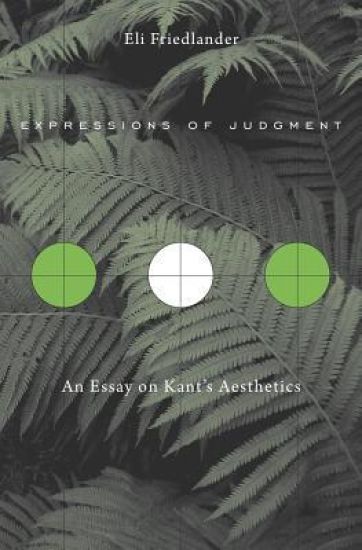
Expressions of Judgment

Expressions of Judgment

Eli Friedlander

Harvard University Press
2015
sidottu
The Critique of Judgment—the third and final work in Kant’s critical system—laid the groundwork of modern aesthetics when it appeared in 1790. Eli Friedlander’s reappraisal of this seminal accomplishment reformulates and elucidates Kant’s thought in order to reveal the inner unity of the Third Critique.Expressions of Judgment emphasizes the internal connection of judgment and meaning in Kant’s aesthetics, showing how the pleasure in judging is intimately related to our capacity to draw meaning from our encounter with beauty. Although the meaningfulness of aesthetic judgment is most evident in the response to art, the appreciation of nature’s beauty has an equal share in the significant experience of our world. Friedlander’s attention to fundamental dualities underlying the Third Critique—such as that of art and nature—underscores how its themes are subordinated systematically to the central task Kant sets himself: that of devising a philosophical blueprint for the mediation between the realms of nature and freedom.This understanding of the mediating function of judgment guides Friedlander in articulating the dimensions of the field of the aesthetic that opens between art and nature, the subject and the object, knowledge and the will, as well as between the individual and the communal. Expressions of Judgment illuminates the distinctness as well as the continuity of this important late phase in Kant’s critical enterprise, providing insights for experienced scholars as well as new students of philosophy.
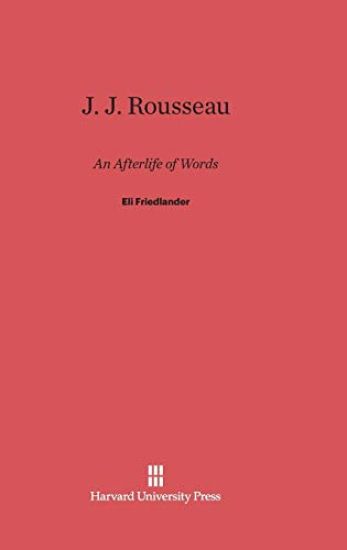
J. J. Rousseau: an Afterlife of Words

J. J. Rousseau: an Afterlife of Words

Eli Friedlander

Harvard University Press
2004
sidottu
Friedlander's book provides an afterlife for the Reveries in modern philosophy. It constitutes an alternative to the analytic tradition's revival of Rousseau, primarily through Rawls' influential vision of the social contract. It also counters the fate of Rousseau's writings in the continental tradition, determined by and large by Derrida's deconstruction.
Signs of Sense

Signs of Sense

Eli Friedlander

Harvard University Press
2001
sidottu
This work seeks to shed light on one of the most enigmatic masterpieces of twentieth-century thought. At the heart of Eli Friedlander's interpretation is the internal relation between the logical and the ethical in the "Tractatus," a relation that emerges in the work of drawing the limits of language. To show how the "Tractatus," far from separating the ethical and the logical into distinct domains, instead brings out their essential affinity, Friedlander focuses on Wittgenstein's use of the term "form," particularly his characterization of the form of objects. In this reading, the concept of form points to a threefold distinction in the text among the problematics of facts, objects, and the world. Most important, it provides a key to understanding how Wittgenstein's work opens a perspective on the world through the recognition of the form of objects rather than through the grasping of facts--thus revealing the dimensions of subjectivity involved in having a world, or in assuming that form of experience apart from systematic logic. Bearing on the question of the divide between analytic and Continental philosophy, this interpretation views Wittgenstein's work as a possible mediation between these two central philosophical traditions of the modern age. It will interest Wittgenstein scholars as well as anyone concerned with twentieth-century philosophy.
Walter Benjamin and the Idea of Natural History

Walter Benjamin and the Idea of Natural History

Eli Friedlander

STANFORD UNIVERSITY PRESS
2024
sidottu
In this incisive new work, Eli Friedlander demonstrates that Walter Benjamin's entire corpus, from early to late, comprises a rigorous and sustained philosophical questioning of how human beings belong to nature. Across seemingly heterogeneous writings, Friedlander argues, Benjamin consistently explores what the natural in the human comes to, that is, how nature is transformed, actualized, redeemed, and overcome in human existence. The book progresses gradually from Benjamin's philosophically fundamental writings on language and nature to his Goethean empiricism, from the presentation of ideas to the primal history of the Paris arcades. Friedlander's careful analysis brings out how the idea of natural history inflects Benjamin's conception of the work of art and its critique, his diagnosis of the mythical violence of the legal order, his account of the body and of action, of material culture and technology, as well as his unique vision of historical materialism. Featuring revelatory new readings of Benjamin's major works that differ, sometimes dramatically, from prevailing interpretations, this book reveals the internal coherence and philosophical force of Benjamin's thought.
Walter Benjamin and the Idea of Natural History

Walter Benjamin and the Idea of Natural History

Eli Friedlander

STANFORD UNIVERSITY PRESS
2024
pokkari
In this incisive new work, Eli Friedlander demonstrates that Walter Benjamin's entire corpus, from early to late, comprises a rigorous and sustained philosophical questioning of how human beings belong to nature. Across seemingly heterogeneous writings, Friedlander argues, Benjamin consistently explores what the natural in the human comes to, that is, how nature is transformed, actualized, redeemed, and overcome in human existence. The book progresses gradually from Benjamin's philosophically fundamental writings on language and nature to his Goethean empiricism, from the presentation of ideas to the primal history of the Paris arcades. Friedlander's careful analysis brings out how the idea of natural history inflects Benjamin's conception of the work of art and its critique, his diagnosis of the mythical violence of the legal order, his account of the body and of action, of material culture and technology, as well as his unique vision of historical materialism. Featuring revelatory new readings of Benjamin's major works that differ, sometimes dramatically, from prevailing interpretations, this book reveals the internal coherence and philosophical force of Benjamin's thought.