Kirjojen hintavertailu. Mukana 11 342 296 kirjaa ja 12 kauppaa.

Kirjahaku

Etsi kirjoja tekijän nimen, kirjan nimen tai ISBN:n perusteella.

7 kirjaa tekijältä Eli Lederhendler

American Jewry

American Jewry

Eli Lederhendler

Cambridge University Press
2016
sidottu
Understanding the history of Jews in America requires a synthesis of over 350 years of documents, social data, literature and journalism, architecture, oratory, and debate, and each time that history is observed, new questions are raised and new perspectives found. This book presents a readable account of that history, with an emphasis on migration patterns, social and religious life, and political and economic affairs. It explains the long-range development of American Jewry as the product of 'many new beginnings' more than a direct evolution leading from early colonial experiments to latter-day social patterns. This book also shows that not all of American Jewish history has occurred on American soil, arguing that Jews, more than most other Americans, persist in assigning crucial importance to international issues. This approach provides a fresh perspective that can open up the practice of minority-history writing, so that the very concepts of minority and majority should not be taken for granted.
Jewish Immigrants and American Capitalism, 1880–1920

Jewish Immigrants and American Capitalism, 1880–1920

Eli Lederhendler

Cambridge University Press
2009
sidottu
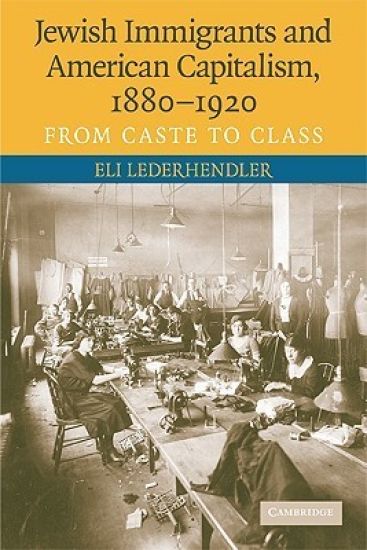
Eli Lederhendler's Jewish Immigrants and American Capitalism, 1880–1920: From Caste to Class reexamines the immigration of Russian Jews to the United States around the turn of the 20th century – a group that accounted for 10 to 15 percent of immigrants to the United States between 1899 and 1920 – challenging and revising common assumptions concerning the ease of their initial adaptation and image as a 'model' immigrant minority. Lederhendler demonstrates that the characteristics for which Jewish immigrants are commonly known – their industriousness, 'middle-class' domestic habits, and political sympathy for the working class – were, in fact, developed in response to their new situation in the United States. This experience realigned Jewish social values and restored to these immigrants a sense of status, honor, and a novel kind of social belonging, and with it the 'social capital' needed to establish a community quite different from the ones they came from.
Jewish Immigrants and American Capitalism, 1880–1920

Jewish Immigrants and American Capitalism, 1880–1920

Eli Lederhendler

Cambridge University Press
2009
pokkari
Eli Lederhendler's Jewish Immigrants and American Capitalism, 1880–1920: From Caste to Class reexamines the immigration of Russian Jews to the United States around the turn of the 20th century – a group that accounted for 10 to 15 percent of immigrants to the United States between 1899 and 1920 – challenging and revising common assumptions concerning the ease of their initial adaptation and image as a 'model' immigrant minority. Lederhendler demonstrates that the characteristics for which Jewish immigrants are commonly known – their industriousness, 'middle-class' domestic habits, and political sympathy for the working class – were, in fact, developed in response to their new situation in the United States. This experience realigned Jewish social values and restored to these immigrants a sense of status, honor, and a novel kind of social belonging, and with it the 'social capital' needed to establish a community quite different from the ones they came from.
Jewish Responses to Modernity

Jewish Responses to Modernity

Eli Lederhendler

New York University Press
1994
sidottu
Facing the dizzying array of changes commonly referred to as modernity, Jews in 19th-century Eastern Europe and early 20th-century America reflected the crises and opportunities of the modern world most eloquently in their speech, culture, and literature. Relying on those spoken and written words as eyewitnesses, Eli Lederhendler illustrates how the self- perceptions of Jews evolved, both in the Old World and among immigrants to America. He focuses on a wide range of subjects to provide an overview of this clash between old and new and to reveal ways in which cultural conflicts were reconciled. How, for instance, was messianic language adapted to serve nationalistic goals? What did America signify to Jewish thinkers at the turn of the century? What do Jewish user's guides to the New World tell us about Jewish secular culture and its perspective on sex, love, marriage, etiquette, and health? More generally, what do Jewish letters and literature tell us about how communities adapt to radically new environments? Jewish Responses to Modernity highlights the manner in which codes and symbols are passed from one generation to the next, reinforcing a group's sense of self and helping to define its relations with other. The book clearly demonstrates the importance of language as a vehicle for minority-group self-expression in the past and in the present.
Jewish Responses to Modernity

Jewish Responses to Modernity

Eli Lederhendler

New York University Press
1997
pokkari
Facing the dizzying array of changes commonly referred to as modernity, Jews in 19th-century Eastern Europe and early 20th-century America reflected the crises and opportunities of the modern world most eloquently in their speech, culture, and literature. Relying on those spoken and written words as eyewitnesses, Eli Lederhendler illustrates how the self- perceptions of Jews evolved, both in the Old World and among immigrants to America. He focuses on a wide range of subjects to provide an overview of this clash between old and new and to reveal ways in which cultural conflicts were reconciled. How, for instance, was messianic language adapted to serve nationalistic goals? What did America signify to Jewish thinkers at the turn of the century? What do Jewish user's guides to the New World tell us about Jewish secular culture and its perspective on sex, love, marriage, etiquette, and health? More generally, what do Jewish letters and literature tell us about how communities adapt to radically new environments? Jewish Responses to Modernity highlights the manner in which codes and symbols are passed from one generation to the next, reinforcing a group's sense of self and helping to define its relations with other. The book clearly demonstrates the importance of language as a vehicle for minority-group self-expression in the past and in the present.
American Jewry

American Jewry

Eli Lederhendler

Cambridge University Press
2016
pokkari
Understanding the history of Jews in America requires a synthesis of over 350 years of documents, social data, literature and journalism, architecture, oratory, and debate, and each time that history is observed, new questions are raised and new perspectives found. This book presents a readable account of that history, with an emphasis on migration patterns, social and religious life, and political and economic affairs. It explains the long-range development of American Jewry as the product of 'many new beginnings' more than a direct evolution leading from early colonial experiments to latter-day social patterns. This book also shows that not all of American Jewish history has occurred on American soil, arguing that Jews, more than most other Americans, persist in assigning crucial importance to international issues. This approach provides a fresh perspective that can open up the practice of minority-history writing, so that the very concepts of minority and majority should not be taken for granted.