Kirjojen hintavertailu. Mukana 12 016 292 kirjaa ja 12 kauppaa.

Kirjahaku

Etsi kirjoja tekijän nimen, kirjan nimen tai ISBN:n perusteella.

9 kirjaa tekijältä Elizabeth A. Clark

Melania the Younger

Melania the Younger

Elizabeth A. Clark

Oxford University Press Inc
2021
sidottu
Melania the Younger: From Rome to Jerusalem explores the richly detailed story of Melania, an early fifth-century Roman Christian aristocrat who renounced her staggering wealth to lead a life of ascetic renunciation. Hers is a tale of "riches to rags." Born to high Roman aristocracy in the late fourth century, Melania encountered numerous difficulties posed by family members, Roman officials, and historical circumstances in disposing of her wealth, property (spread across at least eight Roman provinces), and thousands of slaves. Leaving Rome with her entourage a few years before Alaric the Goth's sack of Rome in 410, she journeyed to Sicily, then to North Africa, finally settling in Jerusalem-all while founding monasteries along the way. Towards the end of her life, she traveled to Constantinople (present-day Istanbul) in an attempt to convert to Christianity her still-pagan uncle, who was on a state mission to the eastern Roman court. Throughout her life, she was accustomed to meet and be assisted by emperors and empresses, bishops, and other high dignitaries. Embracing a fairly extreme asceticism, Melania died in Jerusalem in 439. A new English translation of her Life, composed by a long-time assistant who succeeded her in the direction of the male and female monasteries in Jerusalem, accompanies this biographical study.
Melania the Younger

Melania the Younger

Elizabeth A. Clark

Oxford University Press Inc
2021
nidottu
Melania the Younger: From Rome to Jerusalem explores the richly detailed story of Melania, an early fifth-century Roman Christian aristocrat who renounced her staggering wealth to lead a life of ascetic renunciation. Hers is a tale of "riches to rags." Born to high Roman aristocracy in the late fourth century, Melania encountered numerous difficulties posed by family members, Roman officials, and historical circumstances in disposing of her wealth, property (spread across at least eight Roman provinces), and thousands of slaves. Leaving Rome with her entourage a few years before Alaric the Goth's sack of Rome in 410, she journeyed to Sicily, then to North Africa, finally settling in Jerusalem-all while founding monasteries along the way. Towards the end of her life, she traveled to Constantinople (present-day Istanbul) in an attempt to convert to Christianity her still-pagan uncle, who was on a state mission to the eastern Roman court. Throughout her life, she was accustomed to meet and be assisted by emperors and empresses, bishops, and other high dignitaries. Embracing a fairly extreme asceticism, Melania died in Jerusalem in 439. A new English translation of her Life, composed by a long-time assistant who succeeded her in the direction of the male and female monasteries in Jerusalem, accompanies this biographical study.
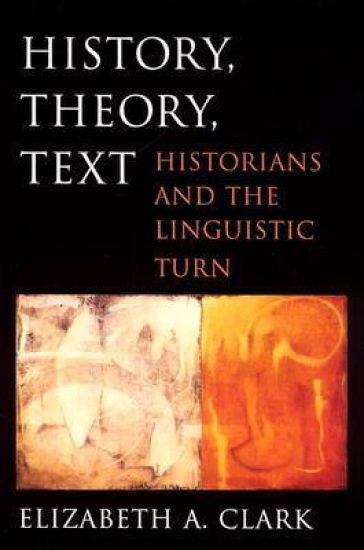
History, Theory, Text

History, Theory, Text

Elizabeth A. Clark

Harvard University Press
2004
nidottu
In this work of sweeping erudition, one of our foremost historians of early Christianity considers a variety of theoretical critiques to examine the problems and opportunities posed by the ways in which history is written. Elizabeth Clark argues forcefully for a renewal of the study of premodern Western history through engagement with the kinds of critical methods that have transformed other humanities disciplines in recent decades.History, Theory, Text provides a user-friendly survey of crucial developments in nineteenth- and twentieth-century debates surrounding history, philosophy, and critical theory. Beginning with the "noble dream" of "history as it really was" in the works of Leopold von Ranke, Clark goes on to review Anglo-American philosophies of history, schools of twentieth-century historiography, structuralism, the debate over narrative history, the changing fate of the history of ideas, and the impact of interpretive anthropology and literary theory on current historical scholarship. In a concluding chapter she offers some practical case studies to illustrate how attending to theoretical considerations can illuminate the study of premodernity.Written with energy and clarity, History, Theory, Text is a clarion call to historians for richer and more imaginative use of contemporary theory.
Reading Renunciation

Reading Renunciation

Elizabeth A. Clark

Princeton University Press
1999
pokkari
A study of how asceticism was promoted through Biblical interpretation, Reading Renunciation uses contemporary literary theory to unravel the writing strategies of the early Christian authors. Not a general discussion of early Christian teachings on celibacy and marriage, the book is a close examination, in the author's words, of how "the Fathers' axiology of abstinence informed their interpretation of Scriptural texts and incited the production of ascetic meaning." Elizabeth Clark begins with a survey of scholarship concerning early Christian asceticism that is designed to orient the nonspecialist. Section Two is organized around potentially troubling issues posed by Old Testament texts that demanded skillful handling by ascetically inclined Christian exegetes. The third section, "Reading Paul," focuses on the hermeneutical problems raised by I Corinthians 7, and the Deutero-Pauline and Pastoral Epistles. Elizabeth Clark's remarkable work will be of interest to scholars of late antiquity, religion, literary theory, and history.
The Origenist Controversy

The Origenist Controversy

Elizabeth A. Clark

Princeton University Press
2014
pokkari
Around the turn of the fifth century, Christian theologians and churchmen contested each other's orthodoxy and good repute by hurling charges of "Origenism" at their opponents. And although orthodoxy was more narrowly defined by that era than during Origen's lifetime in the third century, his speculative, Platonizing theology was not the only issue at stake in the Origenist controversy: "Origen" became a code word for nontheological complaints as well. Elizabeth Clark explores the theological and extra-theological implications of the dispute, uses social network analysis to explain the personal alliances and enmities of its participants, and suggests how it prefigured modern concerns with the status of representation, the social construction of the body, and praxis vis--vis theory. Shaped by the Trinitarian and ascetic debates, and later to influence clashes between Augustine and the Pelagians, the Origenist controversy intersected with patristic campaigns against pagan "idolatry" and Manichean and astrological determinism. Discussing Evagrius Ponticus, Epiphanius, Theophilus, Jerome, Shenute, and Rufinus in turn, Clark concludes by showing how Augustine's theory of original sin reconstructed the Origenist theory of the soul's pre-existence and "fall" into the body. Originally published in 1992. The Princeton Legacy Library uses the latest print-on-demand technology to again make available previously out-of-print books from the distinguished backlist of Princeton University Press. These editions preserve the original texts of these important books while presenting them in durable paperback and hardcover editions. The goal of the Princeton Legacy Library is to vastly increase access to the rich scholarly heritage found in the thousands of books published by Princeton University Press since its founding in 1905.
The Origenist Controversy

The Origenist Controversy

Elizabeth A. Clark

Princeton University Press
2016
sidottu
Around the turn of the fifth century, Christian theologians and churchmen contested each other's orthodoxy and good repute by hurling charges of "Origenism" at their opponents. And although orthodoxy was more narrowly defined by that era than during Origen's lifetime in the third century, his speculative, Platonizing theology was not the only issue at stake in the Origenist controversy: "Origen" became a code word for nontheological complaints as well. Elizabeth Clark explores the theological and extra-theological implications of the dispute, uses social network analysis to explain the personal alliances and enmities of its participants, and suggests how it prefigured modern concerns with the status of representation, the social construction of the body, and praxis vis--vis theory. Shaped by the Trinitarian and ascetic debates, and later to influence clashes between Augustine and the Pelagians, the Origenist controversy intersected with patristic campaigns against pagan "idolatry" and Manichean and astrological determinism. Discussing Evagrius Ponticus, Epiphanius, Theophilus, Jerome, Shenute, and Rufinus in turn, Clark concludes by showing how Augustine's theory of original sin reconstructed the Origenist theory of the soul's pre-existence and "fall" into the body. Originally published in 1992. The Princeton Legacy Library uses the latest print-on-demand technology to again make available previously out-of-print books from the distinguished backlist of Princeton University Press. These editions preserve the original texts of these important books while presenting them in durable paperback and hardcover editions. The goal of the Princeton Legacy Library is to vastly increase access to the rich scholarly heritage found in the thousands of books published by Princeton University Press since its founding in 1905.
Founding the Fathers

Founding the Fathers

Elizabeth A. Clark

University of Pennsylvania Press
2011
sidottu
Through their teaching of early Christian history and theology, Elizabeth A. Clark contends, Princeton Theological Seminary, Harvard Divinity School, Yale Divinity School, and Union Theological Seminary functioned as America's closest equivalents to graduate schools in the humanities during the nineteenth century. These four Protestant institutions, founded to train clergy, later became the cradles for the nonsectarian study of religion at secular colleges and universities. Clark, one of the world's most eminent scholars of early Christianity, explores this development in Founding the Fathers: Early Church History and Protestant Professors in Nineteenth-Century America. Based on voluminous archival materials, the book charts how American theologians traveled to Europe to study in Germany and confronted intellectual currents that were invigorating but potentially threatening to their faith. The Union and Yale professors in particular struggled to tame German biblical and philosophical criticism to fit American evangelical convictions. German models that encouraged a positive view of early and medieval Christianity collided with Protestant assumptions that the church had declined grievously between the Apostolic and Reformation eras. Trying to reconcile these views, the Americans came to offer some counterbalance to traditional Protestant hostility both to contemporary Roman Catholicism and to those historical periods that had been perceived as Catholic, especially the patristic era.
The Fathers Refounded

The Fathers Refounded

Elizabeth A. Clark

University of Pennsylvania Press
2019
sidottu
In the early twentieth century, a new generation of liberal professors sought to prove Christianity's compatibility with contemporary currents in the study of philosophy, science, history, and democracy. These modernizing professors-Arthur Cushman McGiffert at Union Theological Seminary, George LaPiana at Harvard Divinity School, and Shirley Jackson Case at the University of Chicago Divinity School-hoped to equip their students with a revisionary version of early Christianity that was embedded in its social, historical, and intellectual settings. In The Fathers Refounded, Elizabeth A. Clark provides the first critical analysis of these figures' lives, scholarship, and lasting contributions to the study of Christianity. The Fathers Refounded continues the exploration of Christian intellectual revision begun by Clark in Founding the Fathers: Early Church History and Protestant Professors in Nineteenth-Century America. Drawing on rigorous archival research, Clark takes the reader through the professors' published writings, their institutions, and even their classrooms-where McGiffert tailored nineteenth-century German Protestant theology to his modernist philosophies; where LaPiana, the first Catholic professor at Harvard Divinity School, devised his modernism against the tight constraints of contemporary Catholic theology; and where Case promoted reading Christianity through social-scientific aims and methods. Each, in his own way, extricated his subfield from denominationally and theologically oriented approaches and aligned it with secular historical methodologies. In so doing, this generation of scholars fundamentally altered the directions of Catholic Modernism and Protestant Liberalism and offered the promise of reconciling Christianity and modern intellectual and social culture.
Women in the Early Church

Women in the Early Church

Elizabeth A. Clark

Liturgical Press
1983
pokkari
Elizabeth Clark, a patristic scholar and founder of the Department of Religion at Mary Washington College, has drawn upon her depth of scholarship and linguistic ability to make available to an educated but nonspecialized readership an intriguing mosaic of opinions." - America