Kirjojen hintavertailu. Mukana 12 353 949 kirjaa ja 12 kauppaa.

Kirjahaku

Etsi kirjoja tekijän nimen, kirjan nimen tai ISBN:n perusteella.

11 kirjaa tekijältä Elizabeth Closs Traugott, Richard B. Dasher

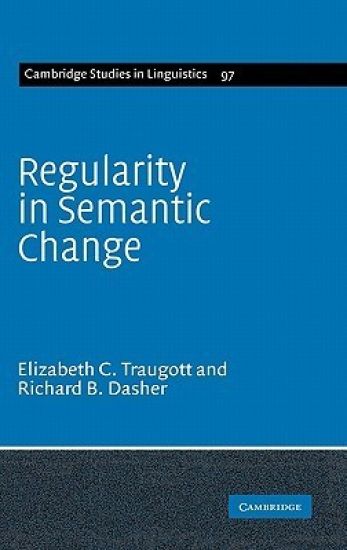
Regularity in Semantic Change

Regularity in Semantic Change

Elizabeth Closs Traugott; Richard B. Dasher

Cambridge University Press
2001
sidottu
This important study of semantic change examines how new meanings arise through language use, especially the various ways in which speakers and writers experiment with uses of words and constructions in the flow of strategic interaction with addressees. There has been growing interest in exploring systemicities in semantic change from a number of perspectives including theories of metaphor, pragmatic inferencing, and grammaticalization. Like earlier studies, these have for the most part been based on data taken out of context. This book is a detailed examination of semantic change from the perspective of historical pragmatics and discourse analysis. Drawing on extensive corpus data from over a thousand years of English and Japanese textual history, Traugott and Dasher show that most changes in meaning originate in and are motivated by the associative flow of speech and conceptual metonymy.
Regularity in Semantic Change

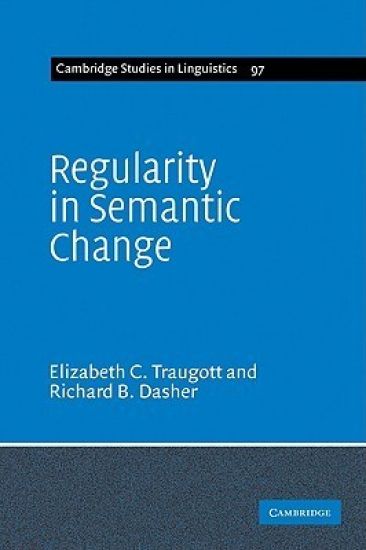
Regularity in Semantic Change

Elizabeth Closs Traugott; Richard B. Dasher

Cambridge University Press
2005
pokkari
This important study of semantic change examines how new meanings arise through language use, especially the various ways in which speakers and writers experiment with uses of words and constructions in the flow of strategic interaction with addressees. There has been growing interest in exploring systemicities in semantic change from a number of perspectives including theories of metaphor, pragmatic inferencing, and grammaticalization. Like earlier studies, these have for the most part been based on data taken out of context. This book is a detailed examination of semantic change from the perspective of historical pragmatics and discourse analysis. Drawing on extensive corpus data from over a thousand years of English and Japanese textual history, Traugott and Dasher show that most changes in meaning originate in and are motivated by the associative flow of speech and conceptual metonymy.
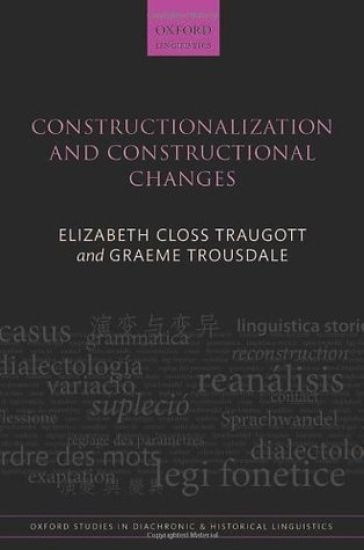
Constructionalization and Constructional Changes

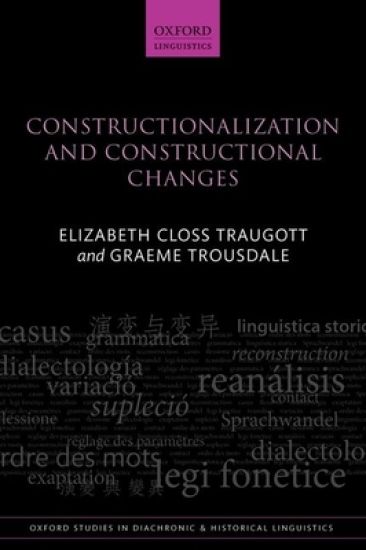
Constructionalization and Constructional Changes

Elizabeth Closs Traugott; Graeme Trousdale

Oxford University Press
2016
nidottu
In this book Elizabeth Closs Traugott and Graeme Trousdale develop an approach to language change based on construction grammar. Construction grammar is a theory of signs construed at the level of the phrase, clause, and complex sentence. Until now it has been mainly synchronic. The authors use it to reconceptualize grammaticalization (the process by which verbs like 'to have' lose semantic content and gain grammatical functions, or word order is reorganised as syntax-prominent rather than discourse-prominent), and lexicalization (in which idioms become fixed and complex words simplified). Basing their argument on the notions that language is made up of language-specific form-meaning pairings and that there is a gradient between lexical and grammatical constructions, Professor Traugott and Dr Trousdale suggest that language change proceeds by micro-steps that involve closely related changes in syntax, morphology, phonology, semantics, pragmatics, and discourse functions. They illustrate their exposition with numerous English examples drawn from Anglo-Saxon times to the present, many of which they discuss in depth. The book is organized in six chapters. The first outlines the approach and the questions to be addressed, while the second reviews usage-based models of language change, and the third considers the relation between grammatical constructionalization and grammaticalization. Chapters 4 and 5 focus respectively on lexical constructionalization and the role of context, before the final chapter draws the authors' arguments together and outlines prospects for further research. Constructionalization and Constructional Changes propounds and demonstrates a new and productive approach to historical linguistics.
Constructionalization and Constructional Changes

Constructionalization and Constructional Changes

Elizabeth Closs Traugott; Graeme Trousdale

Oxford University Press
2013
sidottu
Elizabeth Closs Traugott and Graeme Trousdale develop an approach to language change based on construction grammar. Construction grammar is a theory of signs construed at the level of the phrase, clause, and complex sentence. Until now it has been mainly synchronic. The authors use it to reconceptualize grammaticalization (the process by which verbs like to have lose semantic content and gain grammatical functions, or word order moves from discourse-prominent to syntax-prominent), and lexicalization (in which idioms become fixed and complex words simplified). Basing their argument on the notions that language is made up of language-specific form-meaning pairings and that there is a gradient between lexical and grammatical constructions, Professor Traugott and Dr Trousdale suggest that language change proceeds by micro-steps that involve closely related changes in syntax, morphology, phonology, semantics, pragmatics, and discourse functions. They illustrate their exposition with numerous English examples drawn from Anglo-Saxon times to the present, many of which they discuss in depth. The book is organized in six chapters. The first outlines the approach and the questions to be addressed. The second reviews usage-based models of language change. The third considers the relation between grammatical constructionalization and grammaticalization. Chapters 4 and 5 focus respectively on lexical constructionalization and the role of context. The final chapter draws the authors' arguments together and outlines prospects for further research. Constructionalization and Constructional Changes propounds and demonstrates a new and productive approach to historical linguistics.
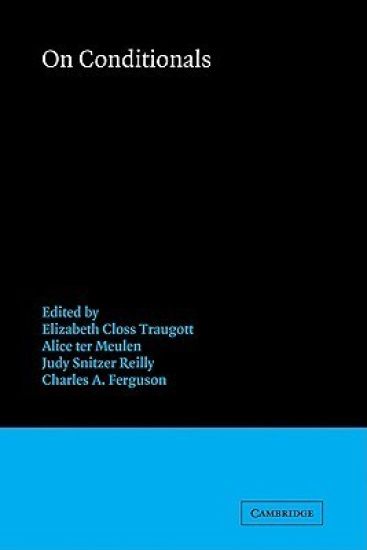
On Conditionals

On Conditionals

Elizabeth Closs Traugott; Meulen Alice Ter; Reilly Judy Snitzer; Charles A. Ferguson

Cambridge University Press
2009
pokkari
On Conditionals provides the first major cross-disciplinary account of conditional (if-then) constructions. Conditional sentences directly reflect the language user's ability to reason about alternatives, uncertainties, and unrealised contingencies. An understanding of the conceptual and behavioural organisation involved in the construction and interpretation of these kinds of sentences therefore provides fundamental insights into the inferential strategies and the cognitive and linguistic processes of human beings. The present volume brings together studies from several perspectives - philosophical, linguistic and psychological - and aims to emphasise the intrinsic connections between the issues to be addressed and to point to new directions for interdisciplinary work.
Constructions, Networks and Linguistic Change

Constructions, Networks and Linguistic Change

Graeme Trousdale; Elizabeth Closs Traugott

Cambridge University Press
2026
nidottu
The topic of linguistic networks unites different frameworks in cognitive linguistics. This Element explores two approaches to networks, specifically Construction Grammar of the Goldberg variety and Word Grammar as developed by Hudson, and how they inform work on language change. Both are usage-based theories, but while the basic units of Construction Grammar are conventionalized form-meaning pairings gathered in a construct-i-con, the basic units of Word Grammar are words in dependency and other relations. Construction Grammar allows for schematic, hierarchized abstract generalizations attributable to social groups, whereas Word Grammar focuses on relations at the micro-level and attributable primarily to individuals. Consequences of the differences are discussed with reference to perspectives on the diachronic development of causal connectives in English, especially because.
Constructions, Networks and Linguistic Change

Constructions, Networks and Linguistic Change

Graeme Trousdale; Elizabeth Closs Traugott

Cambridge University Press
2026
sidottu
The topic of linguistic networks unites different frameworks in cognitive linguistics. This Element explores two approaches to networks, specifically Construction Grammar of the Goldberg variety and Word Grammar as developed by Hudson, and how they inform work on language change. Both are usage-based theories, but while the basic units of Construction Grammar are conventionalized form-meaning pairings gathered in a construct-i-con, the basic units of Word Grammar are words in dependency and other relations. Construction Grammar allows for schematic, hierarchized abstract generalizations attributable to social groups, whereas Word Grammar focuses on relations at the micro-level and attributable primarily to individuals. Consequences of the differences are discussed with reference to perspectives on the diachronic development of causal connectives in English, especially because.
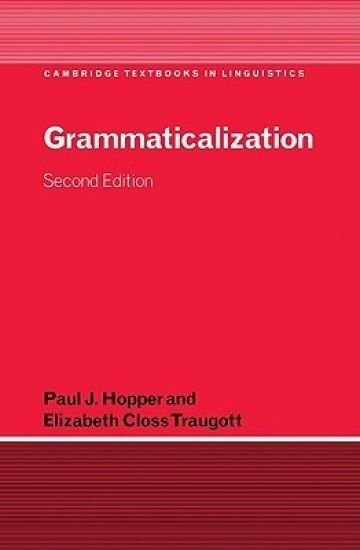
Grammaticalization

Grammaticalization

Paul J. Hopper; Elizabeth Closs Traugott

Cambridge University Press
2003
sidottu
Hardback edition This is a general introduction to grammaticalization, the change whereby lexical terms and constructions come in certain linguistic contexts to serve grammatical functions, and, once grammaticalized, continue to develop new grammatical functions. The authors synthesize work from several areas of linguistics, including historical linguistics, discourse analysis, and pragmatics. Data are drawn from many languages including Ewe, Finnish, French, Hindi, Hittite, Japanese, Malay, and especially English. This second edition has been thoroughly revised with substantial updates on theoretical and methodological issues that have arisen in the decade since the first edition, and includes a significantly expanded bibliography. Particular attention is paid to recent debates over directionality in change and the role of grammaticalization in creolization. Grammaticalization will be a valuable and stimulating textbook for all linguists interested in the development of grammatical forms and will also be of interest to readers in anthropology and psychology. Contents Preface to the second edition and acknowledgements; List of abbreviations; 1. Some preliminaries; 2. The history of grammaticalization; 3. Reanalysis; 4. Pragmatic factor; 5. The hypothesis of unidirectionality; 6. Clause-internal morphological changes; 7. Grammaticalization across clauses; 8. Grammaticalization in situations of extreme language contact; 9. Summary and suggestions for further work; References; Index of names; Index of languages; General index.
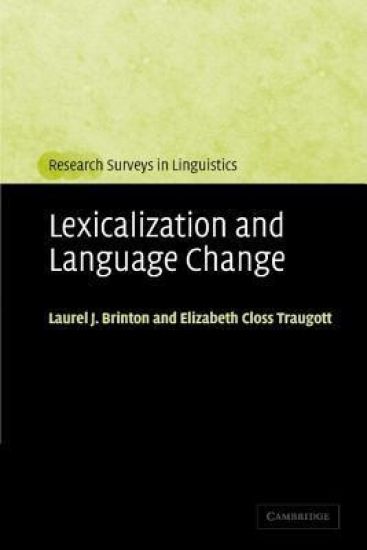
Lexicalization and Language Change

Lexicalization and Language Change

Laurel J. Brinton; Elizabeth Closs Traugott

Cambridge University Press
2005
pokkari
Lexicalization, a process of language change, has been conceptualized in a variety of ways. Broadly defined as the adoption of concepts into the lexicon, it has been viewed by syntacticians as the reverse process of grammaticalization, by morphologists as a routine process of word-formation, and by semanticists as the development of concrete meanings. In this up-to-date survey, Laurel Brinton and Elizabeth Traugott examine the various conceptualizations of lexicalization that have been presented in the literature. In light of contemporary work on grammaticalization, they then propose a new, unified model of lexicalization and grammaticalization. Their approach is illustrated with a variety of case studies from the history of English, including present participles, multi-word verbs, adverbs, and discourse markers, as well as some examples from other Indo-European languages. The first review of the various approaches to lexicalization, this book will be invaluable to students and scholars of historical linguistics and language change.
Grammaticalization

Grammaticalization

Paul J. Hopper; Elizabeth Closs Traugott

Cambridge University Press
2003
pokkari
Paperback edition This is a general introduction to grammaticalization, the change whereby lexical terms and constructions come in certain linguistic contexts to serve grammatical functions, and, once grammaticalized, continue to develop new grammatical functions. The authors synthesize work from several areas of linguistics, including historical linguistics, discourse analysis, and pragmatics. Data are drawn from many languages including Ewe, Finnish, French, Hindi, Hittite, Japanese, Malay, and especially English. This second edition has been thoroughly revised with substantial updates on theoretical and methodological issues that have arisen in the decade since the first edition, and includes a significantly expanded bibliography. Particular attention is paid to recent debates over directionality in change and the role of grammaticalization in creolization. Grammaticalization will be a valuable and stimulating textbook for all linguists interested in the development of grammatical forms and will also be of interest to readers in anthropology and psychology. Contents Preface to the second edition and acknowledgements; List of abbreviations; 1. Some preliminaries; 2. The history of grammaticalization; 3. Reanalysis; 4. Pragmatic factor; 5. The hypothesis of unidirectionality; 6. Clause-internal morphological changes; 7. Grammaticalization across clauses; 8. Grammaticalization in situations of extreme language contact; 9. Summary and suggestions for further work; References; Index of names; Index of languages; General index.
Lexicalization and Language Change

Lexicalization and Language Change

Laurel J. Brinton; Elizabeth Closs Traugott

Cambridge University Press
2005
sidottu
Lexicalization, a process of language change, has been conceptualized in a variety of ways. Broadly defined as the adoption of concepts into the lexicon, it has been viewed by syntacticians as the reverse process of grammaticalization, by morphologists as a routine process of word-formation, and by semanticists as the development of concrete meanings. In this up-to-date survey, Laurel Brinton and Elizabeth Traugott examine the various conceptualizations of lexicalization that have been presented in the literature. In light of contemporary work on grammaticalization, they then propose a new, unified model of lexicalization and grammaticalization. Their approach is illustrated with a variety of case studies from the history of English, including present participles, multi-word verbs, adverbs, and discourse markers, as well as some examples from other Indo-European languages. The first review of the various approaches to lexicalization, this book will be invaluable to students and scholars of historical linguistics and language change.