
Kirjojen hintavertailu. Mukana 11 342 296 kirjaa ja 12 kauppaa.

Kirjahaku

Etsi kirjoja tekijän nimen, kirjan nimen tai ISBN:n perusteella.

5 kirjaa tekijältä Ellen Willis

The Essential Ellen Willis

The Essential Ellen Willis

Ellen Willis

University of Minnesota Press
2014
nidottu
Out of the Vinyl Deeps, published in 2011, introduced a new generation to the incisive, witty, and merciless voice of Ellen Willis through her pioneering rock music criticism. In the years that followed, Willis’s daring insights went beyond popular music, taking on such issues as pornography, religion, feminism, war, and drugs. The Essential Ellen Willis gathers writings that span forty years and are both deeply engaged with the times in which they were first published and yet remain fresh and relevant amid today’s seemingly intractable political and cultural battles. Whether addressing the women’s movement, sex and abortion, race and class, or war and terrorism, Willis brought to each a distinctive attitude-passionate yet ironic, clear-sighted yet hopeful. Offering a compelling and cohesive narrative of Willis’s liberationist “transcendence politics,” the essays-among them previously unpublished and uncollected pieces-are organized by decade from the 1960s to the 2000s, with each section introduced by young writers who share Willis’s intellectual bravery, curiosity, and lucidity: Irin Carmon, Spencer Ackerman, Cord Jefferson, Ann Friedman, and Sara Marcus. The Essential Ellen Willis concludes with excerpts from Willis’s unfinished book about politics and the cultural unconscious, introduced by her longtime partner, Stanley Aronowitz. An invaluable reckoning of American society since the 1960s, this volume is a testament to an iconoclastic and fiercely original voice.
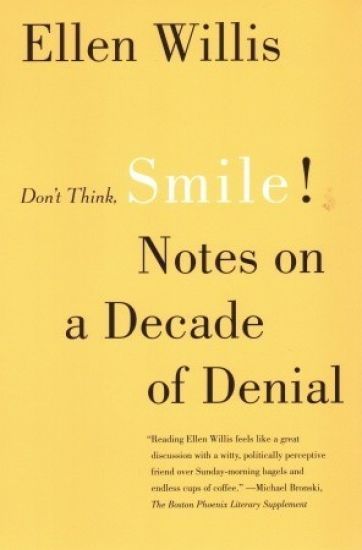
Don't Think, Smile!

Don't Think, Smile!

Ellen Willis

Beacon Press
2000
pokkari
"Reading Ellen Willis feels like a great discussion with a witty, politically perceptive friend over Sunday-morning bagels and endless cups of coffee."*The 1990s were a decade of unprecedented economic expansion. They were also a decade that saw stagnant wages and globalization, Monica-gate and the O. J. Simpson trial, The Bell Curve and the Million Man March. Most notably, Ellen Willis argues, they were a decade that saw an astounding refusal, on both the left and right, to question received wisdom or engage in substantive deliberation. Turning her acute eye on the cultural and political reaction to these imbroglios, Willis demands that we radically rethink our country and ourselves to create a society in which we can fully enjoy life. "Illuminating and incisive."-Judith Newman, The New York Times Book Review "In a time when politics and political writing have degenerated into sound bites and sensationalism, Ellen Willis reminds us that integrity and human dignity, a quick wit and a dead-on style, offer the hope that we can make sense of-and maybe even change-the world."-*Michael Bronski, The Boston Phoenix Literary Supplement "For thirty years, in a wide arc from the Village Voice and Social Text to the New Yorker and Mirabella, Ellen Willis has been the sixties' best exponent and a savvy interpreter of American politics and culture."-George Scialabba, Dissent "Suffused by a romantic and intelligent magnanimity, these essays abound with nuggets of insight."-Eugene McCarraher, Commonweal Author Bio: Formerly a staff writer for The New Yorker and The Village Voice, Ellen Willis is director of the cultural reporting and criticism program at New York University. She is the author of Beginning to See the Light: Sex, Hope, and Rock & Roll and No More Nice Girls: Countercultural Essays. She lives in New York City.
Out of the Vinyl Deeps

Out of the Vinyl Deeps

Ellen Willis

University of Minnesota Press
2011
nidottu
In 1968, the New Yorker hired Ellen Willis as its first popular music critic. Her column, Rock, Etc., ran for seven years and established Willis as a leader in cultural commentary and a pioneer in the nascent and otherwise male-dominated field of rock criticism. As a writer for a magazine with a circulation of nearly half a million, Willis was also the country’s most widely read rock critic. With a voice at once sharp, thoughtful, and ecstatic, she covered a wide range of artists-Bob Dylan, The Who, Van Morrison, Elvis Presley, David Bowie, the Rolling Stones, Creedence Clearwater Revival, Joni Mitchell, the Velvet Underground, Sam and Dave, Bruce Springsteen, and Stevie Wonder-assessing their albums and performances not only on their originality, musicianship, and cultural impact but also in terms of how they made her feel. Because Willis stopped writing about music in the early 1980s-when, she felt, rock ’n’ roll had lost its political edge-her significant contribution to the history and reception of rock music has been overshadowed by contemporary music critics like Robert Christgau, Lester Bangs, and Dave Marsh. Out of the Vinyl Deeps collects for the first time Willis’s Rock, Etc. columns and her other writings about popular music from this period (includingliner notes for works by Lou Reed and Janis Joplin) and reasserts her rightful place in rock music criticism. More than simply setting the record straight, Out of the Vinyl Deeps reintroduces Willis’s singular approach and style-her use of music to comment on broader social and political issues, critical acuity, vivid prose, against-the-grain opinions, and distinctly female (and feminist) perspective-to a new generation of readers. Featuring essays by the New Yorker’s current popular music critic, Sasha Frere-Jones, and cultural critics Daphne Carr and Evie Nagy, this volume also provides a lively and still relevant account of rock music during, arguably, its most innovative period.
Beginning to See the Light

Beginning to See the Light

Ellen Willis

University of Minnesota Press
2012
nidottu
From the New Yorker’s inimitable first pop music critic comes this pioneering collection of essays by a conscientious writer whose political realm is both radical and rational, and whose prime preoccupations are with rock ’n’ roll, sexuality, and above all, freedom. Here Ellen Willis assuredly captures the thrill of music, the disdain of authoritarian culture, and the rebellious spirit of the ’60s and ’70s.
No More Nice Girls

No More Nice Girls

Ellen Willis

University of Minnesota Press
2012
nidottu
With characteristic intelligence, wit, and feminist insight, Ellen Willis addresses democracy as she sees it: “a commitment to individual freedom and egalitarian self-government in every area of social, economic, and cultural life.” Moving between scholarly and down-to-earth activist writing styles, Willis confronts the conservative backlash that has slowly eroded democratic ideals and advances of the 1960s as well as the internal debates that have frequently splintered the left.