Kirjojen hintavertailu. Mukana 11 244 527 kirjaa ja 12 kauppaa.

Kirjahaku

Etsi kirjoja tekijän nimen, kirjan nimen tai ISBN:n perusteella.

13 kirjaa tekijältä Eric M. Uslaner

National Identity and Partisan Polarization

National Identity and Partisan Polarization

Eric M. Uslaner

OXFORD UNIVERSITY PRESS INC
2023
sidottu
National Identity Identity and Partisan Polarization examines how national identity has become a central issue in political and social life across the world. Questions of identity--who should be counted as a "true member" of a society and who deserves assistance from the government--have displaced other social and economic issues across nations in many countries. This study considers the role of identity theoretically and in the United States, the United Kingdom, France, Austria, Germany, Sweden, Hungary, Poland, Israel, and Taiwan. Identity varies over time and over countries. Some such as Sweden have a more "inclusive" sense of identity--one does not need to be born in the country or have ancestry to be considered a "true Swede." Other countries, such as Austria, France, Hungary, Poland, Israel, and Taiwan, have a more "exclusive" notion of identity--where one was born and a common heritage (race, religion, ethnicity) are seen as essential for seeing others as "true" members of society. "Outsiders" are viewed negatively, often as threatening a national culture and not deserving of government assistance. In the United States, the United Kingdom, and France, the major political parties take opposing positions on identity. In the United States and the United Kingdom, issues of identity have become highly correlated (polarized) with social and economic issues. In the former Communist countries of Hungary and Poland, the dominant parties have taken nationalist positions on identity but favor generous welfare policies for people of their own background. In Israel and Taiwan, social and economic issues have become less important than nationalism.
The Movers and the Shirkers

The Movers and the Shirkers

Eric M. Uslaner

The University of Michigan Press
2002
nidottu
What is the nature of representation? Why do some legislators seem to pursue their own policy agenda and others only vote for the wishes of a majority in their district? Eric M. Uslaner sheds new light on this important debate, demonstrating that current notions of representation are too narrow and that members of Congress do both pursue a policy agenda and represent their constituents's interests.Uslaner argues that most representatives do not have to choose between following their ideals or constituency preferences, because voters usually elect public officials who are in tune with their beliefs. And because the constituency is a complex organization of sub-groups--some of which are more critical to achieving re-election than others--the legis-lator is able to form alliances with those who support the legislator's policy preferences. The views of these groups within the constituence become the views to which the legislator pays most attention. In short, the author argues, politics are both local and ideological.Uslaner explores the intersection of a legislator ideology and the preferences of various constituencies. In looking at how they interact and how representation affects reelection, the book sheds new light on the place of ideology in American politics.This book will be of interest to those concerned with representation in all legislative bodies, including political scientists and historians. Eric M. Uslaner is Professor of Government, University of Maryland. He is the author of The Decline of Comity in Congress.
The Movers and the Shirkers

The Movers and the Shirkers

Eric M. Uslaner

The University of Michigan Press
1999
sidottu
What is the nature of representation? Why do some legislators seem to pursue their own policy agenda and others only vote for the wishes of a majority in their district? Eric M. Uslaner sheds new light on this important debate, demonstrating that current notions of representation are too narrow and that members of Congress do both pursue a policy agenda and represent their constituents's interests. Uslaner argues that most representatives do not have to choose between following their ideals or constituency preferences, because voters usually elect public officials who are in tune with their beliefs. And because the constituency is a complex organization of sub-groups--some of which are more critical to achieving re-election than others--the legis-lator is able to form alliances with those who support the legislator's policy preferences. The views of these groups within the constituence become the views to which the legislator pays most attention. In short, the author argues, politics are both local and ideological. Uslaner explores the intersection of a legislator ideology and the preferences of various constituencies. In looking at how they interact and how representation affects reelection, the book sheds new light on the place of ideology in American politics. This book will be of interest to those concerned with representation in all legislative bodies, including political scientists and historians. Eric M. Uslaner is Professor of Government, University of Maryland. He is the author of The Decline of Comity in Congress.
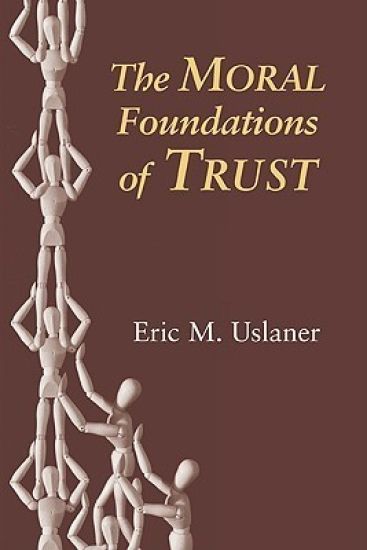
The Moral Foundations of Trust

The Moral Foundations of Trust

Eric M. Uslaner

Cambridge University Press
2002
pokkari
The Moral Foundations of Trust seeks to explain why people place their faith in strangers, and why doing so matters. Trust is a moral value that does not depend upon personal experience or on interacting with people in civic groups or informal socializing. Instead, we learn to trust from our parents, and trust is stable over long periods of time. Trust depends on an optimistic world view: the world is a good place and we can make it better. Trusting people are more likely to give through charity and volunteering. Trusting societies are more likely to redistribute resources from the rich to the poor. Trust has been in decline in the United States for over 30 years. The roots of this decline are traceable to declining optimism and increasing economic inequality, which Uslaner supports by aggregate time series in the United States and cross-sectional data across market economies.
Corruption, Inequality, and the Rule of Law

Corruption, Inequality, and the Rule of Law

Eric M. Uslaner

Cambridge University Press
2010
pokkari
Corruption flouts rules of fairness and gives some people advantages that others don't have. Corruption is persistent; there is little evidence that countries can escape the curse of corruption easily - or at all. Instead of focusing on institutional reform, in this book Eric M. Uslaner suggests that the roots of corruption lie in economic and legal inequality, low levels of generalized trust (which are not readily changed), and poor policy choices (which may be more likely to change). Economic inequality provides a fertile breeding ground for corruption, which, in turn, leads to further inequalities. Just as corruption is persistent, inequality and trust do not change much over time, according to Uslaner's cross-national aggregate analyses. He argues that high inequality leads to low trust and high corruption, and then to more inequality - an inequality trap - and identifies direct linkages between inequality and trust in surveys of the mass public and elites in transition countries.
Segregation and Mistrust

Segregation and Mistrust

Eric M. Uslaner

Cambridge University Press
2012
pokkari
Generalized trust – faith in people you do not know who are likely to be different from you – is a value that leads to many positive outcomes for a society. Yet some scholars now argue that trust is lower when we are surrounded by people who are different from us. Eric M. Uslaner challenges this view and argues that residential segregation, rather than diversity, leads to lower levels of trust. Integrated and diverse neighborhoods will lead to higher levels of trust, but only if people also have diverse social networks. Professor Uslaner examines the theoretical and measurement differences between segregation and diversity and summarizes results on how integrated neighborhoods with diverse social networks increase trust in the United States, Canada, the United Kingdom, Sweden and Australia. He also shows how different immigration and integration policies toward minorities shape both social ties and trust.
Segregation and Mistrust

Segregation and Mistrust

Eric M. Uslaner

Cambridge University Press
2012
sidottu
Generalized trust – faith in people you do not know who are likely to be different from you – is a value that leads to many positive outcomes for a society. Yet some scholars now argue that trust is lower when we are surrounded by people who are different from us. Eric M. Uslaner challenges this view and argues that residential segregation, rather than diversity, leads to lower levels of trust. Integrated and diverse neighborhoods will lead to higher levels of trust, but only if people also have diverse social networks. Professor Uslaner examines the theoretical and measurement differences between segregation and diversity and summarizes results on how integrated neighborhoods with diverse social networks increase trust in the United States, Canada, the United Kingdom, Sweden and Australia. He also shows how different immigration and integration policies toward minorities shape both social ties and trust.
The Moral Foundations of Trust

The Moral Foundations of Trust

Eric M. Uslaner

Cambridge University Press
2002
sidottu
The Moral Foundations of Trust seeks to explain why people place their faith in strangers, and why doing so matters. Trust is a moral value that does not depend upon personal experience or on interacting with people in civic groups or informal socializing. Instead, we learn to trust from our parents, and trust is stable over long periods of time. Trust depends on an optimistic world view: the world is a good place and we can make it better. Trusting people are more likely to give through charity and volunteering. Trusting societies are more likely to redistribute resources from the rich to the poor. Trust has been in decline in the United States for over 30 years. The roots of this decline are traceable to declining optimism and increasing economic inequality, which Uslaner supports by aggregate time series in the United States and cross-sectional data across market economies.
Corruption, Inequality, and the Rule of Law

Corruption, Inequality, and the Rule of Law

Eric M. Uslaner

Cambridge University Press
2008
sidottu
Corruption flouts rules of fairness and gives some people advantages that others don't have. Corruption is persistent; there is little evidence that countries can escape the curse of corruption easily - or at all. Instead of focusing on institutional reform, in this book Eric M. Uslaner suggests that the roots of corruption lie in economic and legal inequality, low levels of generalized trust (which are not readily changed), and poor policy choices (which may be more likely to change). Economic inequality provides a fertile breeding ground for corruption, which, in turn, leads to further inequalities. Just as corruption is persistent, inequality and trust do not change much over time, according to Uslaner's cross-national aggregate analyses. He argues that high inequality leads to low trust and high corruption, and then to more inequality - an inequality trap - and identifies direct linkages between inequality and trust in surveys of the mass public and elites in transition countries.
The Historical Roots of Corruption

The Historical Roots of Corruption

Eric M. Uslaner

Cambridge University Press
2017
pokkari
Why does corruption persist over long periods of time? Why is it so difficult to eliminate? Suggesting that corruption is deeply rooted in the underlying social and historical political structures of a country, Uslaner observes that there is a powerful statistical relationship between levels of mass education in 1870 and corruption levels in 2010 across 78 countries. He argues that an early introduction of universal education is shown to be linked to levels of economic equality and to efforts to increase state capacity. Societies with more equal education gave citizens more opportunities and power for opposing corruption, whilst the need for increased state capacity was a strong motivation for the introduction of universal education in many countries. Evidence for this argument is presented from statistical models, case studies from Northern and Southern Europe, Asia, Africa, Latin America, the United States, Canada, Australia, and New Zealand, as well as a discussions of how some countries escaped the 'trap' of corruption.
The Historical Roots of Corruption

The Historical Roots of Corruption

Eric M. Uslaner

Cambridge University Press
2017
sidottu
Why does corruption persist over long periods of time? Why is it so difficult to eliminate? Suggesting that corruption is deeply rooted in the underlying social and historical political structures of a country, Uslaner observes that there is a powerful statistical relationship between levels of mass education in 1870 and corruption levels in 2010 across 78 countries. He argues that an early introduction of universal education is shown to be linked to levels of economic equality and to efforts to increase state capacity. Societies with more equal education gave citizens more opportunities and power for opposing corruption, whilst the need for increased state capacity was a strong motivation for the introduction of universal education in many countries. Evidence for this argument is presented from statistical models, case studies from Northern and Southern Europe, Asia, Africa, Latin America, the United States, Canada, Australia, and New Zealand, as well as a discussions of how some countries escaped the 'trap' of corruption.