Kirjojen hintavertailu. Mukana 11 627 220 kirjaa ja 12 kauppaa.

Kirjahaku

Etsi kirjoja tekijän nimen, kirjan nimen tai ISBN:n perusteella.

7 kirjaa tekijältä Eric Pimpler

ArcGIS Blueprints

ArcGIS Blueprints

Eric Pimpler

Packt Publishing Limited
2015
nidottu
Explore the robust features of Python to create real-world ArcGIS applications through exciting, hands-on projects About This Book • Get to grips with the big world of Python add-ins and wxPython in GUI development to implement their features in your application • Integrate advanced Python libraries, ArcPy mapping, and data access module techniques to develop a mapping application • Construct a top-notch intermediate-to-advanced project by accessing ArcGIS Server and ArcGIS Online resources through the ArcGIS REST API using a project-based approach Who This Book Is For If you have prior experience building simple apps with ArcGIS and now have a fancy for developing a more challenging and complex desktop application in ArcGIS, then this book is ideal for you. What You Will Learn • Automate the creation of creative output data visualizations including maps, charts, and graphs • Explore ways to use the ArcPy Mapping module and Data-driven Pages to automate the creation of map books in your own project • Develop applications that use the Plotly platform and library to create stunning charts and graphs that can be integrated into ArcGIS Desktop • Build tools that access REST services and download data to a local geodatabase • Design, build, and integrate advanced GUIs with wxPython and ArcGIS Desktop in ArcGIS • Get clued up about constructing applications that export data to Google Earth Pro to automate time-consuming complex processes • Maximize the access of ArcGIS Server and ArcGIS Online using the ArcGIS REST API with Python In Detail This book is an immersive guide to take your ArcGIS Desktop application development skills to the next level It starts off by providing detailed description and examples of how to create ArcGIS Desktop Python toolboxes that will serve as containers for many of the applications that you will build. We provide several practical projects that involve building a local area/community map and extracting wildfire data. You will then learn how to build tools that can access data from ArcGIS Server using the ArcGIS REST API. Furthermore, we deal with the integration of additional open source Python libraries into your applications, which will help you chart and graph advanced GUI development; read and write JSON, CSV, and XML format data sources; write outputs to Google Earth Pro, and more. Along the way, you will be introduced to advanced ArcPy Mapping and ArcPy Data Access module techniques and use data-driven Pages to automate the creation of map books. Finally, you will learn advanced techniques to work with video and social media feeds. By the end of the book, you will have your own desktop application without having spent too much time learning sophisticated theory. Style and approach This is an easy-to-follow, project-based guide that guides you through the whole ArcGIS theme with practical, real-world examples and a systematic approach.
Spatial Analytics with ArcGIS

Spatial Analytics with ArcGIS

Eric Pimpler

Packt Publishing Limited
2017
nidottu
Pattern Analysis and cluster mapping made easy About This Book • Analyze patterns, clusters, and spatial relationships using ArcGIS tools • Get up to speed in R programming to create custom tools for analysis • Sift through tons of crime and real estate data and analyze it using the tools built in the book Who This Book Is For This book is for ArcGIS developers who want to perform complex geographic analysis through the use of spatial statistics tools including ArcGIS and R. No knowledge of R is assumed. What You Will Learn • Get to know how to measure geographic distributions • Perform clustering analysis including hot spot and outlier analysis • Conduct data conversion tasks using the Utilities toolset • Understand how to use the tools provided by the Mapping Clusters toolset in the Spatial Statistics Toolbox • Get to grips with the basics of R for performing spatial statistical programming • Create custom ArcGIS tools with R and ArcGIS Bridge • Understand the application of Spatial Statistics tools and the R programming language through case studies In Detail Spatial statistics has the potential to provide insight that is not otherwise available through traditional GIS tools. This book is designed to introduce you to the use of spatial statistics so you can solve complex geographic analysis. The book begins by introducing you to the many spatial statistics tools available in ArcGIS. You will learn how to analyze patterns, map clusters, and model spatial relationships with these tools. Further on, you will explore how to extend the spatial statistics tools currently available in ArcGIS, and use the R programming language to create custom tools in ArcGIS through the ArcGIS Bridge using real-world examples. At the end of the book, you will be presented with two exciting case studies where you will be able to practically apply all your learning to analyze and gain insights into real estate data. Style and approach Filled with live examples that you can code along with, this book will show you different methods and techniques to effectively analyze spatial data with ArcGIS and the R language. The exciting case studies at the end will help you immediately put your learning to practice.
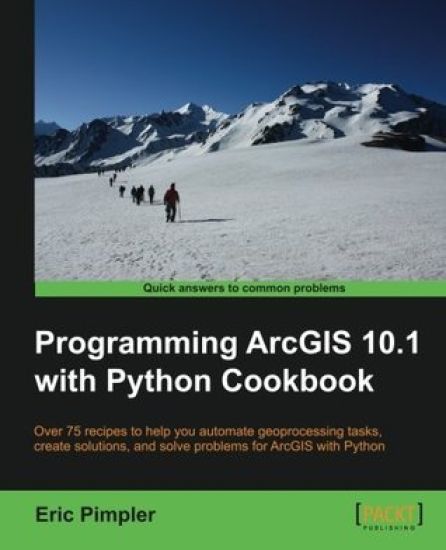
Programming ArcGIS 10.1 with Python Cookbook

Programming ArcGIS 10.1 with Python Cookbook

Eric Pimpler

Packt Publishing Limited
2013
nidottu
This book is written in a helpful, practical style with numerous hands-on recipes and chapters to help you save time and effort by using Python to power ArcGIS to create shortcuts, scripts, tools, and customizations. "Programming ArcGIS 10.1 with Python Cookbook" is written for GIS professionals who wish to revolutionize their ArcGIS workflow with Python. Basic Python or programming knowledge is essential(?).
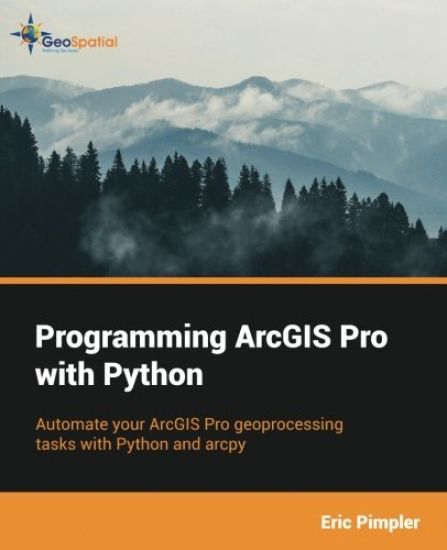
Programming ArcGIS Pro with Python

Programming ArcGIS Pro with Python

Eric Pimpler

Createspace Independent Publishing Platform
2017
nidottu
This hands on exercise book starts with an overview of the Python 3.x language. You'll learn the basic constructs of this powerful, easy to learn language for automating your ArcGIS Pro geoprocessing tasks. You'll also learn how to install, configure, and write scripts using the popular PyCharm development environment.We'll then dive into the details of the ArcGIS Pro arcpy module by learning how to execute geoprocessing tools from your scripts. From there you'll learn how to manage project and layer files, and manage the data within those files. You'll discover how to programmatically add, insert, remove, and move layers in table of contents.Next, you'll learn how to apply symbology and update properties of layers, work with 2D and 3D display properties, and manage layouts. You'll also learn how to automate map production through the use of map series functionality, formerly called map books.The later part of the books covers attribute and spatial queries, and the creation of selection sets for feature classes and tables along with the arcpy data access module for insert, updating, and deleting data from feature classes and tables. Finally, we'll close the book by discovering how you can create your own custom geoprocessing tools using custom toolboxes with ArcGIS Pro and Python.
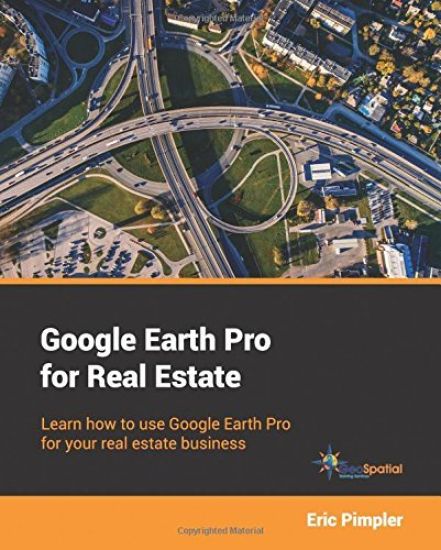
Google Earth Pro for Real Estate: Learn how to use Google Earth Pro for your real estate business
Google Earth Pro has become a must have tool that every real estate professional should have in their toolbox. This interactive 3D mapping software can be used for a variety of real estate activities including marketing and presentation, property research, and property visualization. Location, location, location is the mantra of real estate professionals. Google Earth Pro provides the ultimate platform for viewing and distributing real estate information to your customers. Whether you're working in commercial or residential real estate, Google Earth provides functionality that will allow you to effectively communicate the value of your properties to clients. Google Earth Pro is a 3D interactive globe that can be used to aid planning, analysis and decision-making. Businesses, governments and professional users from around the world use Google Earth Pro data visualization, site planning and information sharing tools. Google Earth places vital real estate information at your fingertips. Simply fly over and zoom in to inspect any site. How many competitors are within a three-mile radius? Is there a scrap yard next door? You'll know, without even getting on an airplane.