Kirjojen hintavertailu. Mukana 11 342 296 kirjaa ja 12 kauppaa.

Kirjahaku

Etsi kirjoja tekijän nimen, kirjan nimen tai ISBN:n perusteella.

3 kirjaa tekijältä Eric Prieto

Listening in

Listening in

Eric Prieto

University of Nebraska Press
2007
pokkari
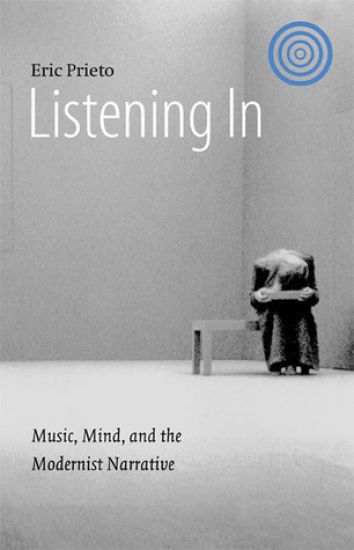
What can music teach a novelist, autobiographer, or playwright about the art of telling stories? The musical play of forms and sounds seems initially to have little to do with the representational function of the traditional narrative genres. Yet throughout the modernist era, music has been invoked as a model for narrative in its specifically mimetic dimension. Although modernist writers may conceive of musical communication in widely divergent ways, they have tended to agree on one crucial point: that music can help transform narrative into a medium better adapted to the representation of consciousness. Eric Prieto studies the twentieth-century evolution of this use of music, with particular emphasis on the postwar Parisian avant-garde. For such writers as Samuel Beckett, Michel Leiris, and Robert Pinget, music provides a number of guiding metaphors for the inwardly directed mode of mimesis that Prieto calls "listening in," where the object of representation is not the outside world but the subtly modulating relations between consciousness and world.This kind of semiotic boundary crossing between music and literature is inherently metaphorical, but, as Prieto's analyses of Beckett, Leiris, and Pinget show, these interart analogies provide valuable clues for bringing to light the unspoken assumptions, obscurely understood principles, and extra-literary aspirations that gave such urgency to the modernist quest to better represent the mind in action.
Urban Informality and Narrative Form

Urban Informality and Narrative Form

Eric Prieto

TAYLOR FRANCIS LTD
2026
sidottu
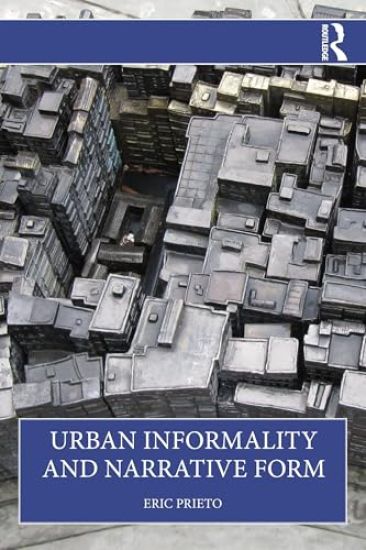
Urban Informality and Narrative Form brings together literary analysis and spatial planning theory in an interdisciplinary study of urban informality. It examines a diverse array of literary and cinematic fictions from across the globe--West and North Africa, West and South Asia, the Caribbean and Latin America--in dialogue with influential social scientific studies of urban informality. Leading scholar Eric Prieto explores the formal and representational strategies authors have used to address the realities of life in the informal city. He demonstrates the ability of literary texts to provide significant insights into the kinds of real-world concerns that preoccupy planning and policy specialists but that have remained resistant to the more traditional methodologies of urban studies and planning. The book sheds new light on the forces that have led to the prevalence of urban informality in the Global South, while also debunking some common misconceptions about the phenomenon, highlighting the great diversity of subjective experiences hidden behind the euphemistic "informal settlement" (or the more pejorative "slum"), and identifying some of the most promising ways forward for the urban poor. At a time when over half of all city dwellers in the Global South live in an in informal settlement of some kind, the urgency of the topic could not be clearer. With its global breadth and novel methodology (using urban theory as literary theory), this book will be of interest to scholars of urban literature, postcolonial and world literature, and to social scientists working in the spatial planning and policy fields.
Urban Informality and Narrative Form

Urban Informality and Narrative Form

Eric Prieto

TAYLOR FRANCIS LTD
2026
nidottu
Urban Informality and Narrative Form brings together literary analysis and spatial planning theory in an interdisciplinary study of urban informality. It examines a diverse array of literary and cinematic fictions from across the globe--West and North Africa, West and South Asia, the Caribbean and Latin America--in dialogue with influential social scientific studies of urban informality. Leading scholar Eric Prieto explores the formal and representational strategies authors have used to address the realities of life in the informal city. He demonstrates the ability of literary texts to provide significant insights into the kinds of real-world concerns that preoccupy planning and policy specialists but that have remained resistant to the more traditional methodologies of urban studies and planning. The book sheds new light on the forces that have led to the prevalence of urban informality in the Global South, while also debunking some common misconceptions about the phenomenon, highlighting the great diversity of subjective experiences hidden behind the euphemistic "informal settlement" (or the more pejorative "slum"), and identifying some of the most promising ways forward for the urban poor. At a time when over half of all city dwellers in the Global South live in an in informal settlement of some kind, the urgency of the topic could not be clearer. With its global breadth and novel methodology (using urban theory as literary theory), this book will be of interest to scholars of urban literature, postcolonial and world literature, and to social scientists working in the spatial planning and policy fields.