9 BENEFITS In nine ways, this manual simplifies and accelerates your fiber optic network design process. First, it leads the designer through an organized and logical, 14-step process. The author developed this process from training more than three thousand professionals during the last 22 years. Second, it provides an extensive list of specifications that the designer needs to consider for each component. Third, it provides typical values for these specifications. Fourth, it identifies the situations in which such specifications are appropriate. Fifth, it provides a package of forms that the designer can use in his design activities. These forms accelerate the design process by including information that would take months to develop. Sixth, it includes subjects, like range testing and certification strategies, that are not found elsewhere. Seventh, from conversations with more than ten thousand designers, end users, installers, fiber optic professionals and clients, it includes the lessons learned, both by successful design activities and oversights. Eighth, it includes many practical considerations.Ninth, it provides review questions for most chapters, so that the designer can test his understanding of the material presented.This manual helps the designer avoid overlooking important considerations, determine a combination of components that achieves low total installed cost, design to meet future bandwidth requirements, and design a network based on existing standards.
This is an introductory text for those interested in fiber optic communications. This text provides a frame-work on which the student can organize additional, detailed know-ledge. It is not designed to be comprehensive. The words in bold print are the important technical terms. Recognition of these terms is essential to understanding the subtleties of this powerful and exciting technology.This text is a result of this author's 38 years in fiber optic communications. During this time, this author has trained more than 8800 people in more than 530 presentations. This experience has shown this author the concepts that people understand easily. These are the concepts in this text. Enjoy.
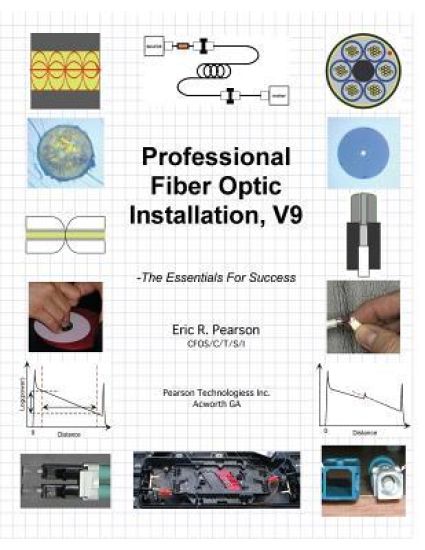
Depending on one's goals, v10 is: a guidebook for becoming a professional fiber installer, a training and reference manual for trainers and field supervisors, a manual for field installers, a study guide for passing basic and advanced certification examinations from the Fiber Optic Association FOA], and an educational book for those interested in fiber optic communications. The information in PFOIv10 applies to data networks, data centers, telephone networks, fiber to the home networks, optical LANs, fiber to the antenna, distributed antenna systems, and CATV systems. This comprehensive manual supports achieving the five goals of installation for cables, connectors, splices, passive devices, and optoelectronics. This well-written and highly organized, 35 chapter, 496 page manual presents the concepts, numbers, product advantages, and installation and testing procedures required to achieve and verify the five goals of installation: low cost (do it right the first time), lowest possible optical power loss, low reflectance, short installation time, and high reliability. Chapters 1-9 detail essential information on available products, their most important performance parameters, and advantages of product types. This information sensitizes the installer to the capabilities and limitations of the products he installs. With this sensitivity, the installer understands how his actions influence power loss, reflectance, and reliability. Chapters 10-13 present the principles and methods of installation, through which the installer achieves the five goals. Chapters 14-20 detail testing and inspection principles and methods, which enable the installer to verify proper and reliable installation. Chapters 20-28 provide detailed, cookbook-like instructions for performing installation, inspection, and testing activities. By following the instructions in these 9 chapters, the installer develops 38 critical skills and abilities essential to achieving the five goals of a professional installer.Chapters 29-35 focus information in previous chapters on 7 applications: outside plant, fiber to the antenna, distributed antenna systems, fiber to the home PON], data centers, optical LANs, and fiber characterization. Chapters 1-20 enable installers to pass the FOA CFOT basic certification examination. Chapters 10-17 and 29-35 enable installers to pass 10 of the FOA advanced certification CFOS] examinations. PFOIv10 provides the trainer with tools for effective training: modular organization, 35 focused chapters, 749 review questions, 651 figures, and 75 tables. The modular organization facilitates training programs with multiple goals: basic skill development, advanced skill development, connector installation, splicing, inspection and testing. Finally, PFOIv10 includes 10 chapters of hands-on activities.PFOIv10 is based on the author's extensive field and training experience, which includes: Mr. Pearson has the following credentials: 39 years in fiber optics, 27 years of training manual development, 554 fiber presentations, 8886 fiber trainees, 49,728 connectors installed or supervised, 104,256 insertion loss tests supervised, 30,266 OTDR traces made or supervised, and 12 years as a Director of the FOA and developer of certification examinations. The author has been recognized as a Master Instructor by the FOA and, for 15 years, was a BICSI Master Instructor. He has degrees from Massachusetts Institute of Technology BS] and Case-Western University MS]. Both degrees are in Metallurgy and Materials Science.