Kirjojen hintavertailu. Mukana 11 342 296 kirjaa ja 12 kauppaa.

Kirjahaku

Etsi kirjoja tekijän nimen, kirjan nimen tai ISBN:n perusteella.

6 kirjaa tekijältä Eric W. Sager

Inequality in Canada

Inequality in Canada

Eric W. Sager

McGill-Queen's University Press
2021
sidottu
In Inequality in Canada Eric Sager considers one of the defining – but hardest to define – ideas of our era and traces its different meanings and contexts across the nineteenth and twentieth centuries.Sager shows how the idea of inequality arose in the long evolution in Britain and the United States from classical economics to the emerging welfare economics of the twentieth century. Within this transatlantic frame, inequality took a distinct form in Canada: different iterations of the idea appear in Protestant critiques of wealth, labour movements, farmer-progressive politics, the social gospel, social Catholicism in Quebec, English-Canadian political economy, and political and intellectual justifications of the social security state. A tradition of idealist thought persisted in the twentieth century, sustaining the idea of inequality despite deep silences among Canadian economists. Sager argues that inequality goes beyond the distribution of income and wealth: it is the idea that there are wide gaps between rich and poor, that the gaps are both an economic problem and a social injustice, and that when inequality appears, it is as a problem that can be either eliminated or reduced.It is precisely because inequality appears in different contexts, and because it changes, Sager reasons, that we can begin to perceive the contours and cleavages of inequality in our time. In our century, a political solution to inequality may rest on the recovery of an ethical ideal and egalitarian politics that have long preoccupied the history of Canadian thought.
Inequality in Canada

Inequality in Canada

Eric W. Sager

McGill-Queen's University Press
2021
nidottu
In Inequality in Canada Eric Sager considers one of the defining – but hardest to define – ideas of our era and traces its different meanings and contexts across the nineteenth and twentieth centuries.Sager shows how the idea of inequality arose in the long evolution in Britain and the United States from classical economics to the emerging welfare economics of the twentieth century. Within this transatlantic frame, inequality took a distinct form in Canada: different iterations of the idea appear in Protestant critiques of wealth, labour movements, farmer-progressive politics, the social gospel, social Catholicism in Quebec, English-Canadian political economy, and political and intellectual justifications of the social security state. A tradition of idealist thought persisted in the twentieth century, sustaining the idea of inequality despite deep silences among Canadian economists. Sager argues that inequality goes beyond the distribution of income and wealth: it is the idea that there are wide gaps between rich and poor, that the gaps are both an economic problem and a social injustice, and that when inequality appears, it is as a problem that can be either eliminated or reduced.It is precisely because inequality appears in different contexts, and because it changes, Sager reasons, that we can begin to perceive the contours and cleavages of inequality in our time. In our century, a political solution to inequality may rest on the recovery of an ethical ideal and egalitarian politics that have long preoccupied the history of Canadian thought.
Seafaring Labour

Seafaring Labour

Eric W. Sager

McGill-Queen's University Press
1996
nidottu
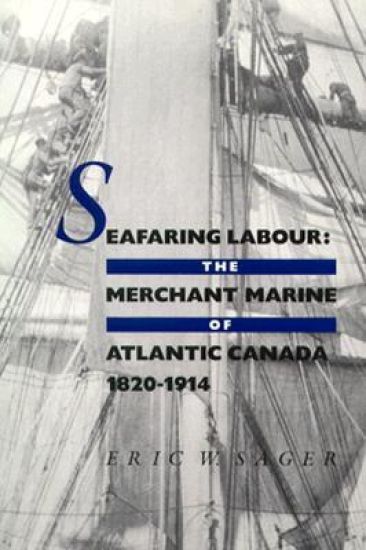
Sager argues that sailors were not misfits or outcasts but were divorced from society only by virtue of their occupation. The wooden ships were small communities at sea, fragments of normal society where workers lived, struggled, and often died. With the coming of the age of steam, the sailor became part of a new division of labour and a new social hierarchy at sea. Sager shows that the sailor was as integral to the transition to industrial capitalism as any land worker.
Ships and Memories

Ships and Memories

Eric W. Sager

University of British Columbia Press
1993
sidottu
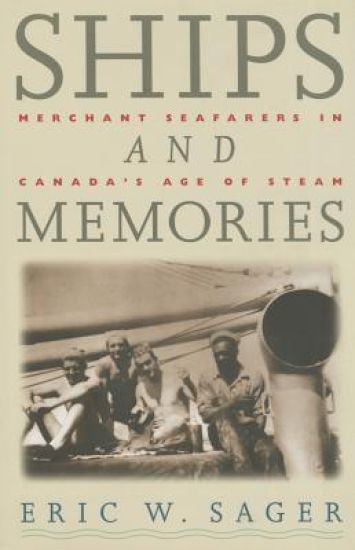
Canada is a great maritime nation. Although ships and the sea havebeen part of its history for centuries, very little is known about themen and women who have worked in its coastal and lake fleets. Shipsand Memories is a fascinating account of life at sea during theage of steam. In it, seafarers tell ther own stories and remember thegood times as well as the bad, in peace and war and during thedepression. Eric Sager draws on interviews with master mariners, engineers, ableseamen, cooks, stewards, and many others who worked aboard steamshipsfrom 1920 to 1950.
The Thinking Historian

The Thinking Historian

Eric W. Sager

De Gruyter
2025
sidottu
What is history? What are historians doing, when we create our histories? The need for answers is more urgent than ever. We live in an era when history is often rejected or ignored, and when all teachers of history confront formidable challenges. In the culture of screen capitalism and social media, historical knowledge is evaded in an expanding present-minded consciousness. How can history be defended, and what is it that we are defending?This book argues that history is a mode of thinking, a form of imaginative reasoning with its own informal logic. In non-technical language and using examples from important works of history, the book defines core elements in historical thinking. These include contingency, complexity, temporality, parts and wholes, consilience, perspectives, analogy, and abduction. These elements are subsumed into the concept of imaginative reasoning. The overall argument echoes the work of hermeneutic philosophers. History is a disciplined imagination, tempered and empowered by its forms of reasoning. It embraces ethical imperatives that the historian has a duty to declare. Equipped with such understanding, historians may answer the many rejections of history and secure its place in our shared futures.
The Thinking Historian

The Thinking Historian

Eric W. Sager

De Gruyter
2025
isokokoinen pokkari
What is history? What are historians doing, when we create our histories? The need for answers is more urgent than ever. We live in an era when history is often rejected or ignored, and when all teachers of history confront formidable challenges. In the culture of screen capitalism and social media, historical knowledge is evaded in an expanding present-minded consciousness. How can history be defended, and what is it that we are defending?This book argues that history is a mode of thinking, a form of imaginative reasoning with its own informal logic. In non-technical language and using examples from important works of history, the book defines core elements in historical thinking. These include contingency, complexity, temporality, parts and wholes, consilience, perspectives, analogy, and abduction. These elements are subsumed into the concept of imaginative reasoning. The overall argument echoes the work of hermeneutic philosophers. History is a disciplined imagination, tempered and empowered by its forms of reasoning. It embraces ethical imperatives that the historian has a duty to declare. Equipped with such understanding, historians may answer the many rejections of history and secure its place in our shared futures.