Kirjojen hintavertailu. Mukana 12 016 292 kirjaa ja 12 kauppaa.

Kirjahaku

Etsi kirjoja tekijän nimen, kirjan nimen tai ISBN:n perusteella.

12 kirjaa tekijältä Erica Benner

Really Existing Nationalisms

Really Existing Nationalisms

Erica Benner

Clarendon Press
1995
sidottu
This is an impressive re-examination of the theories of Marx and Engels on nationalism. The author challenges the conventional view that Marx and Engels lacked the theoretical resources needed to understand nationalism. It argues that the two men had a much better explanatory grasp of national phenomena than is usually supposed, and that the reasoning behind their policy towards specific national movements was often subtle and sensitive to the ethical issues at stake. Instead of offering an insular `Marxian' account of nationalism, the book identifies arguments in Marx and Engels' writings that can help us to think more clearly about national identity and conflict today. These arguments are located in a distinctive theory of politics, which enabled the authors to analyse the relations between nationalism and other social movements and to discriminate between democratic, outward-looking national programmes and authoritarian, ethnocentric nationalism. The book suggest that this approach improves on accounts which stress the `independent' force of nationality over other concerns, and on thos that fail to analyse the complex motives of nationalist actors. It concludes by criticizing these `methodological nationalist' assumptions and `post-nationalist' views about the future role of nationalism, showing how some of marx and Engles' arguments can yield a better understanding of the national movements that have emerged in the wake of `really existing socialism'.

Machiavelli's Prince

Machiavelli's Prince

Erica Benner

Oxford University Press
2015
nidottu
Why did Machiavelli write the Prince - and why did religious and political authorities find it so threatening? Five hundred years on, this book tries to answer these questions. In the first detailed, chapter-by-chapter reading of the Prince in any language, Erica Benner shows that the book is a masterpiece of ironic writing. Machiavelli's style is deliberately ambiguous: he often seems to say one thing, but gives readers clues that point toward a very different message. Beyond its 'Machiavellian' surface, the Prince has a surprisingly moral purpose. It teaches readers how to recognize hidden dangers in political conduct that merely appears great or praiseworthy - and to mistrust promises of easy solutions to political problems. This highly engaging new interpretation helps readers to see beyond the Prince's deceptive first appearances. Benner sets out Machiavelli's main ironic techniques at the outset, especially his coded use of words to signal praise or blame. Once readers become familiar with these codes, they will find it easier to grasp the Prince's surreptitiously pro-republican message - and its powerful critique of charismatic one-man rule and imperial politics.
Machiavelli's Prince

Machiavelli's Prince

Erica Benner

Oxford University Press
2013
sidottu
Why did Machiavelli write the Prince - and why did religious and political authorities find it so threatening? Five hundred years on, this book tries to answer these questions. In the first detailed, chapter-by-chapter reading of the Prince in any language, Erica Benner shows that the book is a masterpiece of ironic writing. Machiavelli's style is deliberately ambiguous: he often seems to say one thing, but gives readers clues that point toward a very different message. Beyond its 'Machiavellian' surface, the Prince has a surprisingly moral purpose. It teaches readers how to recognize hidden dangers in political conduct that merely appears great or praiseworthy - and to mistrust promises of easy solutions to political problems. This highly engaging new interpretation helps readers to see beyond the Prince's deceptive first appearances. Benner sets out Machiavelli's main ironic techniques at the outset, especially his coded use of words to signal praise or blame. Once readers become familiar with these codes, they will find it easier to grasp the Prince's surreptitiously pro-republican message - and its powerful critique of charismatic one-man rule and imperial politics.
Be Like the Fox

Be Like the Fox

Erica Benner

WW Norton Co
2018
nidottu
Since the publication of The Prince five centuries ago, Machiavelli has been associated with political amorality. But that characterization is unfair. In Be Like the Fox, Erica Benner sets the record straight: far from the ruthless "Machiavellian" henchman that people think he was, Machiavelli emerges here as a profound ethical thinker who fought to uphold high moral standards and restore the democratic freedoms of his beloved Florence.Shaking the dust from history, Benner masterfully interweaves Machiavelli's words with those of his friends and enemies, giving us a biography with all the energy of fiction. Through dialogues and diaries, we witness dramatic episodes, including Savonarola's fiery sermons against the elite in Florence's piazza, Machiavelli's secret negotiations with Caterina Sforza at the court of Forli, and the Florentines' frantic preparations to resist Pope Julius's plan to over-throw their Republic.Benner relates how Machiavelli rose as an advisor in the Florentine Republic, advancing the city's interests as a diplomat and military strategist, only to become a political pariah when the Republic was defeated. His egalitarian politics made him an enemy of the Medici family, and his secular outlook put him at odds with religious zealots. But he soon learned to mask his true convictions, becoming a great artist of foxlike dissimulation. Machiavelli's masterpiece, The Prince, was in fact a critique of princely power, but the critique had to be veiled, written as it was after the Medici triumphed over the Republic.In Be Like the Fox, the most accurate and compelling portrait of Machiavelli yet, Benner recounts the gripping story of a brilliant political thinker, showing that Machiavelli's ideas--about democratic institutions, diplomacy, and freedom--are more important than ever.
Machiavelli's Ethics

Machiavelli's Ethics

Erica Benner

Princeton University Press
2009
pokkari
Machiavelli's Ethics challenges the most entrenched understandings of Machiavelli, arguing that he was a moral and political philosopher who consistently favored the rule of law over that of men, that he had a coherent theory of justice, and that he did not defend the "Machiavellian" maxim that the ends justify the means. By carefully reconstructing the principled foundations of his political theory, Erica Benner gives the most complete account yet of Machiavelli's thought. She argues that his difficult and puzzling style of writing owes far more to ancient Greek sources than is usually recognized, as does his chief aim: to teach readers not how to produce deceptive political appearances and rhetoric, but how to see through them. Drawing on a close reading of Greek authors--including Thucydides, Xenophon, Plato, and Plutarch--Benner identifies a powerful and neglected key to understanding Machiavelli. This important new interpretation is based on the most comprehensive study of Machiavelli's writings to date, including a detailed examination of all of his major works: The Prince, The Discourses, The Art of War, and Florentine Histories. It helps explain why readers such as Bacon and Rousseau could see Machiavelli as a fellow moral philosopher, and how they could view The Prince as an ethical and republican text. By identifying a rigorous structure of principles behind Machiavelli's historical examples, the book should also open up fresh debates about his relationship to later philosophers, including Rousseau, Hobbes, and Kant.
Really Existing Nationalisms

Really Existing Nationalisms

Erica Benner

Verso Books
2018
nidottu
Really Existing Nationalisms challenges the conventional view that Marx and Engels lacked the theoretical resources needed to understand nationalism. It argues that the two thinkers had a much better explanatory grasp of national phenomena than is usually supposed, and that the reasoning behind their policy towards specific national movements was often subtle and sensitive to the ethical issues at stake.Instead of offering an insular 'Marxian' account of nationalism, the book identifies arguments in Marx and Engels' writings that can help us to think more clearly about national identity and conflict today. These arguments are located in a distinctive theory of politics, which enabled the authors to analyse the relations between nationalism and other social movements and to discriminate between democratic, outward-looking national programmes and authoritarian, ethnocentric nationalism. Erica Benner suggest that this approach improves on accounts which stress the `independent' force of nationality over other concerns, and on those that fail to analyse the complex motives of nationalist actors. She concludes by criticising these 'methodological nationalist' assumptions and 'post-nationalist' views about the future role of nationalism, showing how some of Marx and Engels' arguments can yield a better understanding of the national movements that have emerged in the wake of 'really existing socialism'. This new edition includes a new introduction.
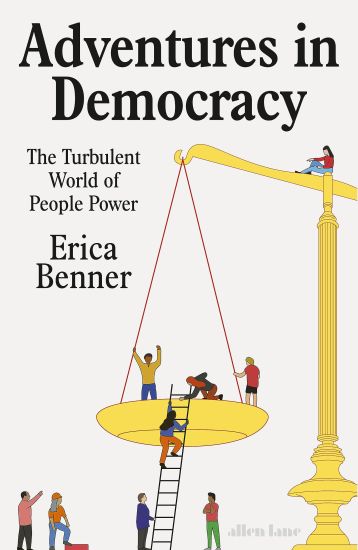
Adventures in Democracy

Adventures in Democracy

Erica Benner

PENGUIN BOOKS LTD
2025
pokkari
'Sparkling . . . a page-turner full of wit, original insight and unassuming erudition' Guardian'Enjoyable vitality' The Times'Highly stimulating . . . wonderfully readable . . . her analysis of democracy's key strengths and weaknesses is forensic' Literary ReviewDemocracy is a living, breathing thing and Erica Benner has spent a lifetime thinking about the role ordinary citizens play in keeping it alive: from her childhood in post-war Japan, where democracy was imposed on a defeated country, to working in post-communist Poland, with its sudden gaps of wealth and security. This book draws on her experiences and the deep history of self-ruling peoples – going back to ancient Greece, the French revolution and Renaissance Florence – to rethink some of the toughest questions that we face today.What do democratic ideals of equality mean in a world obsessed with competition, wealth, and greatness? How can we hold the powerful to account? Can we find enough common ground to keep sharing democratic power in the future? Challenging well-worn myths of heroic triumph over tyranny, Benner reveals the inescapable vulnerabilities of people power, inviting us to consider why democracy is worth fighting for and the role each of us must play.
Vapaus ja valta

Vapaus ja valta

Erica Benner

Otava
2024
sidottu
Monipuolinen tietokirja kutsuu taistelemaan vapaan maailman puolesta.Mitä demokratia on ja mitä se ei ole? Mikä sitä uhkaa? Kysymykset ovat isoja, mutta helposti lähestyttävä teos tarjoaa niihin oivallisia vastauksia.Demokratia ei totisesti toteudu kaikkialla, vaan vallasta taistellaan kovin keinoin. Kosmopoliittikirjailija Erica Benner vastustaa terävin sanankääntein ja konkreettisin esimerkein populisteja, diktaattoreita ja äärinationalisteja.Benner punoo taitavasti yhteen demokratian haasteita ja omaa kansainvälistä tarinaansa. Hän kurkistaa juhlapuheiden kulisseihin ja paljastaa myös kansanvallan haavoittuvuudet.