Kirjojen hintavertailu. Mukana 12 390 323 kirjaa ja 12 kauppaa.

Kirjahaku

Etsi kirjoja tekijän nimen, kirjan nimen tai ISBN:n perusteella.

14 kirjaa tekijältä Ernest R. House, Kenneth R. Howe

Values in Evaluation and Social Research

Values in Evaluation and Social Research

Ernest R. House; Kenneth R. Howe

SAGE Publications Inc
1999
sidottu
"Values in Evaluation is a breakthrough book that will change the way evaluators think about the relationship between facts and values. Using the tools of philosophy and insights from evaluation practice, the authors attack the inconsistencies in current thinking about the interplay of facts and values and give us an outline for reconstructing the approach to values within evaluation." --Gary T. Henry, Georgia State University "This book, as the title promises, unfurls the concept of value in the practice of program evaluation. The editors go well beyond recognizing that all data gathering and description are value laden and that all evaluators have value commitments shaping their designs. They examine the ethical and political burdens accompanying any evaluation contract. Out of an extended collaboration, Kenneth R. Howe and Ernest R. House together redirect their advocacy toward the pursuit of democracy." --Robert E. Stake, University of Illinois, Urbana-Champaign The authors use the tools of philosophy and the insights from evaluation practice to cut through current confusion about values and the interplay of facts and values. Four views of facts and values in evaluation are analyzed: those rooted in a fact-value dichotomy and those of radical constructivists, postmodernists, and deliberative democrats. The arguments are tough, the prose concise, and the insights compelling.
Values in Evaluation and Social Research

Values in Evaluation and Social Research

Ernest R. House; Kenneth R. Howe

SAGE Publications Inc
1999
nidottu
"Values in Evaluation is a breakthrough book that will change the way evaluators think about the relationship between facts and values. Using the tools of philosophy and insights from evaluation practice, the authors attack the inconsistencies in current thinking about the interplay of facts and values and give us an outline for reconstructing the approach to values within evaluation." --Gary T. Henry, Georgia State University "This book, as the title promises, unfurls the concept of value in the practice of program evaluation. The editors go well beyond recognizing that all data gathering and description are value laden and that all evaluators have value commitments shaping their designs. They examine the ethical and political burdens accompanying any evaluation contract. Out of an extended collaboration, Kenneth R. Howe and Ernest R. House together redirect their advocacy toward the pursuit of democracy." --Robert E. Stake, University of Illinois, Urbana-Champaign The authors use the tools of philosophy and the insights from evaluation practice to cut through current confusion about values and the interplay of facts and values. Four views of facts and values in evaluation are analyzed: those rooted in a fact-value dichotomy and those of radical constructivists, postmodernists, and deliberative democrats. The arguments are tough, the prose concise, and the insights compelling.
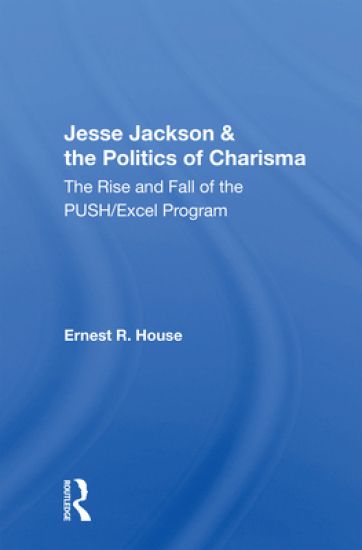
Jesse Jackson & the Politics of Charisma
"On January 15, 1975, the Reverend Jesse Jackson was leading a demonstration around the White House to protest the lack of jobs for black youths. As the demonstrators marched, Jackson was shocked to discover that many of the black youths marching with him were drunk or on drugs, many of them ""out of control."" Abruptly, he called a halt to the demonstration and sent the marchers home. Within a few months, Jackson launched a national campaign in the urban high schools of the nation to save the black youths of his country, to get them off drugs and motivate them to work hard, study in school, develop self-discipline, and become successful in American society. A program called PUSH for Excellence, or PUSH/Excel, was an outgrowth of his Operation PUSH organization. Society had no solutions for the black teenagers whom Jackson was trying to help, and his efforts were highly praised, at first, by the media and government officials."
Jesse Jackson & the Politics of Charisma
This book is about Jesse Jackson's PUSH/Excel program—a national campaign in urban schools to save the American black youths, to get them off drugs and motivate them to become successful. It discusses the drama of misunderstandings, suspicions, soaring aspirations, and steep disillusionment.
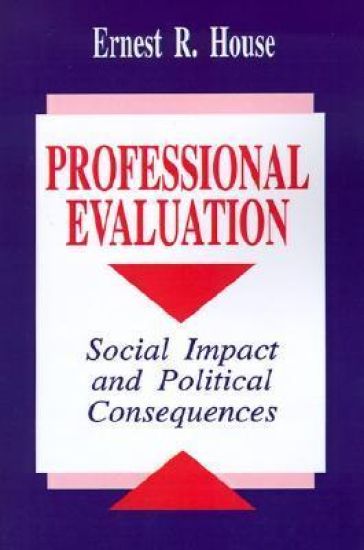
Professional Evaluation

Professional Evaluation

Ernest R. House

SAGE Publications Inc
1993
nidottu
The book provides an in-depth examination of the history and discipline of evaluation, as well as its treatment of the subjects of ethics, justice, and professionalism. . . . The strength of the book is, without question, Ernest R. House's many years of experience as an evaluator and his proposition that evaluation, as an institution, profession, and discipline, represents a strong and significant force in the process of social change. --Evaluation and Program Planning "This book pushes back the frontiers Ernest R. House has already established with his previous work in the political and social dimensions of professional evaluation. It represents the thoughtful reflections of an experienced evaluator with an unusual talent for original perspectives on this complex and vital emergent discipline." --Michael Scriven, Director, Evaluation Institute, Pacific Graduate School of Psychology "For 25 years, Ernest R. House has watched us who specialize in program evaluation, recording and interpreting in the best of qualitative ways, the maturation of our field. In this book, he portrays us as white collar migrant workers; carded, coddled, and manipulated by governments, reluctant to leave the comfort of social science but having outgrown that dependency, reaching toward what Michael Scriven called a transdiscipline. If Lee Cronbach once made us wince by revealing our political blood, House startles us, exposing neural ties with ethics, technocracy, capitalism, manifest destiny, even craniometry. Popping bluerock metaphors from liberal left to libertarian right, House declares us to be complex creature of nature and nurture, seldom acting of our own free will. It is a magical, mythological tour. "Never before has the special work of the program evaluator been shown to be immersed in and buffeted by such a diverse array of social, political, and philosophical currents. In an appealing mix of personal reminiscence and social commentary, Ernie House has collected a fine album of the early years of program evaluation." --Robert E. Stake, Center for Instructional Research and Curriculum Evaluation, University of Illinois at Urbana-Champaign Why do we have evaluation? Is evaluation a discipline? How much impact does evaluation have on government, education, or politics? Can social problems, such as poverty, be solved like engineering problems by the application of resources and intelligence? By exploring how evaluation has evolved as a discipline, science, and profession, House examines how evaluation impacts modern societies and the issues that this impact (social force) raises for evaluators. Addressing such issues as pluralism vs. managerialism, quantitative vs. qualitative methodologies, the purpose of higher education for knowledge production vs. educating people for professions, clientism, and multicultural concerns, House traces how evaluation has evolved as a basis for determining where the field should go--and, how.
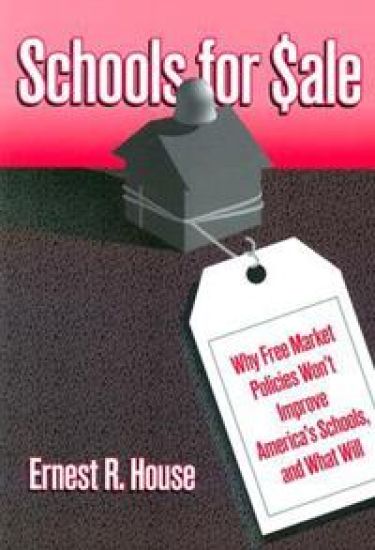
Schools for Sale

Schools for Sale

Ernest R. House

Teachers' College Press
1998
nidottu
In Schools for Sale, author Ernest House debunks the myth that economic productivity should shape educational policy and practice. House conclusively illustrates that the attempts by the Reagan, Bush, and Clinton administrations to reshape the school to make "productive workers" ignore how schools work and students learn, and in the end are doomed to failure. Politically driven proposals for vouchers and privatization to increased calls for accountability and standards gain headlines and capture the attention of the public, but they routinely ignore the need to involve teachers and schools in the debate over the future of our schools. ;Based on his years of work as a professor of educational policy analysis, House develops an appraisal framework which evaluates reforms and enables readers to test the relative merits and viability of popular reform ideas. This book provides a signal service to politicians, policy makers, and the general public interested in creating a sustainable future for our nation's students and schools.
Cherry Street Alley

Cherry Street Alley

Ernest R. House

Createspace Independent Publishing Platform
2015
nidottu
A butcher knife whistled and crackled through gristle and bone as grandma cut through rabbits and squirrels. Browned, crisped, and mixed with a gravy made from milk, flour, and meat drippings, this was served as the daily feast. That was 1939 in Depression-era Alton, Illinois, when Ernest R. House was born. So begins Cherry Street Alley, his memoir of a childhood filled with adventures, mishaps, and family sagas. House endures poverty and a rotating cast of guardians. Born into an extended family, he and his sister are sent to live with relatives after his father dies suddenly and his mother remarries. He recounts stories of coming-of-age in a rough neighborhood of Alton, a former riverboat town along the Mississippi River. Many remembrances are dotted with humor-such as growing up next to a whorehouse and having people mistake your home for it. There's violence in House's outlines of his relatives, including his father's loving-but criminal-personality. There's also compassion in a memoir about a family's struggles to survive. Told in the style of popular childhood memoirs Angela's Ashes and This Boy's Life, Cherry Street Alley is a book you won't soon forget.
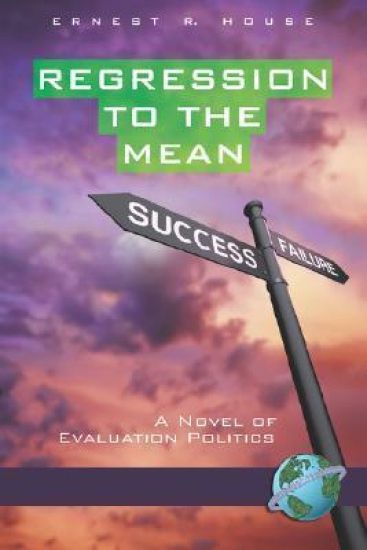
Regression to the Mean

Regression to the Mean

Ernest R. House

Information Age Publishing
2007
nidottu
Evaluation politics is one of the most critical, yet least understood aspects of evaluation. To succeed, evaluators must grasp the politics of their situation, lest their work be derailed. This engrossing novel illuminates the politics and ethics of evaluation, even as it entertains. Paul Reeder, an experienced (and all too human) evaluator, must unravel political, ethical, and technical puzzles in a mysterious world he does not fully comprehend. The book captures the complexities of evaluation politics in ways other works do not. Written expressly for learning and teaching, the evaluation novel is an unconventional foray into vital topics rarely explored.
Regression to the Mean

Regression to the Mean

Ernest R. House

Information Age Publishing
2007
sidottu
Evaluation politics is one of the most critical, yet least understood aspects of evaluation. To succeed, evaluators must grasp the politics of their situation, lest their work be derailed. This engrossing novel illuminates the politics and ethics of evaluation, even as it entertains. Paul Reeder, an experienced (and all too human) evaluator, must unravel political, ethical, and technical puzzles in a mysterious world he does not fully comprehend. The book captures the complexities of evaluation politics in ways other works do not. Written expressly for learning and teaching, the evaluation novel is an unconventional foray into vital topics rarely explored.
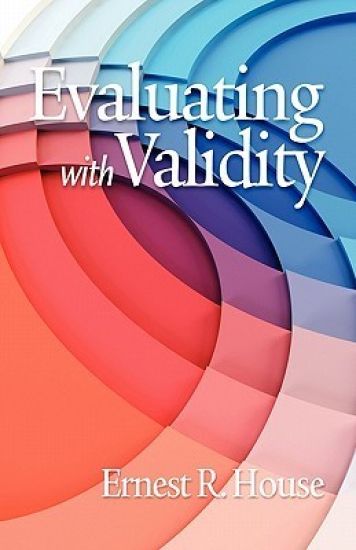
Evaluating with Validity

Evaluating with Validity

Ernest R. House

Information Age Publishing
2010
nidottu
This reissued book is one of the key works that influenced and shaped the contemporary evaluation field. The book developed a new, expanded conception of the validity of evaluation studies, based on broad criteria of truth, beauty, and justice. It also presented a widely-used typology of evaluation approaches and critiqued these approaches with the validity criteria. Its long term influence is demonstrated by the book, (published in 1980) and criteria being prominently featured in the overall theme for the forthcoming American Evaluation Association’s annual conference in November, 2010.
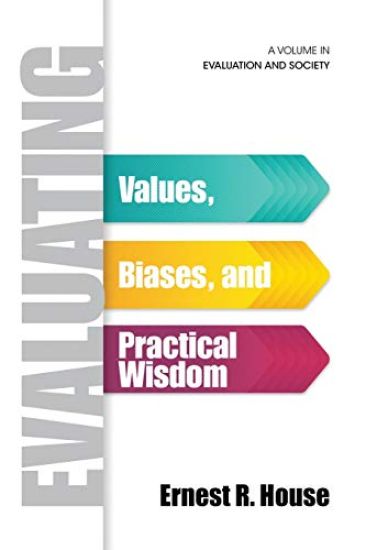
Evaluating

Evaluating

Ernest R. House

Information Age Publishing
2014
nidottu
In this book, Ernie House reframes how we think about evaluation by reconsidering three key concepts of values, biases, and practical wisdom. The first part of the book reconstructs core evaluation concepts, with a focus on the origins of our values and biases. The second part explores how we handle values and biases in practice, and the third shows how we learn practical wisdom and use it in evaluations.Value is the central concept in this volume, yet it’s a fuzzy concept. In Part I, Ernie clarifies the concept of value by addressing basic questions: What are values? Where do they come from? Why do we have them? Why is our conception so confused? How do we handle values in evaluations?In Part II, another central concept is added, that of biases. Prominent evaluation frameworks have focused on biases, including Campbell and Stanley’s (1963) framework for validating causal inferences and Scriven’s (1972) conception of objectivity, which is achieved by correcting for biases in general. In addition, research on thought processes has made progress by focusing on cognitive biases (Kahneman, 2011). Even so, through a case example, Ernie demonstrates that the concept of biases is under-appreciated and not well engaged in evaluation practice.The third important concept, featured in Part III, is practical wisdom, which is the knowledge that evaluators acquire through experience. Practical wisdom informs what we do, possibly as much as theory. Experienced evaluators often conduct evaluations in similar ways, regardless of their theory, because practical wisdom determines much of what they do. Ernie provides concrete examples of practical wisdom and how we employ it. Throughout the book, he draws on the empirical research on thinking processes, especially Kahneman’s Thinking Fast and Slow (2011).This book will be of interest and relevance to all evaluation scholars and practitioners, as it thoughtfully engages core constructs of the field. The book can also well serve as a supplementary text in multiple evaluation courses, as it offers valuable conceptual and practical perspectives on our craft.
Evaluating

Evaluating

Ernest R. House

Information Age Publishing
2014
sidottu
In this book, Ernie House reframes how we think about evaluation by reconsidering three key concepts of values, biases, and practical wisdom. The first part of the book reconstructs core evaluation concepts, with a focus on the origins of our values and biases. The second part explores how we handle values and biases in practice, and the third shows how we learn practical wisdom and use it in evaluations.Value is the central concept in this volume, yet it’s a fuzzy concept. In Part I, Ernie clarifies the concept of value by addressing basic questions: What are values? Where do they come from? Why do we have them? Why is our conception so confused? How do we handle values in evaluations?In Part II, another central concept is added, that of biases. Prominent evaluation frameworks have focused on biases, including Campbell and Stanley’s (1963) framework for validating causal inferences and Scriven’s (1972) conception of objectivity, which is achieved by correcting for biases in general. In addition, research on thought processes has made progress by focusing on cognitive biases (Kahneman, 2011). Even so, through a case example, Ernie demonstrates that the concept of biases is under-appreciated and not well engaged in evaluation practice.The third important concept, featured in Part III, is practical wisdom, which is the knowledge that evaluators acquire through experience. Practical wisdom informs what we do, possibly as much as theory. Experienced evaluators often conduct evaluations in similar ways, regardless of their theory, because practical wisdom determines much of what they do. Ernie provides concrete examples of practical wisdom and how we employ it. Throughout the book, he draws on the empirical research on thinking processes, especially Kahneman’s Thinking Fast and Slow (2011).This book will be of interest and relevance to all evaluation scholars and practitioners, as it thoughtfully engages core constructs of the field. The book can also well serve as a supplementary text in multiple evaluation courses, as it offers valuable conceptual and practical perspectives on our craft.
New Directions in Educational Evaluation

New Directions in Educational Evaluation

Ernest R. House

Falmer Press Ltd
1986
nidottu
First published in 2004. Measuring the outcomes of educational practices is a modern phenomenon. Valuing their worth is as old as philosophy itself. It is the singular value of this collection of papers set in context and introduced by Ernest House that it holds in dynamic equilibrium both the measurement and the valuing sides of educational evaluation. This book will appeal to the student who will find the theoretical analysis of educational evaluation in its several meanings, suggested practices and also the specialist will also find much, not least a critical and challenging appreciation of educational evaluation theory and practice as it faces the problems of the final decades of the twentieth century.