
Kirjojen hintavertailu. Mukana 12 039 528 kirjaa ja 12 kauppaa.

Kirjahaku

Etsi kirjoja tekijän nimen, kirjan nimen tai ISBN:n perusteella.

2 kirjaa tekijältä Ernest W. Adams

A Primer of Probability Logic

A Primer of Probability Logic

Ernest W. Adams

Centre for the Study of Language Information
1996
pokkari
This book is meant to be a primer, that is an introduction, to probability logic, a subject that appears to be in its infancy. Probability logic is a subject envisioned by Hans Reichenbach and largely created by Adams. It treats conditionals as bearers of conditional probabilities and discusses an appropriate sense of validity for arguments such conditionals, as well as ordinary statements as premises. This is a clear well written text on the subject of probability logic, suitable for advanced undergraduates or graduates, but also of interest to professional philosophers. There are well thought out exercises, and a number of advanced topics treated in appendices, while some are brought up in exercises and some are alluded to only in footnotes. By this means it is hoped that the reader will at least be made aware of most of the important ramifications of the subject and its tie-ins with current research, and will have some indications concerning recent and relevant literature.
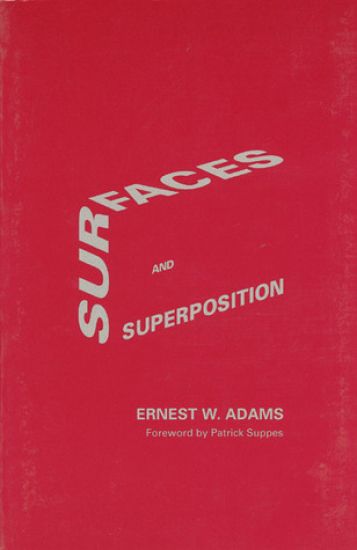
Surfaces and Superposition

Surfaces and Superposition

Ernest W. Adams

Centre for the Study of Language Information
2001
nidottu
Buildings appear to rest on the Earth's surface, yet the surface has actually been permeated by the building's foundations. If blueprints of the foundation are unavailable, excavation would be needed to discover what actually supports a specific building. Geometry and topology have easily observable concepts resting on the surface of theoretical underpinnings that have not been completely discovered, unearthed or understood. Geometrical and topological principles of superposition provide insight into probing the connections between accessible superstructures and their hideen underpinnings. This book develops and applies these insights, from physics to mathematics to philosophy. This text examines the dimensionality of surfaces, how superpositions can make stable frameworks and gives a quasi-Leibnizian account of the relative "spaces" that are defined by these frameworks.