Kirjojen hintavertailu. Mukana 11 342 296 kirjaa ja 12 kauppaa.

Kirjahaku

Etsi kirjoja tekijän nimen, kirjan nimen tai ISBN:n perusteella.

61 kirjaa tekijältä Ernst Mach

Zur Theorie des Gehörorgans von E. Mach

Zur Theorie des Gehörorgans von E. Mach

Ernst Mach

Antigonos Verlag
2024
pokkari
Unver nderter Nachdruck der Originalausgabe von 1872. Der Verlag Antigonos spezialisiert sich auf die Herausgabe von Nachdrucken historischer B cher. Wir achten darauf, dass diese Werke der ffentlichkeit in einem guten Zustand zug nglich gemacht werden, um ihr kulturelles Erbe zu bewahren.
The Science of Mechanics

The Science of Mechanics

Ernst Mach

Cambridge University Press
2013
pokkari
Ernst Mach (1838–1916), the first scientist to study objects moving faster than the speed of sound, propounded a scientific philosophy which called for a strict adherence to observable data. He maintained that the sole purpose of scientific study is to provide the simplest possible description of detectable phenomena. In this work, first published in German in 1883 and here translated in 1893 by Thomas J. McCormack (1865–1932) from the 1888 second edition, Mach begins with a historical discussion of mechanical principles. He then proceeds to a critique of Newton's concept of 'absolute' space and time, reflecting Mach's rejection of theoretical concepts in the absence of definitive evidence. Although historically controversial, Mach's ideas and attitudes informed philosophers as influential as Russell and Wittgenstein, and his insistence upon a 'relative' idea of space and time provided much of the philosophical basis for Einstein's theory of general relativity decades later.
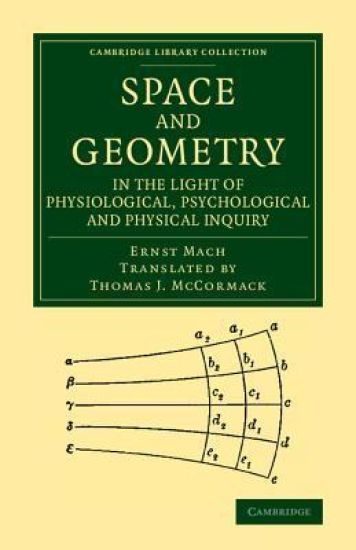
Space and Geometry in the Light of Physiological, Psychological and Physical Inquiry
The Austrian scientist Ernst Mach (1838–1916) carried out work of importance in many fields of enquiry, including physics, physiology, psychology and philosophy. Published in this English translation of 1906, these essays examine geometry from three different perspectives. Mach argues that, as our ideas about space are created by the senses and how we experience our environment, researchers must not consider the subject from a mathematical standpoint alone. In the first essay, he explains how humans generate spatial concepts. Next, he discusses the psychology of geometry, its empirical origins, and its development. In the final piece, he writes from the viewpoint of a physicist, outlining how various mathematicians, such as Carl Friedrich Gauss and Bernhard Riemann, have contributed to our geometrical understanding. Also reissued in this series in English translation are Mach's The Science of Mechanics (1893) and Popular Scientific Lectures (1895).
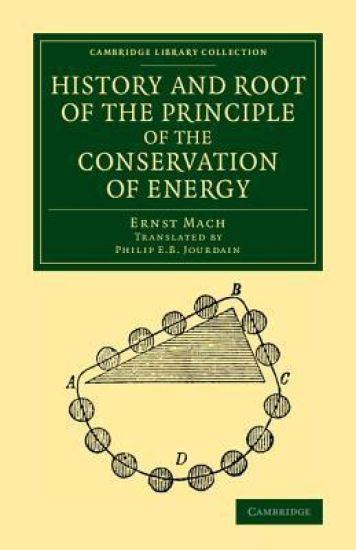
History and Root of the Principle of the Conservation of Energy
The Austrian scientist Ernst Mach (1838–1916) carried out work of importance in several fields of enquiry, including physics, physiology and psychology. In this short work, first published in German in 1872 and translated here into English in 1911 by Philip E. B. Jourdain (1879–1919) from the 1909 second edition, Mach discusses the formulation of one of science's most fundamental theories. He provides his interpretation of the principle of the conservation of energy, claiming its foundations are not in mechanical physics. Mach's 1868 work on the definition of mass - one of his most significant contributions to mechanics - has been incorporated here. His perspective on the topic as a whole remains relevant to those interested in the history of science and the theory of knowledge. Also reissued in this series in English translation are Mach's The Science of Mechanics (1893) and Popular Scientific Lectures (1895).
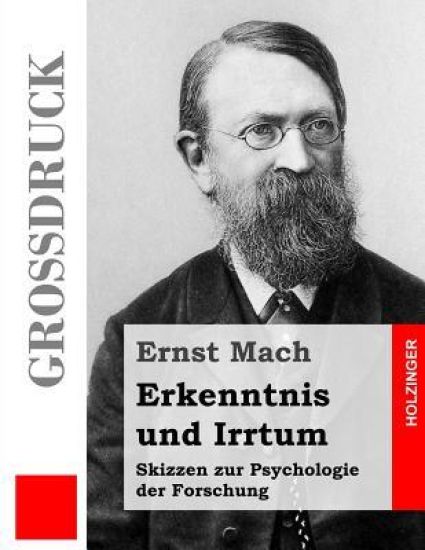
Erkenntnis Und Irrtum: Skizzen Zur Psychologie Der Forschung

Erkenntnis Und Irrtum: Skizzen Zur Psychologie Der Forschung

Ernst Mach

Createspace Independent Publishing Platform
2014
nidottu
Ernst Mach: Erkenntnis und Irrtum. Skizzen zur Psychologie der Forschung Edition Holzinger. Taschenbuch Berliner Ausgabe, 2017, 4. Auflage Durchgesehener Neusatz mit einer Biographie des Autors bearbeitet und eingerichtet von Michael Holzinger Erstdruck: Leipzig (Johann Ambrosius Barth) 1905. Der Text folgt der postum erschienenen 3. durchgesehenen Auflage: Leipzig (Johann Ambrosius Barth) 1917; der Anhang bleibt unber cksichtigt. Widmung: Wilhelm Schuppe in herzlicher Verehrung gewidmet. Textgrundlage ist die Ausgabe: Ernst Mach: Erkenntnis und Irrtum. Skizzen zur Psychologie der Forschung. Dritte durchgesehene Auflage, Leipzig: Johann Ambrosius Barth, 1917. Herausgeber der Reihe: Michael Holzinger Reihengestaltung: Viktor Harvion Umschlaggestaltung unter Verwendung des Bildes: Ernst Mach, Heliograv re von H. F. J tte, 1902 Gesetzt aus der Minion Pro, 11 pt.
Space And Geometry In The Light Of Physiological, Psychological And Physical Inquiry
""Space and Geometry in the Light of Physiological, Psychological and Physical Inquiry"" is a comprehensive exploration of the nature of space and geometry, written by the Austrian physicist and philosopher Ernst Mach. The book delves into the relationship between space and the human mind, examining how our physiological and psychological processes shape our perception of the world around us. Mach also explores the physical properties of space, including its curvature and the role of gravity in shaping the universe. Throughout the book, Mach draws on a range of scientific disciplines, including physics, psychology, and physiology, to provide a nuanced and multifaceted understanding of space and geometry. This work is considered a seminal contribution to the field of philosophy of science and has had a lasting impact on our understanding of the nature of space and the universe.This Is A New Release Of The Original 1906 Edition.This scarce antiquarian book is a facsimile reprint of the old original and may contain some imperfections such as library marks and notations. Because we believe this work is culturally important, we have made it available as part of our commitment for protecting, preserving, and promoting the world's literature in affordable, high quality, modern editions, that are true to their original work.
Erkenntnis und Irrtum (Großdruck): Skizzen zur Psychologie der Forschung

Erkenntnis und Irrtum (Großdruck): Skizzen zur Psychologie der Forschung

Ernst Mach

Createspace Independent Publishing Platform
2014
nidottu
Ernst Mach: Erkenntnis und Irrtum. Skizzen zur Psychologie der Forschung Lesefreundlicher Gro druck in 16-pt-Schrift Edition Holzinger. Gro format, 216 x 279 mm Berliner Ausgabe, 2017 Durchgesehener Neusatz mit einer Biographie des Autors bearbeitet und eingerichtet von Michael Holzinger Erstdruck: Leipzig (Johann Ambrosius Barth) 1905. Der Text folgt der postum erschienenen 3. durchgesehenen Auflage: Leipzig (Johann Ambrosius Barth) 1917; der Anhang bleibt unber cksichtigt. Widmung: Wilhelm Schuppe in herzlicher Verehrung gewidmet. Textgrundlage ist die Ausgabe: Ernst Mach: Erkenntnis und Irrtum. Skizzen zur Psychologie der Forschung. Dritte durchgesehene Auflage, Leipzig: Johann Ambrosius Barth, 1917. Herausgeber der Reihe: Michael Holzinger Reihengestaltung: Viktor Harvion Umschlaggestaltung unter Verwendung des Bildes: Ernst Mach, Heliograv re von H. F. J tte, 1902 Gesetzt aus der Minion Pro, 16 pt.
The Analysis of Sensations, and the Relation of the Physical to the Psychical
Physicist and philosopher Ernst Mach investigates the physical sensations of sight, sound, motion, and the perceptions of space and time.Mach is frank about his book incorporating both scientific and philosophical ideas. While acknowledging his investigations were on the border of what science had helped humans comprehend, he defends his work by stating that the manifold sensations a person experiences each day are the result of a complex interplay of biology and physics. As such, philosophical enquiries on the sensory experience are merited, for science alone cannot encompass or quantify the various sensations with a view to explaining their precise effects on the human mind and its thought processes.An example investigated by Mach is that of time: how certain sensory experiences appear to make time pass slower or faster. Often vivid experiences, a shocking sight, produce the sensation of time slowing - why this occurs and how it affects the mind is discussed at length. Though Mach met with both praise and opposition with the successive editions of this work, he is cheerful at having aroused such debate; he had appropriated aspects of science to philosophic ends.