Kirjojen hintavertailu. Mukana 12 016 292 kirjaa ja 12 kauppaa.

Kirjahaku

Etsi kirjoja tekijän nimen, kirjan nimen tai ISBN:n perusteella.

45 kirjaa tekijältä Etienne Gilson

The Christian Philosophy of St. Thomas Aquinas

The Christian Philosophy of St. Thomas Aquinas

Etienne Gilson

University of Notre Dame Press
1994
nidottu
In this final edition of his classic study of St. Thomas Aquinas, Etienne Gilson presents the sweeping range and organic unity of Thomistic philosophical thought. The philosophical thinking of Aquinas is the result of reason being challenged to relate to many theological conceptions of the Christian tradition. Gilson carefully reviews how Aquinas grapples with the relation itself of faith and reason and continuing through the existence and nature of God and His creation, the world and its creatures, especially human beings with their power of intellect, will, and moral life. He concludes this study by discussing the life of people in society, along with their purpose and final destiny. Gilson demonstrates that Aquinas drew from a wide spectrum of sources in the development of his thought-from the speculations of the ancient Greeks such as Aristotle, to the Arabic and Jewish philosophers of his time, as well as from Christian writers and scripture. The Christian Philosophy of St. Thomas Aquinas offers students of philosophy and medieval studies an insightful introduction to the thought of Aquinas and the Scholastic philosophy of the Middles Ages, insights that are still revelant for today.
From Aristotle to Darwin and Back Again

From Aristotle to Darwin and Back Again

Etienne Gilson

University of Notre Dame Press
1984
sidottu
The great philosopher and historian of philosophy, Étienne Gilson, sets out to show that final causality or purposiveness and formal causality are principles for those who think hard and carefully about the world, including the world of biology. Gilson insists that a completely rational understanding of organisms and biological systems requires the philosophical notion of teleology, the idea that certain kinds of things exist and have ends or purposes the fulfillment of which are linked to their natures—in other words, formal and final causes. His approach relies on philosophical reflection on the facts of science, not upon theology or an appeal to religious authorities such as the Church or the Bible.
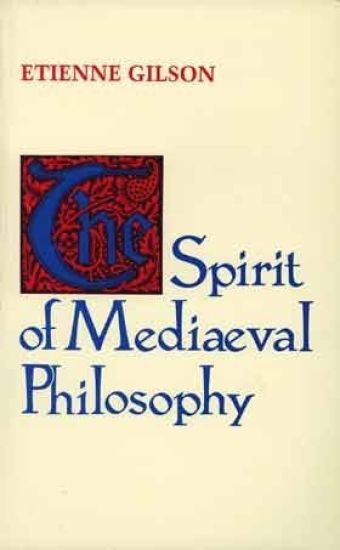
The Spirit of Mediaeval Philosophy

The Spirit of Mediaeval Philosophy

Etienne Gilson

University of Notre Dame Press
1991
nidottu
In this book (a translation of his well-known work L'esprit de la philosophie medievale), Etienne Gilson undertakes the task of defining the spirit of mediaeval philosophy. Gilson asks whether we can form the concept of a Christian philosophy and whether mediaeval philosophy is not its most adequate historical expression. He maintains that the spirit of mediaeval philosophy is the spirit of Christianity penetrating the Greek tradition, working within it, and drawing out of it a certain view of the world that is specifically Christian. To support his hypothesis, Gilson examines mediaeval thought in its nascent state, at that precise point where the Judeo-Christian graft was inserted into the Hellenic tradition. Gilson's demonstration is primarily historical and occasionally theoretical in suggesting how doctrines that satisfied our predecessors for so many centuries may still be found conceivable today.
The Spirit of Mediaeval Philosophy

The Spirit of Mediaeval Philosophy

Etienne Gilson

University of Notre Dame Press
2017
sidottu
In this book (a translation of his well-known work L'esprit de la philosophie medievale), Etienne Gilson undertakes the task of defining the spirit of mediaeval philosophy. Gilson asks whether we can form the concept of a Christian philosophy and whether mediaeval philosophy is not its most adequate historical expression. He maintains that the spirit of mediaeval philosophy is the spirit of Christianity penetrating the Greek tradition, working within it, and drawing out of it a certain view of the world that is specifically Christian. To support his hypothesis, Gilson examines mediaeval thought in its nascent state, at that precise point where the Judeo-Christian graft was inserted into the Hellenic tradition. Gilson's demonstration is primarily historical and occasionally theoretical in suggesting how doctrines that satisfied our predecessors for so many centuries may still be found conceivable today.
The Christian Philosophy of St. Thomas Aquinas

The Christian Philosophy of St. Thomas Aquinas

Etienne Gilson

University of Notre Dame Press
1994
sidottu
In this final edition of his classic study of St. Thomas Aquinas, Etienne Gilson presents the sweeping range and organic unity of Thomistic philosophical thought. The philosophical thinking of Aquinas is the result of reason being challenged to relate to many theological conceptions of the Christian tradition. Gilson carefully reviews how Aquinas grapples with the relation itself of faith and reason and continuing through the existence and nature of God and His creation, the world and its creatures, especially human beings with their power of intellect, will, and moral life. He concludes this study by discussing the life of people in society, along with their purpose and final destiny. Gilson demonstrates that Aquinas drew from a wide spectrum of sources in the development of his thought-from the speculations of the ancient Greeks such as Aristotle, to the Arabic and Jewish philosophers of his time, as well as from Christian writers and scripture. The Christian Philosophy of St. Thomas Aquinas offers students of philosophy and medieval studies an insightful introduction to the thought of Aquinas and the Scholastic philosophy of the Middles Ages, insights that are still revelant for today.
Linguistics and Philosophy

Linguistics and Philosophy

Etienne Gilson

University of Notre Dame Press
2017
nidottu
This marks the first time Linguistics and Philosophy, published in France in 1969, has been translated into English. Here, philosopher Etienne Gilson examines linguistics—from Descartes to Derrida—as he argues for the irreducibility of thought to language. Reviewing the theories of figures such as Condillac, Mallarmé, de Saussure, and Vendryès, Gilson looks at the process whereby thought is translated into language, seeking to reestablish the notion of concepts as mediators. The temptation of linguists to philosophize in such areas as the relationship of thought, language, and the world prompted Gilson to write Linguistics and Philosophy. In the introduction he does not claim to be a linguist, but rather a philosopher exercizing his option of selecting certain issues involving language that seem to be "philosophic constants." Decidedly philosophical in his approach, Gilson examines the way in which words, meanings, and languages grow continually and creatively, an inextricable part of life in society. He also explores our ability to construct abstract thoughts that point to an immaterial power of human beings, and he laments the degeneration of modern language brought about by radio and television broadcasters, especially in connection with neologistic and linguistic borrowing from other languages. We are currently observing the deterioration of language through the spoken word. In this fascinating work, Gilson demonstrates that the linguist cannot be indifferent to this occurrence.
God and Philosophy

God and Philosophy

Etienne Gilson

Yale University Press
2002
pokkari
In this classic work, the eminent Catholic philosopher Étienne Gilson deals with one of the most important and perplexing metaphysical problems: the relation between our notion of God and demonstrations of his existence. Gilson examines Greek, Christian, and modern philosophy as well as the thinking that has grown out of our age of science in this fundamental analysis of the problem of God. “[I] commend to another generation of seekers and students this deeply earnest and yet wistfully gentle little essay on the most important (and often, at least nowadays, the most neglected) of all metaphysical—and existential—questions. . . . The historical sweep is breathtaking, the one-liners arresting, and the style, both intellectual and literary, altogether engaging.” —Jaroslav Pelikan, from the foreword “We have come to expect from the pen of M. Gilson not only an accurate exposition of the thought of the great philosophers, ancient and modern, but what is of much more importance and of greater interest, a keen and sympathetic insight into the reasons for that thought. The present volume does not fail to fulfill our expectations. It should be read by every Christian thinker.” —Ralph O. Dates, America
Heloise and Abelard

Heloise and Abelard

Etienne Gilson

The University of Michigan Press
1960
nidottu
Heloise and Abelard by Etienne Gilson explores the intense and tragic love affair between twelfth-century philosopher Peter Abelard and his brilliant student Heloise. Translated by L. K. Shook, the book delves into the intellectual and personal dynamics of their relationship, set against the backdrop of medieval philosophy and theology. Through a meticulous analysis of their correspondence and historical context, Gilson addresses the secrecy of their marriage, the ethical implications of their love, and Abelard's conversion to religious devotion. The narrative offers a nuanced understanding of their motivations and the societal conflicts they faced, supported by extensive scholarly research. This work provides a comprehensive examination of the intersection of love, philosophy, and theology in their compelling story.
John Duns Scotus

John Duns Scotus

Etienne Gilson

T. T.Clark Ltd
2018
sidottu
Étienne Gilson's Jean Duns Scot: Introduction À Ses Positions Fondamentales is widely understood to be one of the most important works on John Duns Scotus’ texts, famous for their complexity. James Colbert’s translation is the first time that Gilson's work on Scotus has been put into English, with an introduction by Trent Pomplun and an afterword by John Millbank. Scotus contributed to the development of a metaphysical system that was compatible with Christian doctrine, an epistemology that altered the 13th century understanding of human knowledge, and a theology that stressed both divine and human will. Gilson, in turn, offers a thoroughly comprehensive introduction to the fundamental positions that Scotus stood for. Explaining Scotus’s views on metaphysics, the existence of infinite being and divine nature, the matter of the physical spiritual and angelic, intellectual knowledge and will and Scotus’ relationship with other scholars, Gilson and Colbert show how deeply Scotus left a mark on discussions of such disparate topics as the semantics of religious language, the problem of universals, divine illumination, and the nature of human freedom.This work has been translated from the original work in French Jean Duns Scot. Introduction à ses positions fondamentales (© 1952 by Librairie Philosophique J. Vrin).
John Duns Scotus

John Duns Scotus

Etienne Gilson

T. T.Clark Ltd
2020
nidottu
Étienne Gilson's Jean Duns Scot: Introduction À Ses Positions Fondamentales is widely understood to be one of the most important works on John Duns Scotus’ texts, famous for their complexity. James Colbert’s translation is the first time that Gilson's work on Scotus has been put into English, with an introduction by Trent Pomplun and an afterword by John Millbank. Scotus contributed to the development of a metaphysical system that was compatible with Christian doctrine, an epistemology that altered the 13th century understanding of human knowledge, and a theology that stressed both divine and human will. Gilson, in turn, offers a thoroughly comprehensive introduction to the fundamental positions that Scotus stood for. Explaining Scotus’s views on metaphysics, the existence of infinite being and divine nature, the matter of the physical spiritual and angelic, intellectual knowledge and will and Scotus’ relationship with other scholars, Gilson and Colbert show how deeply Scotus left a mark on discussions of such disparate topics as the semantics of religious language, the problem of universals, divine illumination, and the nature of human freedom.This work has been translated from the original work in French Jean Duns Scot. Introduction à ses positions fondamentales (© 1952 by Librairie Philosophique J. Vrin).
Painting and Reality

Painting and Reality

Etienne Gilson

PRINCETON UNIVERSITY PRESS
2023
pokkari
A classic study of the art of painting and its relationship to reality In this book, Étienne Gilson puts forward a bold interpretation of the kind of reality depicted in paintings and its relation to the natural order. Drawing on insights from the writings of great painters—from Leonardo, Reynolds, and Constable to Mondrian and Klee—Gilson shows how painting is foreign to the order of language and knowledge. Painting, he argues, seeks to add new beings to nature, not to represent those that already exist. For this reason, we must distinguish it from another art, that of picturing, which seeks to produce images of actual or possible beings. Though pictures play an important part in human life, they do not belong in the art of painting. Through this distinction, Gilson sheds new light on the evolution of modern painting. A magisterial work of scholarship by an acclaimed historian of philosophy, Painting and Reality features paintings from both classical and modern schools, and includes extended selections from the writings of Reynolds, Delacroix, Gris, Gill, and Ozenfant.
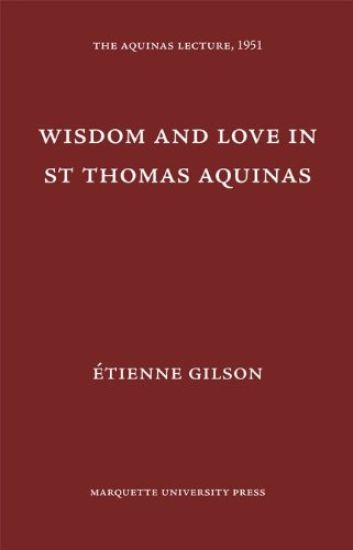
Wisdom and Love in St. Thomas Aquinas

Wisdom and Love in St. Thomas Aquinas

Etienne Gilson

Literary Licensing, LLC
2011
sidottu
Wisdom And Love In St. Thomas Aquinas is a book written by Etienne Gilson, a renowned philosopher and historian of medieval philosophy. The book is a comprehensive exploration of the philosophy of St. Thomas Aquinas, one of the most influential theologians and philosophers in the history of Western thought.Gilson's book is divided into two parts. The first part focuses on Aquinas' concept of wisdom, which he defines as the knowledge of divine things. Gilson explores Aquinas' views on the nature of God, the relationship between faith and reason, and the role of philosophy in understanding the divine.The second part of the book focuses on Aquinas' concept of love, which he sees as the ultimate goal of human existence. Gilson examines Aquinas' views on the nature of love, the relationship between love and knowledge, and the role of love in the moral life.Throughout the book, Gilson provides a detailed analysis of Aquinas' philosophy, drawing on a wide range of texts and sources. He also places Aquinas' ideas in their historical context, showing how they were influenced by the intellectual and cultural currents of the medieval period.Overall, Wisdom And Love In St. Thomas Aquinas is a rich and insightful study of one of the most important thinkers in the history of Western philosophy and theology. It will be of interest to scholars and students of philosophy, theology, and intellectual history, as well as to anyone interested in the relationship between faith and reason, and the nature of human existence.This scarce antiquarian book is a facsimile reprint of the old original and may contain some imperfections such as library marks and notations. Because we believe this work is culturally important, we have made it available as part of our commitment for protecting, preserving, and promoting the world's literature in affordable, high quality, modern editions, that are true to their original work.
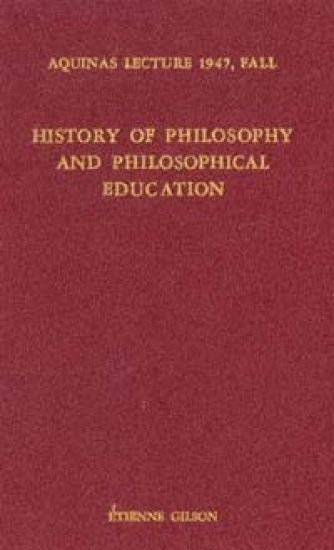
History of Philosophy and Philosophical Education

History of Philosophy and Philosophical Education

Etienne Gilson

Literary Licensing, LLC
2012
sidottu
""History of Philosophy and Philosophical Education"" by Etienne Gilson is a comprehensive study of the development of philosophy and its relationship with education. The book explores the evolution of philosophical thought from ancient Greece to the modern era, tracing the major schools of philosophy and their influence on education. Gilson examines the role of philosophy in shaping the intellectual and moral character of individuals and societies, and argues that a deep understanding of philosophy is essential for a well-rounded education. The book also addresses contemporary debates about the value and relevance of philosophy in the modern world, and offers insights into how philosophy can be taught effectively in the classroom. With its engaging style and insightful analysis, ""History of Philosophy and Philosophical Education"" is an essential resource for students, educators, and anyone interested in the history of ideas and their impact on education and society.Aquinas Lecture Fall, 1947.This scarce antiquarian book is a facsimile reprint of the old original and may contain some imperfections such as library marks and notations. Because we believe this work is culturally important, we have made it available as part of our commitment for protecting, preserving, and promoting the world's literature in affordable, high quality, modern editions, that are true to their original work.