F. B. Meyer's examination of the Prophet Elijah is counted among the most spiritually intensive and detailed ever to be written.The author first places the subject in its historical context - Elijah lived at a time when Israel was divided. Formerly a cohesive society under the able guidance of King Solomon, the Kingdom of Israel and Judah were at odds. The Book of Kings recounts Elijah's ascendance, wherein he became one of the greatest holy men ever seen. Meyer examines the life of the great prophet with a close examination of the scriptures. The various interactions between Elijah and Ahab for example are closely narrated, with their rivalry and conflict over the worship of other Gods analyzed. Meyer discusses the emotional states of Elijah and others, how life's trials presented challenge after challenge, with the gradual, transforming effect of making Eljiah one of God's greatest prophets.F. B. Meyer's books have lost none of their vital essence, their contents being for all-time.
F. B. Meyer's examination of the Prophet Elijah is counted among the most spiritually intensive and detailed ever to be written.The author first places the subject in its historical context - Elijah lived at a time when Israel was divided. Formerly a cohesive society under the able guidance of King Solomon, the Kingdom of Israel and Judah were at odds. The Book of Kings recounts Elijah's ascendance, wherein he became one of the greatest holy men ever seen. Meyer examines the life of the great prophet with a close examination of the scriptures. The various interactions between Elijah and Ahab for example are closely narrated, with their rivalry and conflict over the worship of other Gods analyzed. Meyer discusses the emotional states of Elijah and others, how life's trials presented challenge after challenge, with the gradual, transforming effect of making Eljiah one of God's greatest prophets.F. B. Meyer's books have lost none of their vital essence, their contents being for all-time.
Now with a new foreword by Dallas Willard.F. B. Meyer writes, "The grace of purity and self-control, of fervent prayer and understanding in the Scriptures, of love for men and zeal for God, of lowliness and meekness, of gentleness and goodness--all is in Christ; and if Christ is in us, all is ours also."F.B. Meyer was a contemporary and friend of D.L. Moody who was also a pioneer in the field of inner-city missions work. Drawing constantly on Scripture in this book, Meyer exhorts us to seek after God's best for our lives by examining our inner motives, understanding Christ's role in our present-day, and then examining how we ought to then bear up underneath the secret of God's guidance.
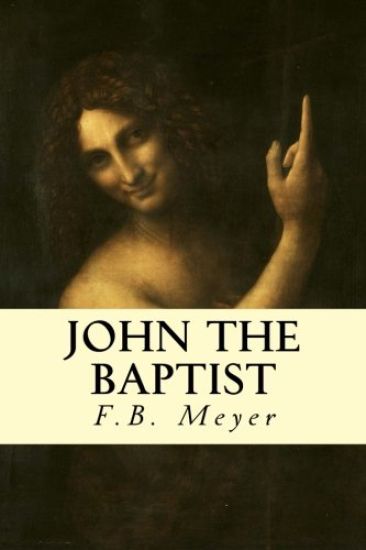
John the Baptist, by F.B. Meyer, is a classic bible biography. As the clasp between the Old Testament and the New--the close of theone and the beginning of the other; as among the greatest of those bornof women; as the porter who opened the door to the True Shepherd; asthe fearless rebuker of royal and shameless sin--the Baptist must evercompel the homage and admiration of mankind. John the Baptist was a Jewish itinerant preacher in the early first century AD. John is revered as a major religious figure in Christianity, Islam, the Bahai Faith, and Mandaeism. He is called a prophet by all of these traditions, and is honored as a saint in many Christian traditions. Other titles for John include John the Forerunner in Eastern Christianity and "the prophet John in Islam. To clarify the meaning of "Baptist", he is sometimes alternatively called John the Baptizer. John used baptism as the central symbol or sacrament of his messianic movement. Most scholars agree that John baptized Jesus. Some scholars believe Jesus was a follower or disciple of John. This idea is strongly controverted, however, by John the Baptist's own words in scripture, although several New Testament accounts report that some of Jesus' early followers had previously been followers of John. 24] John the Baptist is also mentioned by the Jewish historian Josephus. 25] Some scholars maintain that John was influenced by the semi-ascetic Essenes, who expected an apocalypse and practiced rituals corresponding strongly with baptism, 26] although no direct evidence substantiates this. 27] According to the New Testament, John anticipated a messianic figure greater than himself. 28] Christians commonly refer to John as the precursor or forerunner of Jesus, 29] since John announces Jesus' coming. John is also identified as the spiritual successor of the prophet Elijah. The Gospel of Mark introduces John as a fulfilment of a prophecy from the Book of Isaiah (in fact, a conflation of texts from Isaiah, Malachi and Exodus) 31] about a messenger being sent ahead, and a voice crying out in the wilderness. John is described as wearing clothes of camel's hair, living on locusts and wild honey. John proclaims baptism of repentance for the forgiveness of sin, and says another will come after him who will not baptize with water, but with the Holy Spirit. Jesus comes to John, and is baptized by him in the river Jordan. The account describes how; as he emerges from the water, the heavens open and the Holy Spirit descends on him like a dove. A voice from heaven then says, "You are my Son, the Beloved; with you I am well pleased." Later in the gospel there is an account of John's death. It is introduced by an incident where the Tetrarch Herod Antipas, hearing stories about Jesus, imagines that this is John the Baptist raised from the dead. It then explains that John had rebuked Herod for marrying Herodias, the ex-wife of his brother (named here as Philip). Herodias demands his execution, but Herod, who 'liked to listen' to John, is reluctant to do so because he fears him, knowing he is a righteous and holy man. The account then describes how Herod's daughter Herodias (other translations refer to the girl as the daughter of Herodias) dances before Herod, who is pleased and offers her anything she asks for in return. When the girl asks her mother what she should request, she is told to demand the head of John the Baptist. Reluctantly, Herod orders the beheading of John, and his head is delivered to her, at her request, on a plate. John's disciples take the body away and bury it in a tomb.