Kirjojen hintavertailu. Mukana 11 342 296 kirjaa ja 12 kauppaa.

Kirjahaku

Etsi kirjoja tekijän nimen, kirjan nimen tai ISBN:n perusteella.

14 kirjaa tekijältä F. W. J. Schelling

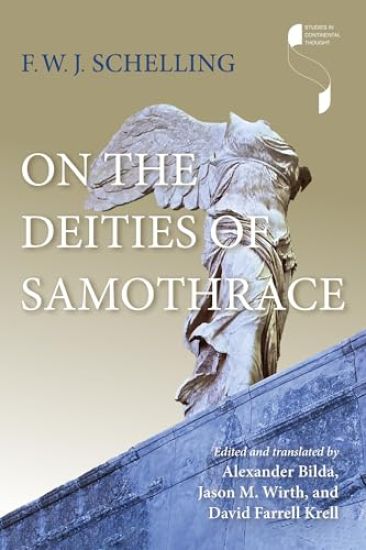
On the Deities of Samothrace

On the Deities of Samothrace

F. W. J. Schelling

INDIANA UNIVERSITY PRESS
2025
sidottu
In 1815, F. W. J. Schelling presented a lecture titled "On the Deities of Samothrace" to the Bavarian Academy of Sciences. The lecture offered a startlingly original reading of the ancient Greek mystery religion on the island of Samothrace. It would be the last book Schelling himself published, and it is the key to his influential Philosophy of Mythology. Now, for the first time in English, this critical edition contains the entirety of Schelling's original text, including the lecture itself, Schelling's afterword, and all his extensive philosophical and philological endnotes. It also offers copious explanatory notes, photographs and maps of the site, and three interpretive essays by the editors and translators elucidating Schelling's text for contemporary readers. On the Deities of Samothrace is one of Schelling's most original and exciting works. It is a signature text in Schelling's thought and in the philosophy of religion generally.
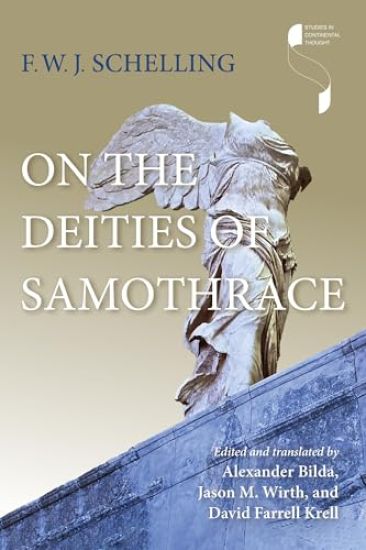
On the Deities of Samothrace

On the Deities of Samothrace

F. W. J. Schelling

INDIANA UNIVERSITY PRESS
2025
pokkari
In 1815, F. W. J. Schelling presented a lecture titled "On the Deities of Samothrace" to the Bavarian Academy of Sciences. The lecture offered a startlingly original reading of the ancient Greek mystery religion on the island of Samothrace. It would be the last book Schelling himself published, and it is the key to his influential Philosophy of Mythology. Now, for the first time in English, this critical edition contains the entirety of Schelling's original text, including the lecture itself, Schelling's afterword, and all his extensive philosophical and philological endnotes. It also offers copious explanatory notes, photographs and maps of the site, and three interpretive essays by the editors and translators elucidating Schelling's text for contemporary readers. On the Deities of Samothrace is one of Schelling's most original and exciting works. It is a signature text in Schelling's thought and in the philosophy of religion generally.

The Ages of the World

The Ages of the World

F. W. J. Schelling

State University of New York Press
2000
pokkari
A new translation of the third and most sustained version of Schelling's magnum opus, this great heroic poem is a genealogy of time. Anticipating Heidegger, as well as contemporary debates about post-modernity and the limits of dialectical thinking, Schelling struggles with the question of time as the relationship between poetry and philosophy. Thinking in the wake of Hegel, although trying to think beyond his grasp, this extraordinary work is a poetic and philosophical address of difference, of thinking's relationship to its inscrutable ground.
Clara

Clara

F. W. J. Schelling

State University of New York Press
2002
pokkari
Part novella, part philosophy, Clara was Schelling's most popular work during his lifetime, and appears here in English for the first time.This is the first English translation of Schelling's novel, most likely written after the death of his first wife, Caroline, the former wife of August Wilhelm Schlegel. Although only a fragment, Clara remains unique. Part novella, part philosophical tome, its central theme is the connection between this world and the next. Schelling masterfully weaves together his knowledge of animal magnetism, literary techniques, and his doctrine of the potencies to make his philosophy accessible to all.Steinkamp addresses the main issues concerning the dating of the work-many commentators have deemed Clara to be a sketch for Schelling's The Ages of the World or an outline for the third, missing book of that work-and provides a short biography of Schelling with particular emphasis on events claimed to play a role in the conception of Clara, such as the deaths of both Caroline and her daughter, Auguste. She also shows how passages in Clara are strikingly similar to the content of Schelling's touching letters mourning Caroline, written to Pauline, the daughter of Caroline's best friend and the woman who would become his second wife. Clara, strongly influenced by the Romantic movement, is an early illustration of Schelling's attempt to unite his positive and negative philosophy.
First Outline of a System of the Philosophy of Nature

First Outline of a System of the Philosophy of Nature

F. W. J. Schelling

State University of New York Press
2004
pokkari
Schelling's first systematic attempt to articulate a complete philosophy of nature.Appearing here in English for the first time, this is F. W. J. Schelling's vital document of the attempts of German Idealism and Romanticism to recover a deeper relationship between humanity and nature and to overcome the separation between mind and matter induced by the modern reductivist program. Written in 1799 and building upon his earlier work, First Outline of a System of the Philosophy of Nature provides the most inclusive exposition of Schelling's philosophy of the natural world. He presents a startlingly contemporary model of an expanding and contracting universe; a unified theory of electricity, gravity magnetism, and chemical forces; and, perhaps most importantly, a conception of nature as a living and organic whole.
Philosophical Investigations into the Essence of Human Freedom

Philosophical Investigations into the Essence of Human Freedom

F. W. J. Schelling

State University of New York Press
2007
pokkari
Schelling's masterpiece investigating evil and freedom.Jeff Love and Johannes Schmidt offer a fresh translation of Schelling's enigmatic and influential masterpiece, widely recognized as an indispensable work of German Idealism. The text is an embarrassment of riches-both wildly adventurous and somberly prescient. Martin Heidegger claimed that it was "one of the deepest works of German and thus also of Western philosophy" and that it utterly undermined Hegel's monumental Science of Logic before the latter had even appeared in print. Schelling carefully investigates the problem of evil by building on Kant's notion of radical evil, while also developing an astonishingly original conception of freedom and personality that exerted an enormous (if subterranean) influence on the later course of European philosophy from Schopenhauer and Kierkegaard through Heidegger to important contemporary theorists like Slavoj Zðizûek.This translation of Schelling's notoriously difficult and densely allusive work provides extensive annotations and translations of a series of texts (by Boehme, Baader, Lessing, Jacobi, and Herder), hard to find or previously unavailable in English, whose presence in the Philosophical Investigations is unmistakable and highly significant. This handy study edition of Schelling's masterpiece will prove useful for scholars and students alike.
The Grounding of Positive Philosophy

The Grounding of Positive Philosophy

F. W. J. Schelling

State University of New York Press
2008
pokkari
The first English translation of Schelling's final "existential system."The Berlin lectures in The Grounding of Positive Philosophy, appearing here for the first time in English, advance Schelling's final "existential system" as an alternative to modernity's reduction of philosophy to a purely formal science of reason. The onetime protégé of Fichte and benefactor of Hegel, Schelling accuses German Idealism of dealing "with the world of lived experience just as a surgeon who promises to cure your ailing leg by amputating it." Schelling's appeal in Berlin for a positive, existential philosophy found an interested audience in Kierkegaard, Engels, Feuerbach, Marx, and Bakunin. His account of the ecstatic nature of existence and reason proved to be decisive for the work of Paul Tillich and Martin Heidegger. Also, Schelling's critique of reason's quixotic attempt at self-grounding anticipates similar criticisms leveled by poststructuralism, but without sacrificing philosophy's power to provide a positive account of truth and meaning. The Berlin lectures provide fascinating insight into the thought processes of one of the most provocative yet least understood thinkers of nineteenth-century German philosophy.
Bruno, or On the Natural and Divine Principle of Things

Bruno, or On the Natural and Divine Principle of Things

F. W. J. Schelling

State University of New York Press
1984
pokkari
Makes Schelling's dialogue Bruno readily accessible to the English-language reader, with valuable commentary on the work itself, which details Schelling's account of his differences from Fichte.F. W. J. Schelling has remained unknown to most contemporary scholars, yet his thought is of great import to early 19th century philosophy and the study of German Idealism. For the first time, Michael G. Vater makes Schelling's dialogue Bruno readily accessible to the English-language reader while providing valuable commentary on the work itself, which details Schelling's account of his differences from Fichte.In an extensive introduction, Vater discusses the background and significance of Schelling's identity-philosophy and its impact on the development of Hegel's thought from 1802 to the publication of Hegel's Phenomenology. Comprehensive notes point out Schelling's use of classic sources, his dependence on Spinoza, and the similarities in Schelling's and Hegel's points of view during their collaboration on the Critical Journal.Through the value of its own arguments and its influence on Hegel, Schelling's Bruno provides key material for the evolution on 19th century philosophy. In Schelling's system, Hegel found the construction of a harmonious whole in which his own basic conflicts and those of his generation found their solution. Hegel's Difference and Schelling's Bruno announce a new programme and outline its foundations: Philosophy must become metaphysical again and unify a world torn by the conflicting and one-sided ideologies of materialism and spiritualism.
Philosophy of Revelation (1841-42) and Related Texts

Philosophy of Revelation (1841-42) and Related Texts

F. W. J. Schelling

Spring Publications Inc
2020
nidottu
The first complete translation of the 1841-42 lectures on "Philosophy and Revelation" by the important German idealist philosopher Friedrich Wilhelm Joseph Schelling (1775-1854), as transcribed by H. E. G. Paulus. Schelling's "Philosophy of Revelation" was never published during his lifetime. The historically most significant 1841-42 lectures in Berlin exist only in transcriptions, which form the basis of this volume. Introduced, translated, and annotated by the Schelling scholar Klaus Ottmann, the lectures are paired with earlier writings and lectures on the subject of philosophy and religion, such as his 1798 text on "Revelation and National Education;" his 1802 Jena lecture "On the Historical Construct of Christianity;" and his 1827 inaugural lecture in Munich.
Statement on the True Relationship of the Philosophy of Nature to the Revised Fichtean Doctrine
Schelling's 1806 polemic against Fichte, and his last major work on the philosophy of nature.The heat of anger can concentrate the mind. Convinced that he had been betrayed by his former collaborator and colleague, Schelling attempts in this polemic to reach a final reckoning with Fichte. Employing the format of a book review, Schelling directs withering scorn at three of Fichte's recent publications, at one point likening them to the hell, purgatory, and would-be paradise of Fichtean philosophy. The central bone of contention is the understanding of nature: Fichte sees it as lifeless matter in motion, sheer opposition to be overcome, while Schelling waxes poetic in his defense of a living, organic nature of which humanity is a vital part. Indeed, we do not know ourselves without understanding our connection to nature, argues Schelling, anticipating many thinkers in contemporary environmental ethics.Dale E. Snow's introduction sets the stage and explains the larger context of the conflict, which was already visible in the correspondence of the two philosophers, which broke off by 1802. Notes are included throughout the text, providing background information and identifying the many references to Fichte.
The Ages of the World (1811)

The Ages of the World (1811)

F. W. J. Schelling

State University of New York Press
2020
pokkari
The first English translation of the first of three versions of this unfinished work by Schelling.In 1810, after establishing a reputation as Europe's most prolific philosopher, F. W. J. Schelling embarked on his most ambitious project, The Ages of the World. For over a decade he produced multiple drafts of the work before finally conceding its failure, a "failure" in which Heidegger, Jaspers, Voegelin, and many others have discerned a pivotal moment in the history of philosophy. Slavoj Žižek calls this text the "vanishing mediator," the project that, even while withheld and concealed from view, connects the epoch of classical metaphysics that stretches from Plato to Hegel with the post-metaphysical thinking that began with Marx and Kierkegaard. Although drafts of the second and third versions from 1813 and 1815 have long been available in English, this translation by Joseph P. Lawrence is the first of the initial 1811 text. In his introductory essay, Lawrence argues for the importance of this first version of the work as the one that reveals the full sweep of Schelling's intended project, and he explains its significance for concerns in modern science, history, and religion.
Filosofiska undersökningar om den mänskliga frihetens väsen
F. W. J. Schellings "frihetsskrift" - eller Filosofiska undersökningar om den mänskliga frihetens väsen och de därmed sammanhängande ämnena, som är bokens fulla originaltitel - är ett av den tyska idealismens absoluta huvudverk. Här lyfter Schelling fram den mänskliga friheten som en levande kraft i ljuset av ondskans möjlighet. Skriften publicerades första gången 1809 och har haft ett avgörande inflytande på filosofins utveckling ända fram till vår tid. Det är glädjande att för första gången kunna presentera Filosofiska undersökningar om den mänskliga frihetens väsen i svensk översättning, här försedd med en orienterande inledning av Marcia Sá Cavalcante Schuback, docent i filosofi vid Södertörns högskola. Översättningen är utförd av Christian Nilsson och utgåvan innehåller också ett appendix i form av Schellings förord till förstapubliceringen av verket i Philosophische Schriften, 1809. F. W. J. Schelling (1775-1854) var en av portalfigurerna för den tyska idealismen och romantiken. Under Schellings livstid hamnade hans spekulativa naturfilosofi och metafysiska utläggningar efter hand i skuggan av G. W. F. Hegels systemtänkande. Postumt har dock Schellings texters potential gång på gång nyupptäckts - genom existensfilosofer som Søren Kierkegaard och Martin Heidegger, men också i vår samtid av bland andra Slavoj iek och Jean-Luc Nancy. Bokförlaget h:ström - Text & Kultur har tidigare av F. W. J Schelling utgivit: Inledning till filosofin (2012)