Kirjojen hintavertailu. Mukana 12 016 292 kirjaa ja 12 kauppaa.

Kirjahaku

Etsi kirjoja tekijän nimen, kirjan nimen tai ISBN:n perusteella.

4 kirjaa tekijältä Felix Alba-Juez

Galloping with Light - Einstein, Relativity, and Folklore

Galloping with Light - Einstein, Relativity, and Folklore

Felix Alba-Juez

Createspace Independent Publishing Platform
2010
nidottu
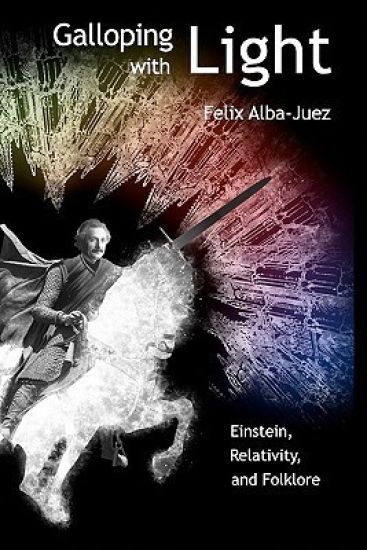
Tired of popular science books written by renowned physicists who think you cannot comprehend what they do, so... all you deserve is the illusion of understanding? If yes, this is the book for you. The fact that the reader may not have a scientific education does not mean that s/he does not have the intelligence to understand profound concepts -- as long as they are presented with semantic and epistemological clarity. After all, Einstein said that Science is simply the refinement of our intuition and everyday experiences.Galloping with Light is a symbolic cavalcade that starts with the discovery of fire 1.5 million years ago; it allegorically employs the imagination of an adolescent called Einstein to explain the Theory of Relativity in non-scientific terms, and ends with the Apollo 11 landing on the Moon in 1969 -- depositing on lunar soil a laser retro-reflector which would prove, once again, that Einstein was right.Motivated by his own difficulties to understand Relativity Theory, and convinced that it is possible to teach the layperson without distorting the subject matter, the author takes an approach utterly opposed to that of most popular science books. Knowing he has to demolish what the reader understands by time, distance, and motion, the author -using his experiences as a child, adolescent, and adult- dedicates the first half of the book to convince the reader that our intuition and common sense, as applied to those three everyday concepts, have a foundation as solid as that of a castle on the sand. The purpose of this book is to demystify and 'defolklorize' the reader; to destroy the aura of mystery and incomprehensibility surrounding Relativity Theory, unmasking and debunking the body of popular (and scientific) beliefs (mostly erroneous) which -taking advantage of the confusion between relativity and subjectivity, as well as of Einstein's popularity and prestige- have been used to validate preposterous assertions in fields like psychology, morality, spirituality, sociology, literature, art, etc.
Aiming at REALITY: Statistical Entropy, Disorder, and the Quantum
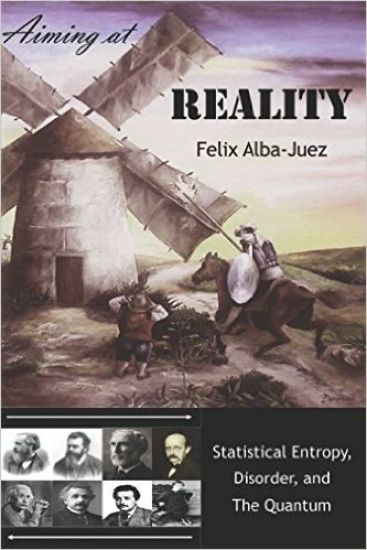
This Black & White printed Edition of Aiming at Reality, the second book of the series 'Quantum Physics free of Folklore', starts with a hypothetical Socratic/Platonic dialog between the realist Sancho Panza and the idealist Don Quixote, after the latter confronted the Reality of colliding with a windmill. He had kicked at one of his imaginary giants and the real windmill had kicked back at him. The Reality of the impact had not been compromised: Don Quixote 'explained' to Sancho that the same enchanter who had burned his library had -with a spooky action at a distance- turned the giant into a windmill right before their encounter. Somehow, the real windmill had been created by the measurement (encounter) while, before it, a blurred pseudo-Reality (a whole set of potentialities) had been hovering in the mind of the ingenious knight-errant. The parallel between this iconic passage of Cervantes's fictional magnum opus and what happened during the first half of the 20th century (and is still happening) is compelling. Reality has dwarfed fiction. Most of the conundrums, ingrained in the century-old controversy regarding the physical interpretations of Quantum Physics, are encrypted in the imaginary dialog between Don Quixote and Sancho: 1. What is the nature of a physical object in the micro-world? Why do we insist in confusing the semantics of 'behaving like' (epistemic metaphor) with the semantics of 'being' (ontic). Micro-objects are neither particles nor waves (and of course they are not both ) 2. What is Probability? How do Probability and Statistics work together to describe Reality in Quantum Physics? Are they just a tool to palliate our lack of knowledge and/or limited computing capacity or... are they Nature's intrinsic modus operandi? 3. What is the role of the observer? Is the correct interpretation of Quantum Mechanics intimately related to the correct interpretation of probability (classical, subjectivist, frequentist, and propensity)? 4. Why are complex numbers so important for the new Physics? If the probabilities are real numbers, why does Quantum Physics calculate them through a mysterious complex number? 5. Why is the Second Law of Thermodynamics not a strictly deterministic law but a probabilistic one? Why is a macro-property like Entropy a measure of disorder (randomness) in the microcosm and how is it related to Nature's innovation by chance we see in biological evolution and everywhere? And what is the relation between Statistical Entropy and the anisotropy of time? Through a quantum-like description of a mundane macro-object like the Galton/Popper bean machine, the reader can grasp the concepts of quantum state, eigenstates, eigenvalues, and wavefunction. S/he can also understand: a. Probabilities are objective properties of the physical world that 'kick' us back when we 'kick' them; b. What is really behind the infamous 'collapse of the wavefunction'; c. A bean (photon) does not need to 'know' whether a pin (slit) has been removed (closed) or not; and d. Einstein's spooky action at a distance is happening around us all the time. The fact that the reader may not have a scientific education does not mean that s/he does not have the intelligence to understand profound concepts -- as long as they are presented with semantic and epistemological clarity. After all, Einstein said that Science is simply the refinement of our intuition and everyday experiences.
Elements of REALITY: 1925-1935 - The Onset of an UNFINISHED Philosophical Struggle
This is a printed Edition for the 4th book in the series 'Quantum Physics free of Folklore'. Besides lack of consensus among scientists/philosophers, there is passion and contention when interpreting Quantum Theory vis vis our notion of REALITY. This book presents a novel interpretation, which is sharply distinguished from the Copenhagen Interpretation and the Many-Worlds Interpretation defended by Sean Carroll in his recent book 'Something Deeply Hidden'. In 2013, the camera in the Cassini-Huygens spacecraft captured Saturn's rings plus our 'pale blue dot' in the same frame (book's cover). At 1.2 million km near Saturn, an inanimate piece of silicon 1.4 billion km afar encoded our planet's existence. Remarkably, we were not the observers but the observed Without our knowledge or volition, reflected light from Earth 'kicked' Cassini's image sensor. In turn, a digital representation of the image was transmitted back, 'kicking' the antennas on our planet. Whether those numbers reached Earth or not, the REALITY of our cosmic home was already 'etched' into the piece of silicon until its demise in 2017. This book's objective is to deeply understand what the 100-year philosophical struggle regarding REALITY is all about. In the process, we will learn that: 1) Through sunglasses and a TV set, complex probability amplitude and phase for the state of a single micro-object seems natural to explain the macro-phenomena of intensity and interference. Born's probability rule is thereby justified. The Principle of Uncertainty is unrelated to measurement, uncertainty, and knowledge. The probability distribution for a physical attribute is far more fundamental than the values the attribute can adopt. 2) The notion of quantum spin is related to the Zeeman Effect and the Stern-Gerlach Experiment. Considering a physical interaction as an ordinary measurement is one of the main reasons behind the hogwash surrounding the so-called 'measurement problem'. The real spin property is the probability distribution of its two values, not the values themselves. 3) Schr dinger's Wave Mechanics and its Born's probabilistic interpretation have profound philosophical implications: locality in the configuration space implies nonlocality in our physical space. The miscalled 'interference of probabilities' is related to decoherence, to the reduction of the wavefunction, and to REALITY. 4) The Cauchy-Schwarz Inequality in complex vector spaces leads directly to the 'Principle of Uncertainty', proving it is not a Principle but a theorem and has nothing to do with the micro-object being disturbed, with measurement errors, or how much knowledge is attainable upon observation. 5) The real property of a qubit is the probability distribution of its values. When a 2-qubit system is in the singlet state, an event involving one qubit does influence the state of the entangled qubit at a distant location -- even if the two events are space-like. Quantum computers promise a novel kind of parallelism, with computational speed exponentially increasing with the number of qubits. A novel approach to safeguard confidential information was critically needed, and the solution turned out to be Quantum Cryptography. 6) A deep understanding of the EPR paper is crucial to grasp the century-long dispute about REALITY. Preconceptions regarding what a physical property is, the Principle of Locality, and the meaning of the 'Uncertainty Principle' populate the EPR paper. EPR conflates the joint reality of two noncommutative physical properties with 'predictability' and 'measurability' of their values. EPR believed the wavefunction did not provide a complete description of REALITY. They believed that such a theory was possible. Einstein was right: such a theory is in fact possible... at the immense cost of his being proven wrong on other front: any such theory must entail his worst nightmare (nonlocal
Nighing REALITY: Quantum Fusion after 25 years of Confusion
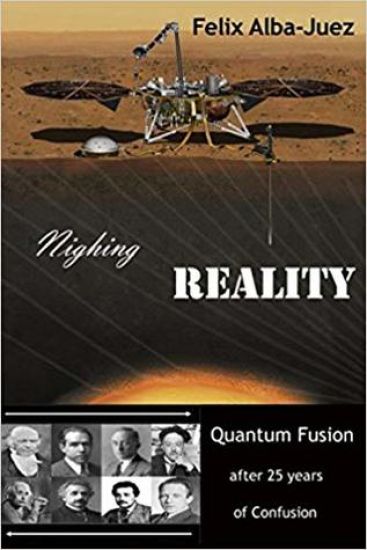
This is a Printed Edition in B & W. After 'Records of the Future' and 'Aiming at REALITY', 'Nighing REALITY' is a step forward towards clutching the elusive notion of Reality. The InSight mission to Mars (book cover) is all about exploring the external world, with measurement being supreme: any instrument suspect of altering what it measures will be blamed on the incompetence of its designer -- not on Reality. Whether we make close contact with Reality or not will depend upon how cogently we process the data that the InSight explorer will transmit to us. With a philosophical introduction, followed by a conceptual presentation of Classical Physics, the evolution towards the new quantum paradigm is narrated through the discussion of spontaneous radioactivity, Ray and Wave Optics, Hamilton's mechanics, Einstein's light quanta, Bohr's atom, Quantum Entropy, and de Broglie's Wave Mechanics. The book ends with a conceptual presentation of how, motivated by persistent disagreement between theory and experiment, the first formulation of modern Quantum Physics -Matrix Mechanics- was born. In the process, the reader will understand that: 1.The relational behavior of a physical object vis vis its environment does not diminish a bit its reality -- let alone does it imply that we are creating the Reality we observe; 2.The object's milieu is an essential part of the object's quantum state; 3.The exponential function with both real and imaginary arguments holds a privileged status in Nature's modus operandi; 4.Discreteness in physical attributes is very common in our level of common experience, e.g. the discrete frequencies of the standing waves established in a guitar string; 5.The classical wavelike interpretation of light diffraction utterly fails as light intensity is gradually reduced. Light is neither a wave nor a stream of Newton's particles; 6.Photons are not Newton's corpuscles because they do not have a rest mass and, due to energy conservation, their number is not conserved; 7.The classical relation between the motion of an electrically charged object and the electromagnetic radiation it creates completely fails in the micro-world; 8.Bosons (e.g. photons) are indistinguishable gregarious quantum objects, and Fermions (e.g. electrons) are indistinguishable separatist quantum objects; 9.With the new quantum statistics (Bose-Einstein and Fermi-Dirac), plus Planck's quantization of Boltzmann's cell, the concept of Statistical Entropy finally becomes absolute and fully consistent with the Third Law of Thermodynamics; 10.De Broglie extended Einstein's theory of the photon to massive particles, proving that Bohr's mysterious quantization of the atom's energy levels was equivalent to identifying the discrete stable states of a continuous system; 11.Heisenberg wrote down the mechanical laws not as equations for the trajectory of the electron orbiting the nucleus but as equations for their Fourier expansions. The Hamiltonian Function became a matrix. The famous matrix commutation relation came about as the generalization of Bohr's quantizing condition; 12.The 'Principle of Uncertainty' is anticipated to have nothing to do with measurement disturbances or measurement errors. As the author likes to say: the fact that the reader may not have a scientific education does not mean that s/he does not have the intelligence to understand profound concepts -- as long as they are presented with semantic and epistemological clarity. After all, Einstein said that Science is simply the refinement of our intuition and everyday experiences.