Kirjojen hintavertailu. Mukana 11 244 527 kirjaa ja 12 kauppaa.

Kirjahaku

Etsi kirjoja tekijän nimen, kirjan nimen tai ISBN:n perusteella.

75 kirjaa tekijältä Felix Klein

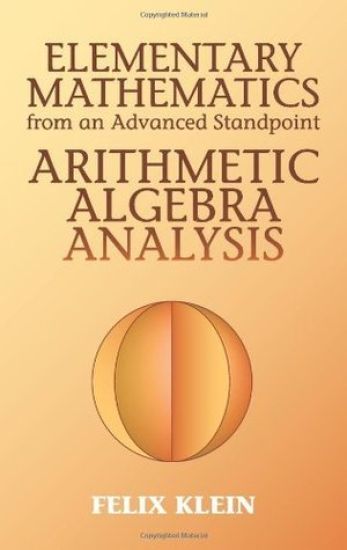
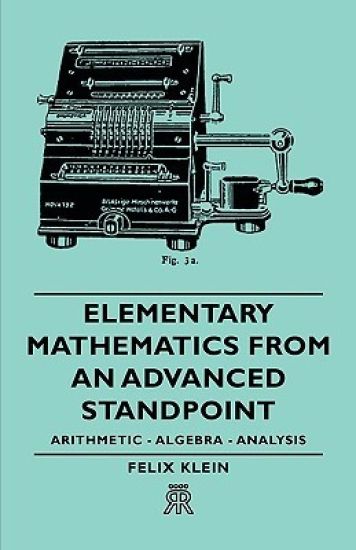
Elementary Mathematics from an Advanced Standpoint

Elementary Mathematics from an Advanced Standpoint

Felix Klein

Dover Publications Inc.
2004
nidottu
Discusses calculating with natural numbers, the first extension of the notion of number, special properties of integers, and complex numbers; algebra-related subjects such as real equations with real unknowns and equations in the field of complex quantities. Also explores elements of analysis, with discussions of logarithmic and exponential functions, the goniometric functions, and infinitesimal calculus. 1932 edition. 125 figures.
Lectures on Mathematics

Lectures on Mathematics

Felix Klein

Amer Mathematical Society
2000
sidottu
In the late summer of 1893, following the Congress of Mathematicians held in Chicago, Felix Klein gave two weeks of lectures on the current state of mathematics. Rather than offering a universal perspective, Klein presented his personal view of the most important topics of the time. It is remarkable how most of the topics continue to be important today. Originally published in 1893 and reissued by the AMS in 1911, we are pleased to bring this work into print once more with this new edition. Klein begins by highlighting the works of Clebsch and of Lie. In particular, he discusses Clebsch's work on Abelian functions and compares his approach to the theory with Riemann's more geometrical point of view. Klein devotes two lectures to Sophus Lie, focussing on his contributions to geometry, including sphere geometry and contact geometry.Klein's ability to connect different mathematical disciplines clearly comes through in his lectures on mathematical developments. For instance, he discusses recent progress in non-Euclidean geometry by emphasizing the connections to projective geometry and the role of transformation groups.In his descriptions of analytic function theory and of recent work in hyperelliptic and Abelian functions, Klein is guided by Riemann's geometric point of view. He discusses Galois theory and solutions of algebraic equations of degree five or higher by reducing them to normal forms that might be solved by non-algebraic means. Thus, as discovered by Hermite and Kronecker, the quintic can be solved 'by elliptic functions'.This also leads to Klein's well-known work connecting the quintic to the group of the icosahedron. Klein expounds on the roles of intuition and logical thinking in mathematics. He reflects on the influence of physics and the physical world on mathematics and, conversely, on the influence of mathematics on physics and the other natural sciences. The discussion is strikingly similar to today's discussions about 'physical mathematics'. There are a few other topics covered in the lectures which are somewhat removed from Klein's own work. For example, he discusses Hilbert's proof of the transcendence of certain types of numbers (including $\pi$ and $e$), which Klein finds much simpler than the methods used by Lindemann to show the transcendence of $\pi$.Also, Klein uses the example of quadratic forms (and forms of higher degree) to explain the need for a theory of ideals as developed by Kummer.Klein's look at mathematics at the end of the 19th Century remains compelling today, both as history and as mathematics. It is delightful and fascinating to observe from a one-hundred year retrospect, the musings of one of the masters of an earlier era.
Lectures on the Icosahedron and the Solution of Equations of the Fifth Degree
Lectures On The Icosahedron And The Solution Of Equations Of The Fifth Degree is a mathematical book written by Felix Klein. The book is divided into two parts. The first part of the book discusses the properties of the icosahedron, which is a three-dimensional geometric shape with 20 equilateral triangles as its faces. Klein explores the symmetry and geometry of the icosahedron and its relationship to other shapes in mathematics.The second part of the book focuses on the solution of equations of the fifth degree. This is a problem that had puzzled mathematicians for centuries, and Klein presents a comprehensive and detailed account of the various attempts to solve this problem. He also provides his own solution to the problem, which involves the use of the icosahedron.Overall, Lectures On The Icosahedron And The Solution Of Equations Of The Fifth Degree is a seminal work in the field of mathematics. It is a must-read for anyone interested in geometry, algebra, or the history of mathematics.This scarce antiquarian book is a facsimile reprint of the old original and may contain some imperfections such as library marks and notations. Because we believe this work is culturally important, we have made it available as part of our commitment for protecting, preserving, and promoting the world's literature in affordable, high quality, modern editions, that are true to their original work.
Differential- und Integral-Rechnung; Vorlesungen, Sommer [und] Winter Semester, 1895-1896/97
This work has been selected by scholars as being culturally important, and is part of the knowledge base of civilization as we know it. This work was reproduced from the original artifact, and remains as true to the original work as possible. Therefore, you will see the original copyright references, library stamps (as most of these works have been housed in our most important libraries around the world), and other notations in the work.This work is in the public domain in the United States of America, and possibly other nations. Within the United States, you may freely copy and distribute this work, as no entity (individual or corporate) has a copyright on the body of the work.As a reproduction of a historical artifact, this work may contain missing or blurred pages, poor pictures, errant marks, etc. Scholars believe, and we concur, that this work is important enough to be preserved, reproduced, and made generally available to the public. We appreciate your support of the preservation process, and thank you for being an important part of keeping this knowledge alive and relevant.