Kirjojen hintavertailu. Mukana 12 390 323 kirjaa ja 12 kauppaa.

Kirjahaku

Etsi kirjoja tekijän nimen, kirjan nimen tai ISBN:n perusteella.

3 kirjaa tekijältä Fernando Luiz Lara

Spatial Theories for the Americas

Spatial Theories for the Americas

Fernando Luiz Lara

UNIVERSITY OF PITTSBURGH PRESS
2025
sidottu
To study the built environment of the Americas is to wrestle with an inherent contradiction. While the disciplines of architecture, urban design, landscape, and planning share the fundamental belief that space and place matter, the overwhelming majority of canonical knowledge and the vernacular used to describe these disciplines comes from another, very different, continent. With this book, Fernando Luiz Lara discusses several theories of space—drawing on cartography, geography, anthropology, and mostly architecture—and proposes counterweights to five centuries of Eurocentrism. The first part of Spatial Theories for the Americas offers a critique of Eurocentrism in the discipline of architecture, problematizing its theoretical foundation in relation to the inseparability of modernization and colonization. The second part makes explicit the insufficiencies of a hegemonic Western tradition at the core of spatial theories by discussing a long list of authors who have thought about the Americas. To overcome centuries of Eurocentrism, Lara concludes, will require a tremendous effort, but, nonetheless, we have the responsibility of looking at the built environment of the Americas through our own lenses. Spatial Theories for the Americas proposes a fundamental step in that direction.

Excepcionalidad del Modernismo Brasileño

Excepcionalidad del Modernismo Brasileño

Fernando Luiz Lara

Nhamerica Press LLC
2019
nidottu
Los textos reunidos en este tomo son el resultado de veinte a os de investigaci n sobre la arquitectura moderna brasile a, sobre su diseminaci n y penetraci n, su genialidad y sus contradicciones, desde la Pampulha hasta las favelas pasando por las casitas de clase media y los maestros alba iles que construyeron todo eso.Entonces, qu hay de excepcional en la arquitectura moderna brasile a? Ser a su exuberancia pl stica? El milagro de arquitectura llamado Oscar Niemeyer del que hablaba L cio Costa en 1951? Su supuesta capacidad de subvertir la matriz corbusiana? Ser a el encuentro de esta misma arquitectura con la voluntad constructora de Juscelino Kubitschek - encuentro que ocurri en la orillas de una laguna de mi ciudad natal diez a os antes del texto de Costa, o sea, en 1941? O ser a excepcional el rigor tect nico paulista que se cristaliz en la d cada subsiguiente al referido texto y que domina el imaginario de la arquitectura con "A" may scula del pa s hasta hoy, 75 a os de despu s de Pampulha y cincuenta a os despu s de la FAU USP?Existe, sin embargo, una excepcionalidad del caso brasile o, y este es el eje central de este libro. La escala de la diseminaci n y de la apropiaci n popular del vocabulario y de la espacialidad moderna en Brasil es impar, efectivamente excepcional.
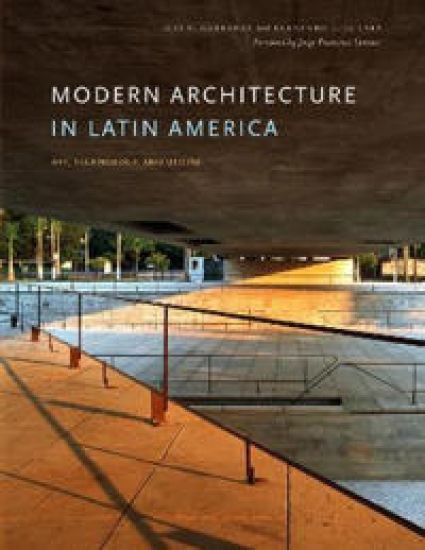
Modern Architecture in Latin America

Modern Architecture in Latin America

Luis E. Carranza; Fernando Luiz Lara

University of Texas Press
2015
pokkari
Designed as a survey and focused on key examples and movements arranged chronologically from 1903 to 2003, this is the first comprehensive history of modern architecture in Latin America in any language. Runner-up, University Co-op Robert W. Hamilton Book Award, 2015Modern Architecture in Latin America: Art, Technology, and Utopia is an introductory text on the issues, polemics, and works that represent the complex processes of political, economic, and cultural modernization in the twentieth century. The number and types of projects varied greatly from country to country, but, as a whole, the region produced a significant body of architecture that has never before been presented in a single volume in any language. Modern Architecture in Latin America is the first comprehensive history of this important production.Designed as a survey and focused on key examples/paradigms arranged chronologically from 1903 to 2003, this volume covers a myriad of countries; historical, social, and political conditions; and projects/developments that range from small houses to urban plans to architectural movements. The book is structured so that it can be read in a variety of ways-as a historically developed narrative of modern architecture in Latin America, as a country-specific chronology, or as a treatment of traditions centered on issues of art, technology, or utopia. This structure allows readers to see the development of multiple and parallel branches/historical strands of architecture and, at times, their interconnections across countries. The authors provide a critical evaluation of the movements presented in relationship to their overall goals and architectural transformations.