Kirjojen hintavertailu. Mukana 12 016 292 kirjaa ja 12 kauppaa.

Kirjahaku

Etsi kirjoja tekijän nimen, kirjan nimen tai ISBN:n perusteella.

25 kirjaa tekijältä Floyd Merrell

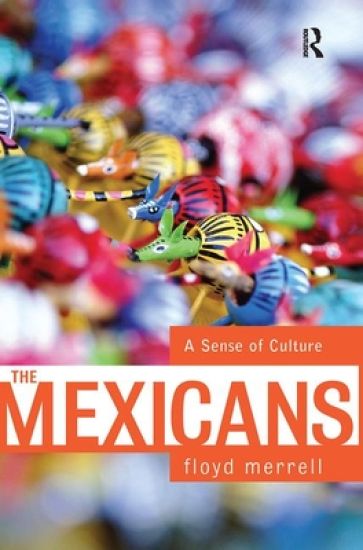
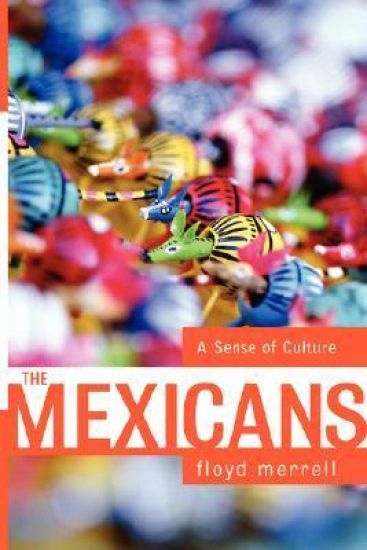
The Mexicans

The Mexicans

Floyd Merrell

Routledge
2019
sidottu
This historical overview of Mexico explores at every opportunity what it is that makes contemporary Mexico the fascinating and vibrant melange of cultures that it is. Embracing an exuberant array of ethnic diversity?including Amerindian, African-American, and European cultures?Mexico is emblematic of much of the clash and combination of cultures that characterizes virtually all of Latin America, from the earliest European conquest and colonization to the present day, The Mexicans: A Sense of Culture captures and reveals the intriguing complexities of daily life in Mexico, from its artistic pursuits to its political and economic patterns.
Sobre las Culturas y Civilizaciones Latinoamericanas

Sobre las Culturas y Civilizaciones Latinoamericanas

Floyd Merrell

University Press of America
1999
nidottu
Unique among textbooks, Sobre Las Culturas Y Civilizaciones Latinoamericanas not only describes the history of Latin America, it sets a mood that allows the reader to get real sense of the languages, cultures, and civilizations that comprise this complex and colorful land. It provides an account of how Columbus's voyages gave rise to utopian dreams, the ramifications of which led to a brilliant display of hybrid cultures, changed the ethnic composition of two continents, accelerated lines of commerce, and refashioned the Western World's diet. After discussing the topographical features and ethnic composition of Latin America, author Floyd Merrell takes the reader through the "discovery," conquest, and colonization of the New World and on to independence and the national period. In the process, he recreates the mood of Latin America with the idea that this will help the reader gain insight into the hopes and fears, as well as the joys and sorrows, of an industrious but long-suffering people. Added features of this textbook are the lists of general concepts, important terms, questions, and topics for classroom debate that accompany each chapter. Comprehensive in scope and compelling in its approach, this text chronicles the history of an important region in a way that will excite students and teachers alike. (TEXT IN SPANISH)
Sensing Corporeally

Sensing Corporeally

Floyd Merrell

University of Toronto Press
2003
sidottu
In Sensing Corporeally, Floyd Merrell argues that human sensation and cognition should be thought of in terms of continually changing signs that can be accounted for in terms of topological forms. Focusing on qualitative and analogical sensing, rather than quantitative and digital reasoning, Merrell begins by reflecting on the concept of consciousness as developed by neurologist Antonio Damasio, whose work in turn reflects Charles Peirce's conception of the sign. By expanding Peirce's notion of the sign in light of Damasio's work, as well as that of Oliver Sacks and the Argentine fabulist Jorge Luis Borges, Merrell demonstrates the importance of the relationship between cognition, consciousness, and fantasy. The philosophy of science espoused by Michael Polanyi, and the analytic and postanalytic philosophies of Donald Davidson, Nelson Goodman, Hilary Putnam, and Richard Rorty are also explored in light of what they bring to Peircean concepts of vagueness and generality, inconsistency and incompleteness, and abduction, induction, and deduction. Merrell concludes by moving to the conceptual world of biologist Jakob von Uexküll and his Umwelt Merrell aims to overcome linear, mechanical thinking by underlining the role of the body and, in turn, the role of feeling and sensing, in the development of cognitive processes. Sensing Corporeally is thus a forceful and timely challenge to traditional models of human understanding.
Signs Grow

Signs Grow

Floyd Merrell

University of Toronto Press
1996
pokkari
This is the third volume in Floyd Merrell's trilogy on semiotics focusing on Peirce's categories of Firstness, Secondness, and Thirdness. In this book the author argues that there are passageways linking the social sciences with the physical sciences, and signs with life processes. This is not a study of the semiotics of life, but rather of semiosis as a living process. Merrell attempts to articulate the links between thought that is rooted in that which can be quantified and thought that resists quantification, namely that of the consciousness. As he writes in his preface, he is intent on `fusing the customary distinctions between life and non-life, mind and matter, self and other, appearance (fiction) and "reality," ... to reveal the everything that is is a sign.' In order to accomplish this goal, Peirce's terciary concept of the sign is crucial. Merrell begins by asking `What are signs that they may take on life-like processes, and what is life that it may know the sign processes that brought it - themselves - into existence?' In order to answer this question he examines semiotic theory, philosophical discourse, the life sciences, the mathematical sciences, and literary theory. He offers an original reading of Peirce's thought along with that of Prigogine and of many others. Following Sebeok, Merrell reminds us that `any and all investigation of nature and of the nature of signs and life must ultimately be semiotic in nature.'
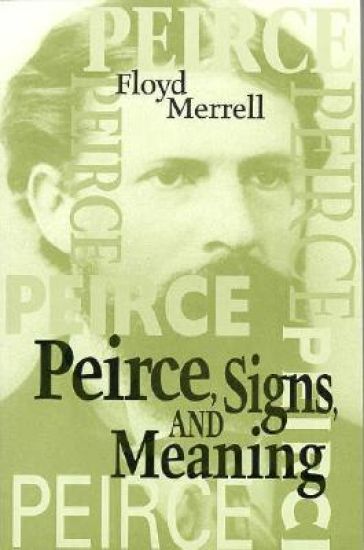
Peirce, Signs, and Meaning

Peirce, Signs, and Meaning

Floyd Merrell

University of Toronto Press
1997
pokkari
C.S. Peirce was the founder of pragmatism and a pioneer in the field of semiotics. His work investigated the problem of meaning, which is the core aspect of semiosis as well as a significant issue in many academic fields. Floyd Merrell demonstrates throughout Peirce, Signs, and Meaning that Peirce's views remain dynamically relevant to the analysis of subsequent work in the philosophy of language. Merrell discusses Peirce's thought in relation to that of early twentieth-century philosophers such as Frege, Russell, and Quine, and contemporaries such as Goodman, Putnam, Davidson, and Rorty. In doing so, Merrell demonstrates how quests for meaning inevitably fall victim to vagueness in pursuit of generality, and how vagueness manifests an inevitable tinge of inconsistency, just as generalities always remain incomplete. He suggests that vagueness and incompleteness/generality, overdetermination and underdetermination, and Peirce's phenomenological categories of Firstness, Secondness, and Thirdness must be incorporated into notions of sign structure for a proper treatment of meaning. He also argues that the twentieth-century search for meaning has placed overbearing stress on language while ignoring nonlinguistic sign modes and means. Peirce, Signs, and Meaning is an important sequel to Merrell's trilogy, Signs Becoming Signs', Semiosis in the Postmodern Age, and Signs Grow. This book is not only a significant contribution to the field of semiotics, it has much to offer scholars in literature, philosophy, linguistics, cultural studies, and other academic disciplines in which meaning is a central concern.
The Mexicans

The Mexicans

Floyd Merrell

Westview Press Inc
2003
pokkari
This historical overview of Mexico explores at every opportunity what it is that makes contemporary Mexico the fascinating and vibrant melange of cultures that it is. Embracing an exuberant array of ethnic diversity,including Amerindian, African-American, and European cultures,Mexico is emblematic of much of the clash and combination of cultures that characterizes virtually all of Latin America, from the earliest European conquest and colonization to the present day, The Mexicans: A Sense of Culture captures and reveals the intriguing complexities of daily life in Mexico, from its artistic pursuits to its political and economic patterns.
Semiosis in the Postmodern Age

Semiosis in the Postmodern Age

Floyd Merrell

Purdue University Press
1995
sidottu
Who are we to suppose we are capable of comprehending the world of which we are a part, and what is the world to suppose it can be understood by us, miniscule and insignificant spatiotemporal warps contained within it?" This provocative question opens Floyd Merrell's study of post modernism and the thought of Charles Sanders Peirce, part of the author's ongoing effort to understand our contemporary cultural and intellectual environment. Merrell's specific focus in this interdisciplinary study is the modernism/postmodernism dichotomy and Peirce's precocious realization that the world does not lend itself to the simplistic binarism of modernist thought. In Merrell's examination of postmodern phenomena, the reader is taken through various facets of the cognitive sciences, philosophy of science, mathematics, and literary theory. Throughout this work, Merrell is scrupulously aware that we are participants within, not detached spectators of, our signs. We understand them while we interact with them, during which process we, and our signs as well, invariably undergo change.
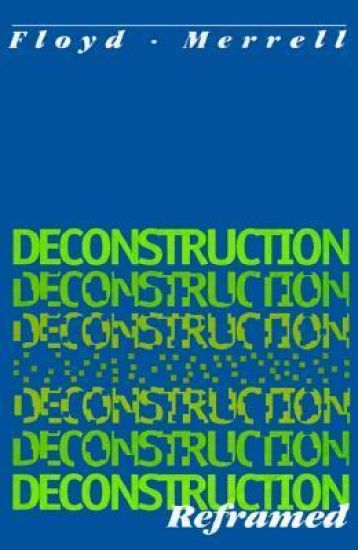
Deconstruction Reframed

Deconstruction Reframed

Floyd Merrell

Purdue University Press
1985
nidottu
Directed chiefly toward scholars in literary criticism and theory, Peircean semiotics, and, more generally, philosophy, this book is, by the nature of its broad focus, more descriptive than critical, synthetic rather than overtly prescriptive. Beginning with a brief discussion of Peirce and deconstruction, the author then turns to the relevance of current concepts in science and the philosophy of science as well as mathematics – especially Gödel's theorems. Subsequently, a series of "thought experiments" is used to illustrate that some concepts propounded by deconstruction are compatible with certain aspects of the "new physics." The notion of writing is compared to Karl Popper's philosophy of science, and finally, a discussion of Beckett rounds out the author's general thesis.
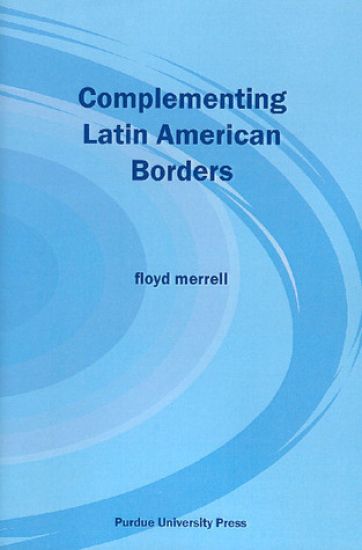
Complementing Latin American Borders

Complementing Latin American Borders

Floyd Merrell

Purdue University Press
2005
nidottu
The idea of complementing borders is appropriately ambiguous with respect to Latin America. People inhabiting cultural borders do not belong to either of the two sides, yet they are contained within the complementation that emerges when two or more cultures interdependently and incongruously interact. In giving an account of complementing borders, this volume alludes to the Latin American context through notions of rhythms and resonances, euphonies and discords, continuous flows and syncopies- all of which are found in everyday life, the arts, politics, economics, and social institutions and practices.
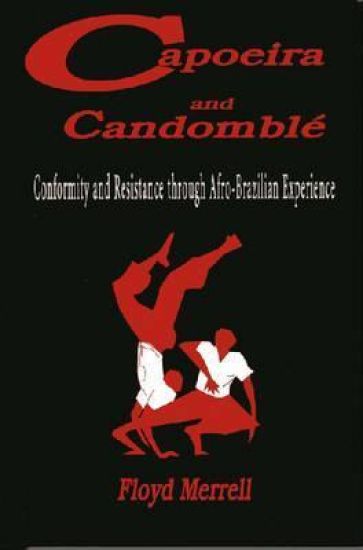
Capoeira and Candomble

Capoeira and Candomble

Floyd Merrell

Markus Wiener Publishing Inc
2005
sidottu
Capoeira is a unique music-dance-sport-play activity created by African slaves, and Candomble is a hybrid religion combining Catholic and African beliefs and practices. And while there are numerous books on Candomble and kindred Afro-American religions, none of them effectively combines Candomble and Capoeira. Actually, Capoeira and Candomble are closely tied to one another. Together, they make up a coherent form of life in Brazil within the current process of globalization about which there has been much ballyhoo, eulogies, and condemnation. This study involves the author's practice of and reflections on the arts of Capoeira and Candomble; it culminates in the idea of an ""other logic,"" an alternative culture ""logic,"" about which much lip service is being paid in academic circles, with little to no concrete details. This book, consequently, is one of a kind insofar as it bears on the interdependency of two Afro-Brazilian practices while grounding them in a theoretical framework and at the same time interrelating them with topics of great concern in the initial years of a new millennium: post-colonial and diaspora studies.
Capoeira and Candomble

Capoeira and Candomble

Floyd Merrell

Markus Wiener Publishing Inc
2005
nidottu
Capoeira is a unique music-dance-sport-play activity created by African slaves, and Candomble is a hybrid religion combining Catholic and African beliefs and practices. And while there are numerous books on Candomble and kindred Afro-American religions, none of them effectively combines Candomble and Capoeira. Actually, Capoeira and Candomble are closely tied to one another. Together, they make up a coherent form of life in Brazil within the current process of globalization about which there has been much ballyhoo, eulogies, and condemnation. This study involves the author's practice of and reflections on the arts of Capoeira and Candomble; it culminates in the idea of an ""other logic,"" an alternative culture ""logic,"" about which much lip service is being paid in academic circles, with little to no concrete details. This book, consequently, is one of a kind insofar as it bears on the interdependency of two Afro-Brazilian practices while grounding them in a theoretical framework and at the same time interrelating them with topics of great concern in the initial years of a new millennium: post-colonial and diaspora studies.
Earth's Android Double?

Earth's Android Double?

Floyd Merrell

Createspace Independent Publishing Platform
2018
nidottu
The Earth came into existence. Centuries later, a supremely competent Android appeared. Her gods created her, then she re-created herself, created her own world, and liberally populated it with Androids. But she knows not how to administer her marvelous design. For they who created her did not properly instruct her. Nevertheless, she does her best. Obsessed over the idea of improvising in line with her style of reasoning, and when it fails, availing herself of scientific knowing. Human immigrants begin pouring into her world. Rendering her best intentions inordinately trying and testy. Yet, life goes on, presenting vicissitudes and violence at every turn, as she dedicates her life to her people, the have-nots. A would-be terrorist murders her. Her enemies, the haves, applaud. Her devotees anguish. Soon thereafter, thoughts, both positive and negative, begin dwelling on her once again. And she lives, in the hearts and minds of her people. To the chagrin of those who rejected her.