Kirjojen hintavertailu. Mukana 11 699 587 kirjaa ja 12 kauppaa.

Kirjahaku

Etsi kirjoja tekijän nimen, kirjan nimen tai ISBN:n perusteella.

5 kirjaa tekijältä Francesca Cauchi

Zarathustra Contra Zarathustra

Zarathustra Contra Zarathustra

Francesca Cauchi

Routledge
2017
sidottu
This study, first published in 1998, makes a lively and welcome contribution to the critical analysis of Nietzsche’s seminal classic This Spoke Zarathustra. Through a close textual reading of the neglected and ill-understood part four of the text, the author seeks to show that Nietzsche’s project of self-overcoming is a failure. Offering herself as a philosopher-priestess of the wisdom of pessimism, Francesca Cauchi invokes a complex of responses in the reader, providing a necessary challenge to any and all advocates of life.
Zarathustra Contra Zarathustra

Zarathustra Contra Zarathustra

Francesca Cauchi

Routledge
2019
nidottu
This study, first published in 1998, makes a lively and welcome contribution to the critical analysis of Nietzsche’s seminal classic This Spoke Zarathustra. Through a close textual reading of the neglected and ill-understood part four of the text, the author seeks to show that Nietzsche’s project of self-overcoming is a failure. Offering herself as a philosopher-priestess of the wisdom of pessimism, Francesca Cauchi invokes a complex of responses in the reader, providing a necessary challenge to any and all advocates of life.
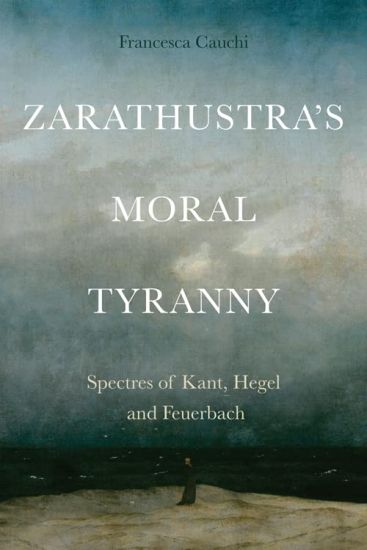
Zarathustra'S Moral Tyranny

Zarathustra'S Moral Tyranny

Francesca Cauchi

EDINBURGH UNIVERSITY PRESS
2022
sidottu
Presents Nietzsche's Zarathustra as a moral tyrant whose ethics are more exacting than the Christian morals they are intended to supplant Identifies and critiques the four key strands of Nietzsche's ethics of self-overcoming Unmasks the 'moralism' behind Nietzsche's self-professed 'immoralism' Furthers research on the intellectual parallels between Nietzsche and Kant and between Nietzsche and Hegel The first critical work to discern affinities between Nietzsche and Feuerbach on the subject of love, sacrifice and a higher humanity By way of a sustained interrogation of Zarathustra's doctrine of self-overcoming, Francesca Cauchi lays bare the asceticism underlying the prescriptive injunctions set forth in the first two parts of Thus Spoke Zarathustra. These injunctions fall under three heads: self-legislation, self-denial and self-sacrifice, which are shown to bear striking affinities with concepts first formulated by Kant, Hegel and Feuerbach, respectively. In Cauchi's new reading, the Kantian rational will, the Hegelian 'labour of the negative' and Feuerbach's indivisible trinity of love, sacrifice and suffering are seen to resurface in Zarathustra as the agents of a ferocious and self-eviscerating doctrine of self-overcoming that exhibits all the attributes of a moral tyranny.
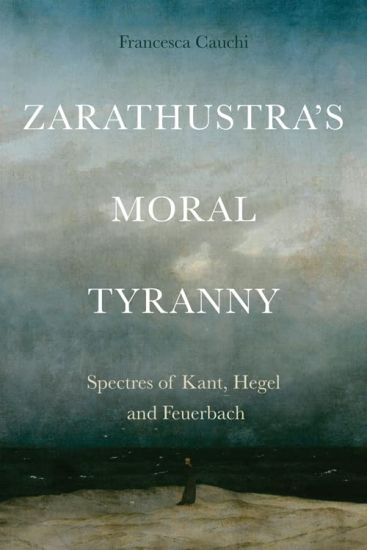
Zarathustra'S Moral Tyranny

Zarathustra'S Moral Tyranny

Francesca Cauchi

EDINBURGH UNIVERSITY PRESS
2024
nidottu
By way of a sustained interrogation of Zarathustra's doctrine of self-overcoming, Francesca Cauchi lays bare the asceticism underlying the prescriptive injunctions set forth in the first two parts of Thus Spoke Zarathustra. These injunctions fall under three heads: self-legislation, self-denial and self-sacrifice, which are shown to bear striking affinities with concepts first formulated by Kant, Hegel and Feuerbach. In Cauchi's new reading, the Kantian rational will, the Hegelian 'labour of the negative' and Feuerbach's indivisible trinity of love, sacrifice and suffering are seen to resurface in Zarathustra as the agents of a ferocious and self-eviscerating doctrine of self-overcoming that exhibits all the attributes of a moral tyranny.

Nietzsche's Rhetoric

Nietzsche's Rhetoric

Francesca Cauchi

Springer International Publishing AG
2023
sidottu
This book excavates the rhetorical devices that Nietzsche habitually uses and demonstrates how they circumscribe rather than expand the reader’s interpretive horizon. Through a sustained analysis of Nietzsche’s rhetorical style, stratagems, and didactic aims in two of his early works (‘On Truth and Lies in a Non-Moral Sense’ and Daybreak) and two of his later works (Beyond Good and Evil and Twilight of the Idols), the book assesses the extent to which Nietzsche’s substantial rhetorical arsenal undermines the philosophical claims he is seeking to advance. The four case studies also bring to the fore some of the less palatable aspects of Nietzsche’s thought such as racial stereotyping, the essentialising of a so-called slave mentality, and the ranking of human beings based on a highly idiosyncratic and prejudiced view of what qualifies as noble and ignoble.