Kirjojen hintavertailu. Mukana 12 016 292 kirjaa ja 12 kauppaa.

Kirjahaku

Etsi kirjoja tekijän nimen, kirjan nimen tai ISBN:n perusteella.

6 kirjaa tekijältä Francesca Rochberg

Before Nature

Before Nature

Francesca Rochberg

University of Chicago Press
2017
sidottu
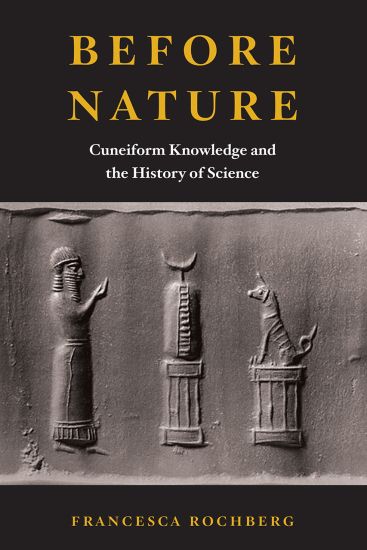
In the modern West, we take for granted that what we call the "natural world" confronts us all and always has but we are wrong. In reality, nature is a human construct. Before Nature is an exploration of that almost unimaginable time when there was no such thing as "nature" no word, reference, or sense for it. Long before the concept of nature formed over the long history of European philosophy and science, our ancestors in ancient Assyria and Babylonia developed the cuneiform script, the earliest system of writing used for documenting and observing the world in a way not wholly dissimilar to our modern science With Before Nature, Francesca Rochberg explores that Assyro-Babylonian knowledge tradition and shows how it relates to the history of science, despite not being focused around a conscious category of nature. From a modern, Western perspective, a world not conceived somehow within the framework of physical nature is difficult if not impossible to imagine. Yet, as Rochberg lays out, ancient Assyro-Babylonian investigations of regularity and irregularity, norms and anomalies clearly established an axis of knowledge between the knower and an intelligible, ordered world. Rochberg is the first scholar to make a case for how exactly we can understand cuneiform knowledge, prediction, and explanation in relation to science without recourse to later ideas of nature. Systematically examining the whole of Mesopotamian science from a remarkable analytic and historical perspective, Before Nature will open up surprising new pathways for studying the history of science.
Before Nature

Before Nature

Francesca Rochberg

University of Chicago Press
2020
nidottu
In the modern West, we take for granted that what we call the “natural world” confronts us all and always has—but Before Nature explores that almost unimaginable time when there was no such conception of “nature”—no word, reference, or sense for it. Before the concept of nature formed over the long history of European philosophy and science, our ancestors in ancient Assyria and Babylonia developed an inquiry into the world in a way that is kindred to our modern science. With Before Nature, Francesca Rochberg explores that Assyro-Babylonian knowledge tradition and shows how it relates to the entire history of science. From a modern, Western perspective, a world not conceived somehow within the framework of physical nature is difficult—if not impossible—to imagine. Yet, as Rochberg lays out, ancient investigations of regularity and irregularity, norms and anomalies clearly established an axis of knowledge between the knower and an intelligible, ordered world. Rochberg is the first scholar to make a case for how exactly we can understand cuneiform knowledge, observation, prediction, and explanation in relation to science—without recourse to later ideas of nature. Systematically examining the whole of Mesopotamian science with a distinctive historical and methodological approach, Before Nature will open up surprising new pathways for studying the history of science.
The Heavenly Writing

The Heavenly Writing

Francesca Rochberg

Cambridge University Press
2004
sidottu
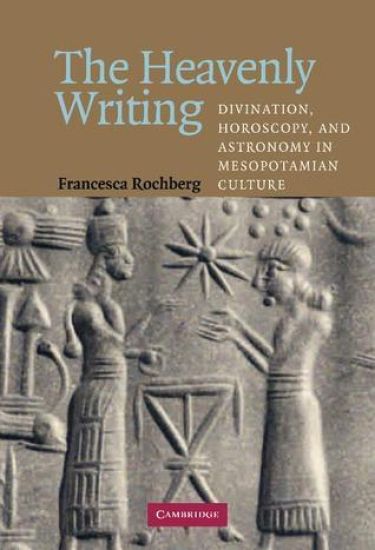
In antiquity, the expertise of the Babylonians in matters of the heavens was legendary and the roots of both western astronomy and astrology are traceable in cuneiform tablets going back to the second and first millennia BC. The Heavenly Writing discusses the place of Babylonian celestial divination, horoscopy, and astronomy in Mesopotamian intellectual culture. Focusing chiefly on celestial divination and horoscopes, it traces the emergence of personal astrology from the tradition of celestial divination and the use of astronomical methods in horoscopes. It further takes up the historiographical and philosophical issue of the nature of these Mesopotamian ‘celestial sciences’ by examining elements traditionally of concern to the philosophy of science, without sacrificing the ancient methods, goals, and interests to a modern image of science. This book will be of particular interest to those concerned with the early history of science.
Babylonian Horoscopes

Babylonian Horoscopes

Francesca Rochberg

American Philosophical Society Press
1998
pokkari
Emerging for the first time in the 5th cent. B.C., horoscopes reflect the application of the idea and practice of celestial divination to the life of the individual. Whereas an omen focuses on a single astronomical phenomenon, the horoscope takes into account the positions of the moon, sun, and five planets at the moment of a birth. As such, Babylonian horoscopes presuppose the concept of the ecliptic and a methodology for obtaining the positions of heavenly bodies when they are not observable. This is the first complete edition of the extant cuneiform horoscopes -- with transcription and philological and astronomical commentary. This study offers a systematic description of the documents as a definable class of Babylonian astronomical/astrological texts.
Worldmaking and Cuneiform Antiquity

Worldmaking and Cuneiform Antiquity

Francesca Rochberg

Cambridge University Press
2025
sidottu
Objects of knowledge exist within material, immaterial, and conceptual worlds. Once the world is conceived from the perspective of others, the physical ontology of modern science no longer functions as a standard by which to understand other orderings of reality, whether from ethnographical or historical sources. Because premodern and non-western sources attest to a plurality of sciences practiced in accordance with different ways of worldmaking from that of the modern West, their study belongs to the history of science, the philosophy of science, and the sociology of science, as well as the anthropology of science. In Worldmaking and Cuneiform Antiquity, Francesca Rochberg extends an anthropology of science to the historical world of cuneiform texts of ancient Babylonia. Exploring how Babylonian science has been understood, she proposes a new direction for scholarship by recognizing the world of ancient science, not as a less developed form of modern science, but as legitimate and real in its own right.
In the Path of the Moon: Babylonian Celestial Divination and Its Legacy
Celestial divination, in the form of omens from lunar, planetary, astral, and meteorological phenomena, was central to Mesopotamian cuneiform scholarship and science from the late second millennium BCE into the Hellenistic period. Beyond the boundaries of ancient Mesopotamia, the ideas, texts, and traditions of Babylonian celestial divination are traceable in Hellenistic sciences and philosophies. This collection of essays investigates features of Babylonian celestial divination with special focus on those aspects that influenced later Greco-Roman astronomy, astrology, and theories of signs. A multi-faceted collection of philological, historical, and philosophical investigations, In the Path of the Moon offers Assyriologists, Classicists, and historians of ancient science a wide-ranging series of studies unified around the theme of Babylonian celestial divination's legacy."The collected essays in this volume, successive steps in an ordered path, constitute an invaluable contribution to a better understanding of Babylonian divination."Lorenzo Verderame, "Sapienza" Universit di Roma"The reader interested in the multifaceted presentation of the problems related to the explanation of Babylonian celestial divination and well equipped with the knowledge of Akkadian will certainly be rewarded by the study of Rochberg's latest publication."Henryk Drawnel, SDB