Kirjojen hintavertailu. Mukana 12 016 292 kirjaa ja 12 kauppaa.

Kirjahaku

Etsi kirjoja tekijän nimen, kirjan nimen tai ISBN:n perusteella.

3 kirjaa tekijältä Francesca Saggini

The Gothic Novel and the Stage

The Gothic Novel and the Stage

Francesca Saggini

Routledge
2019
nidottu
In this ground-breaking study Francesca Saggini explores the relationship between the late eighteenth-century novel and the theatre, arguing that the implicit theatricality of the Gothic novel made it an obvious source from which dramatists could take ideas. Similarly, elements of the theatre provided inspiration to novelists. Saggini opens her study with a very useful and persuasive overview of the themes and forms of Gothic drama. In her view, stage appropriation is the textual threshold in which novelistic and dramatic/ performative texts overlap on and disseminate through each other. She examines in details the use of three specific aspects of Gothic dramatic language as recorded by both novel and drama: music, lighting, and scene design. The following chapters, informed by semiotic and narrative theory, closely examine the stage appropriations respectively in and of the Gothic novel, particularly, though not exclusively, the representation of the supernatural in Ann Radcliffe and Matthew G. Lewis. Boaden’s successful Gothic drama Fontainville Forest challenges a central aspect of Radcliffe’s poetics: her reliance on the so-called explained supernatural and puts it context by looking at contemporary stage presentations of the supernatural as offered for instance in Hamlet. The final part of the study frames Lewis’s representation of the supernatural in The Monk within the contemporary mechanics of staging and discusses the novel in relation to contemporary stage presentation and in the context of Romantic harlequinades and spectacular visual exhibits. Saggini makes a convincing argument for a transmedial and highly cooperative reading of Gothic texts and spectacles. Her approach does not seek to displace the novel or ‘the text’ from modern perceptions of the Gothic, but wants to open the genre to plural and anti-hierarchical forms of reading and to recognise its resourcefulness in appropriating theatrical t
Backstage in the Novel

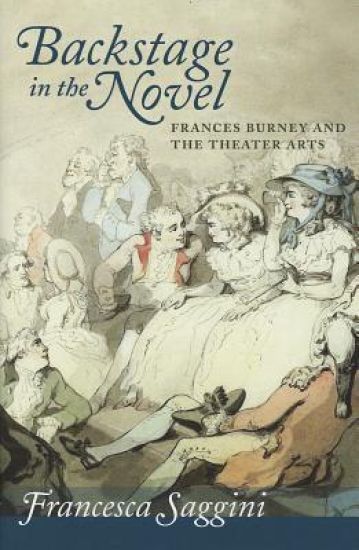
Backstage in the Novel

Francesca Saggini

University of Virginia Press
2012
sidottu
In Backstage in the Novel, Francesca Saggini traces the unique interplay between fiction and theatre in the eighteenth century through an examination of the work of the English novelist, diarist, and playwright Frances Burney. Moving beyond the basic identification of affinities between the genres, Saggini establishes a literary-cultural context for Burney's work, considering the relation between drama, a long-standing tradition, and the still-emergent form of the novel. Through close semiotic analysis, intertextual comparison, and cultural contextualisation, Saggini highlights the extensive metatextual discourse in Burney's novels, allowing the theater within the novels to surface. Saggini's comparative analysis addresses, among other elements, textual structures, plots, characters, narrative discourse, and reading practices. The author explores the theatrical and spectacular elements that made the eighteenth-century novel a hybrid genre infused with dramatic conventions. She analyses such conventions in light of contemporary theories of reception and of the role of the reader that underpinned eighteenth-century cultural consumption. In doing so, Saggini contextualises the typical reader-spectator of Burney's day, one who kept abreast of the latest publications and was able to move effortlessly between ""high"" (sentimental, dramatic) and ""low"" (grotesque, comedic) cultural forms that intersected on the stage. Backstage in the Novel aims to restore to Burney's entire literary corpus the dimensionality that characterised it originally. It is a vivid, close-up view of a writer who operated in a society saturated by theatre and spectacle and who rendered that dramatic text into narrative. More than a study of Burney or an overview of eighteenth-century literature and theater, this book gives immediacy to an understanding of the broad forces informing, and channelled through, Burney's life and work.
The Gothic Novel and the Stage

The Gothic Novel and the Stage

Francesca Saggini

Pickering Chatto (Publishers) Ltd
2015
sidottu
In this ground-breaking study Francesca Saggini explores the relationship between the late eighteenth-century novel and the theatre, arguing that the implicit theatricality of the Gothic novel made it an obvious source from which dramatists could take ideas. Similarly, elements of the theatre provided inspiration to novelists. Saggini opens her study with a very useful and persuasive overview of the themes and forms of Gothic drama. In her view, stage appropriation is the textual threshold in which novelistic and dramatic/ performative texts overlap on and disseminate through each other. She examines in details the use of three specific aspects of Gothic dramatic language as recorded by both novel and drama: music, lighting, and scene design. The following chapters, informed by semiotic and narrative theory, closely examine the stage appropriations respectively in and of the Gothic novel, particularly, though not exclusively, the representation of the supernatural in Ann Radcliffe and Matthew G. Lewis. Boaden’s successful Gothic drama Fontainville Forest challenges a central aspect of Radcliffe’s poetics: her reliance on the so-called explained supernatural and puts it context by looking at contemporary stage presentations of the supernatural as offered for instance in Hamlet. The final part of the study frames Lewis’s representation of the supernatural in The Monk within the contemporary mechanics of staging and discusses the novel in relation to contemporary stage presentation and in the context of Romantic harlequinades and spectacular visual exhibits. Saggini makes a convincing argument for a transmedial and highly cooperative reading of Gothic texts and spectacles. Her approach does not seek to displace the novel or ‘the text’ from modern perceptions of the Gothic, but wants to open the genre to plural and anti-hierarchical forms of reading and to recognise its resourcefulness in appropriating theatrical techniques. The concept of ‘stage appropriation’ gives equal epistemological status to both verbal and non-verbal sign system, and this strategy allows for a holistic approach to the Gothic and an analysis of several literary-cultural formations as correlated, rather than discrete.