Kirjojen hintavertailu. Mukana 11 699 587 kirjaa ja 12 kauppaa.

Kirjahaku

Etsi kirjoja tekijän nimen, kirjan nimen tai ISBN:n perusteella.

10 kirjaa tekijältä Francis J. Beckwith

Defending Life

Defending Life

Francis J. Beckwith

Cambridge University Press
2007
pokkari
Defending Life is arguably the most comprehensive defense of the pro-life position on abortion - morally, legally, and politically - that has ever been published in an academic monograph. It offers a detailed and critical analysis of Roe v. Wade and Planned Parenthood v. Casey as well as arguments by those who defend a Rawlsian case for abortion-choice, such as J. J. Thomson. The author defends the substance view of persons as the view with the most explanatory power. The substance view entails that the unborn is a subject of moral rights from conception. While defending this view, the author responds to the arguments of thinkers such as Boonin, Dworkin, Stretton, Ford and Brody. He also critiques Thomson's famous violinist argument and its revisions by Boonin and McDonagh. Defending Life includes chapters critiquing arguments found in popular politics and the controversy over cloning and stem cell research.
Defending Life

Defending Life

Francis J. Beckwith

Cambridge University Press
2007
sidottu
Defending Life is arguably the most comprehensive defense of the pro-life position on abortion - morally, legally, and politically - that has ever been published in an academic monograph. It offers a detailed and critical analysis of Roe v. Wade and Planned Parenthood v. Casey as well as arguments by those who defend a Rawlsian case for abortion-choice, such as J. J. Thomson. The author defends the substance view of persons as the view with the most explanatory power. The substance view entails that the unborn is a subject of moral rights from conception. While defending this view, the author responds to the arguments of thinkers such as Boonin, Dworkin, Stretton, Ford and Brody. He also critiques Thomson's famous violinist argument and its revisions by Boonin and McDonagh. Defending Life includes chapters critiquing arguments found in popular politics and the controversy over cloning and stem cell research.
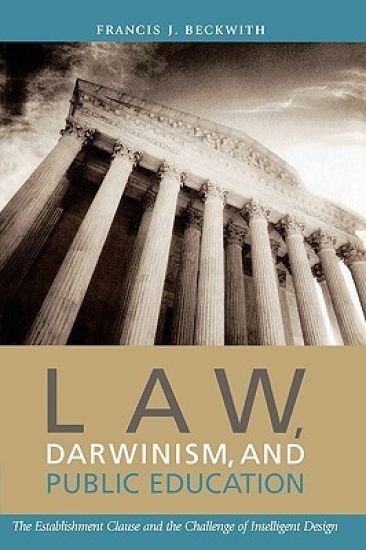
Law, Darwinism, and Public Education

Law, Darwinism, and Public Education

Francis J. Beckwith

Rowman Littlefield Publishers
2002
nidottu
In 1987, in Edwards v. Aguillard, the United States Supreme Court declared as unconstitutional a Louisiana statute requiring the state's public schools to teach creationism if evolution is taught and to teach evolution if creationism is taught. It was a serious blow to creationism in public schools, but a new movement since then has kept the debate alive. That new movement is 'Intelligent Design.' Should Intelligent Design be taught in schools? In Law, Darwinism, & Public Education, Francis J. Beckwith asks whether teaching 'ID' in public schools would be constitutional, in light of the Supreme Court's decision in Edwards v. Aguillard. At that time, the Court ruled that teaching creationism violates the Establishment Clause of the First Amendment of the U.S. Constitution. Beckwith examines the Intelligent Design theory and the Edwards case to find out whether teaching ID would suffer the same fate if brought before the court.
David Hume's Argument Against Miracles

David Hume's Argument Against Miracles

Francis J. Beckwith

University Press of America
1989
sidottu
In this book the author offers a critical analysis of David Hume's argument against miracles from his Enquiry Concerning Human Understanding, "Of Miracles" is one of the most influential works written in defense of the position that belief in supernatural occurrences is not reasonable. Using Hume's work as a point of departure, the author addresses the two most important epistemological questions asked about miracles: Is it ever reasonable to ascribe a divine source to an anomalous event in order to identify it as miraculous? and What theoretically entails sufficient evidence that a miracle has actually taken place? Contemporary rehabilitations of Hume's argument, as put forth by Antony Flew, Alastair McKinnon, and Patrick Nowell-Smith, are evaluated. Contents: Defining the Miraculous; Hume's Argument, Part 1; Hume's Argument, Part 2; The Rationality of Belief and the Existence of God; Contemporary Rehabilitations of Hume's Argument; and Miracles and Evidence.
Politics for Christians – Statecraft as Soulcraft

Politics for Christians – Statecraft as Soulcraft

Francis J. Beckwith

INTERVARSITY PRESS
2010
nidottu
Politics is concerned with citizenship and the administration of justice--how communities are formed and governed. The role of Christians in the political process is hotly contested, but as citizens, Francis Beckwith argues, Christians have a rich heritage of sophisticated thought, as well as a genuine responsibility, to contribute to the shaping of public policy. In particular, Beckwith addresses the contention that Christians, or indeed religious citizens of any faith, should set aside their beliefs before they enter the public square. What role should religious citizens take in a liberal democracy? What is the proper separation of church and state? What place should be made for natural rights and the moral law within a secular state? This cogent introduction to political thought surveys political science, politics and government while making the case for how statecraft may genuinely contribute to soulcraft. Politics for Christians is part of The Christian Worldview Integration Series. The Christian Worldview Integration Series, edited by J. P. Moreland and Francis J. Beckwith, seeks to promote a robust personal and conceptual integration of Christian faith and learning, with textbooks focused on disciplines such as education, psychology, literature, politics, science, communications, biology, philosophy, and history.
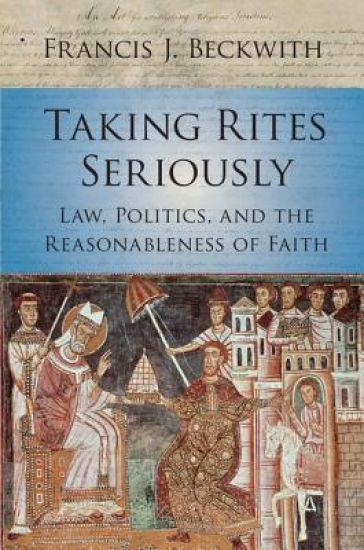
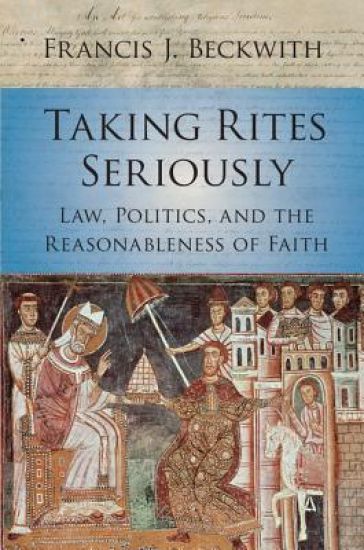
Taking Rites Seriously

Taking Rites Seriously

Francis J. Beckwith

Cambridge University Press
2015
sidottu
Taking Rites Seriously is about how religious beliefs and religious believers are assessed by judges and legal scholars and are sometimes mischaracterized and misunderstood by those who are critical of the influence of religion in politics or in the formation of law. Covering three general topics - reason and motive, dignity and personhood, nature and sex - philosopher and legal theorist Francis J. Beckwith carefully addresses several contentious legal and cultural questions over which religious and non-religious citizens often disagree: the rationality of religious belief, religiously motivated legislation, human dignity in bioethics, abortion and embryonic stem cell research, reproductive rights and religious liberty, evolutionary theory, and the nature of marriage. In the process, he responds to some well-known critics of public faith - including Brian Leiter, Steven Pinker, Suzanna Sherry, Ronald Dworkin, John Rawls, and Richard Dawkins - as well as to some religiously conservative critics of secularism, such as the advocates for intelligent design.
Taking Rites Seriously

Taking Rites Seriously

Francis J. Beckwith

Cambridge University Press
2015
pokkari
Taking Rites Seriously is about how religious beliefs and religious believers are assessed by judges and legal scholars and are sometimes mischaracterized and misunderstood by those who are critical of the influence of religion in politics or in the formation of law. Covering three general topics - reason and motive, dignity and personhood, nature and sex - philosopher and legal theorist Francis J. Beckwith carefully addresses several contentious legal and cultural questions over which religious and non-religious citizens often disagree: the rationality of religious belief, religiously motivated legislation, human dignity in bioethics, abortion and embryonic stem cell research, reproductive rights and religious liberty, evolutionary theory, and the nature of marriage. In the process, he responds to some well-known critics of public faith - including Brian Leiter, Steven Pinker, Suzanna Sherry, Ronald Dworkin, John Rawls, and Richard Dawkins - as well as to some religiously conservative critics of secularism, such as the advocates for intelligent design.
Never Doubt Thomas

Never Doubt Thomas

Francis J. Beckwith

Baylor University Press
2019
sidottu
Theologian, philosopher, teacher. There are few religious figures more Catholic than Saint Thomas Aquinas, a man credited with helping to shape Catholicism of the second millennium. In Never Doubt Thomas, Francis J. Beckwith employs his own spiritual journey from Catholicism to Evangelicalism and then back to Catholicism to reveal the signal importance of Aquinas not only for Catholics but also for Protestants. Beckwith begins by outlining Aquinas' history and philosophy, noting misconceptions and inaccurate caricatures of Thomist traditions. He explores the legitimacy of a ""Protestant"" Aquinas by examining Aquinas' views on natural law and natural theology in light of several Protestant critiques. Not only did Aquinas' presentation of natural law assume some of the very inadequacies Protestant critics have leveled against it, Aquinas did not, as is often supposed, believe that one must first prove God's existence through human reasoning before having faith in God. Rather, Aquinas held that one may know God through reason and employ it to understand more fully the truths of faith. Beckwith also uses Aquinas' preambles of faith - what a person can know about God before fully believing in Him - to argue for a pluralist Aquinas, explaining how followers of Judaism, Christianity, and Islam can all worship the same God, yet adhere to different faiths. Beckwith turns to Aquinas' doctrine of creation to question theories of Intelligent Design, before, finally, coming to the heart of the matter: in what sense can Aquinas be considered an Evangelical? Aquinas' views on justification are often depicted by some Evangelicals as discontinuous with those articulated in the Council of Trent. Beckwith counters this assessment, revealing not only that Aquinas' doctrine fully aligns with the tenets laid out by the Council, but also that this doctrine is more Evangelical than critics care to admit. Beckwith's careful reading makes it hard to doubt that Thomas Aquinas is a theologian, philosopher, and teacher for the universal church - Catholic, Protestant, and Evangelical.
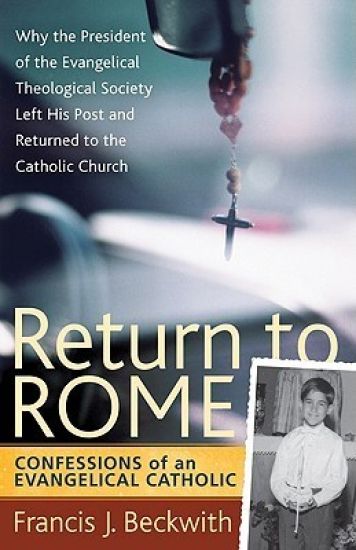
Return to Rome – Confessions of an Evangelical Catholic

Return to Rome – Confessions of an Evangelical Catholic

Francis J. Beckwith

Brazos Press, Div of Baker Publishing Group
2009
nidottu
What does it mean to be evangelical? What does it mean to be Catholic? Can one consider oneself both simultaneously? Francis Beckwith has wrestled with these questions personally and professionally. He was baptized a Catholic, but his faith journey led him to Protestant evangelicalism. He became a philosophy professor at Baylor University and president of the Evangelical Theological Society (ETS). And then, in 2007, after much prayer, counsel, and consideration, Beckwith decided to return to the Catholic church and step down as ETS president.This provocative book details Beckwith's journey, focusing on his internal dialogue between the Protestant theology he embraced for most of his adult life and Catholicism. He seeks to explain what prompted his decision and offers theological reflection on whether one can be evangelical and Catholic, affirming his belief that one can be both. EXCERPTIt's difficult to explain why one moves from one Christian tradition to another. It is like trying to give an account to your friends why you chose to pursue for marriage this woman rather than that one, though both may have a variety of qualities that you found attractive. It seems to me then that any account of my return to the Catholic church, however authentic and compelling it is to me, will appear inadequate to anyone who is absolutely convinced that I was wrong. Conversely, my story will confirm in the minds of many devout Catholics that the supernatural power of the grace I received at baptism and confirmation as a youngster were instrumental in drawing me back to the Mother Church. Given these considerations, I confess that there is an awkwardness in sharing my journey as a published book, knowing that many fellow Christians will scrutinize and examine my reasons in ways that appear to some uncharitable and to others too charitable.
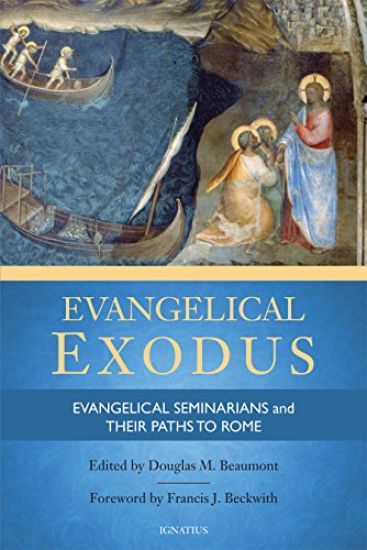
Evangelical Exodus

Evangelical Exodus

Francis J. Beckwith

Ignatius Press
2016
pokkari
Over the course a single decade, dozens of students, alumni, and professors from a conservative, Evangelical seminary in North Carolina (Southern Evangelical Seminary) converted to Catholicism. These conversions were notable as they occurred among people with varied backgrounds and motivations many of whom did not share their thoughts with one another until this book was produced. Even more striking is that the seminary's founder, long-time president, and popular professor, Dr. Norman Geisler, had written two full-length books and several scholarly articles criticizing Catholicism from an Evangelical point of view. What could have led these seminary students, and even some of their professors, to walk away from their Evangelical education and risk losing their jobs, ministries, and even family and friends, to embrace the teachings they once rejected as false or even heretical? Speculation over this phenomenon has been rampant and often dismissive and misguided leading to more confusion than understanding. The stories of these converts are now being told by those who know them best the converts themselves. They discuss the primary issues they had to face: the nature of the biblical canon, the identification of Christian orthodoxy, and the problems with the Protestant doctrines of sola scriptura ("scripture alone"). and sola fide ("faith alone")"