

Kirjahaku
Etsi kirjoja tekijän nimen, kirjan nimen tai ISBN:n perusteella.
10 kirjaa tekijältä Franco Berardi


We have entered the gateway to the apocalypse. This theological concept is the best metaphor to describe the world in which we are already living. Chaos is all around us: political folly, economical delirium, ecological catastrophe, intellectual cynicism, technological simulation of life. This is what Franco ‘Bifo’ Berardi suggests in this wry, dark, disconcerting but also brilliant and invigorating journey through the main events that we have witnessed in recent years. One century after the Communist revolution, the very idea that the world could be changed for the better seems dead once and for all. Every time that a new change occurs nowadays, it seems to be a change for the worse. But the fact that nothing can save us any more shouldn’t be seen as a form of fatality or a reason for surrender. On the contrary, if our world is dead, then the space is open for another to appear – a world where apocalypse can shake us out of our zombie-like contemporary existence. The second coming of Communism will have nothing to do with 1917. Apocalypse has to be conceived of as a metaphor, and Communism is a metaphor too: the metaphor of the possible deployment of the potentials of the mind.
We have entered the gateway to the apocalypse. This theological concept is the best metaphor to describe the world in which we are already living. Chaos is all around us: political folly, economical delirium, ecological catastrophe, intellectual cynicism, technological simulation of life. This is what Franco ‘Bifo’ Berardi suggests in this wry, dark, disconcerting but also brilliant and invigorating journey through the main events that we have witnessed in recent years. One century after the Communist revolution, the very idea that the world could be changed for the better seems dead once and for all. Every time that a new change occurs nowadays, it seems to be a change for the worse. But the fact that nothing can save us any more shouldn’t be seen as a form of fatality or a reason for surrender. On the contrary, if our world is dead, then the space is open for another to appear – a world where apocalypse can shake us out of our zombie-like contemporary existence. The second coming of Communism will have nothing to do with 1917. Apocalypse has to be conceived of as a metaphor, and Communism is a metaphor too: the metaphor of the possible deployment of the potentials of the mind.
What is the relationship between capitalism and mental health? Through an exhilarating mix of philosophical and psychoanalytical theory and reportage - from the suicide epidemic in Korea to the wave of American mass murders - the prominent Italian thinker Franco Berardi Bifo traces the social roots of the mental malaise of our age. His darkest and most unsettling book to date, Berardi proposes dystopian irony as a strategy to disentangle ourselves from the deadly embrace of the neoliberalism.

We live in an age of impotence. Stuck between global war and global finance, between identity and capital, we seem to be incapable of producing that radical change that is so desperately needed. Is there still a way to disentangle ourselves from a global order that shapes our politics as well as our imagination?In his most systematic book to date, renowned Italian theorist Franco Berardi Bifo tackles this question through a solid yet visionary analysis of the three fundamental concepts of Possibility, Potency, and Power. Overcoming any temptation of giving in to despair or nostalgia, Berardi proposes the notion of Futurability as a way to remind us that even within the darkness of our current crisis, still lies dormant the horizon of possibility.
The Unconscious knows no time, it has no before-and-after, it does not have a history of its own. Yet, it does not always remain the same. Different political and economic conditions transform the way in which the Unconscious emerges within the "psychosphere" of society. In the early 20th century, Freud characterized the Unconscious as the dark side of the well-order framework of Progress and Reason. At the end of the past century, Deleuze and Guattari described it as a laboratory: the magmatic force ceaselessly bringing to the fore new possibilities of imagination. Today, at a time of viral pandemics and in the midst of the catastrophic collapse of capitalism, the Unconscious has begun to emerge in yet another form. In this book, Franco 'Bifo' Berardi vividly portraits the form in which the Unconscious will make itself manifest for decades to come, and the challenges that it will pose to our possibilities of political action, poetic imagination, and therapy.
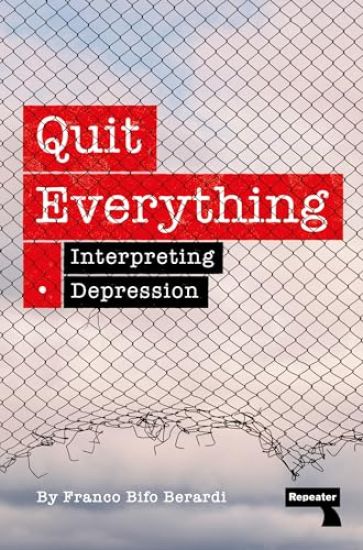
Depression is rife amongst young people the world over. But what if this isn't depression as we know it, but instead a reaction to the chaos and collapse of a seemingly unchangeable and unliveable future? In Quit Everything, Franco Berardi argues that this "depression" is actually conscious or unconscious withdrawal of psychological energy and a dis-investment of desire that he defines instead as "desertion". A desertion from political participation, from the daily grind of capitalism, from the brutal reality of climate collapse, and from a society which offers nothing but chaos and pain. Berardi analyses why this desertion is on the rise and why more people are quitting everything in our age of political impotence and the rise of the far-right, asking if we can find some political hope in desertion amongst the ruins of a world on the brink of collapse.

Through an exhilarating mix of philosophical and psychoanalytical theory and reportage - from the suicide epidemic in Korea to the wave of American mass murders - the prominent Italian thinker Franco Berardi Bifo traces the social roots of the mental malaise of our age. His darkest and most unsettling book to date, Berardi proposes dystopian irony as a strategy to disentangle ourselves from the deadly embrace of neoliberalism.